Santa’s Mission of Love

This story is pulled from the archives as a celebration for the season edition.

Groff Media 2024© Truth Endures IMDbPro

Presented by benandsteve.com By: Benjamin Groff II©

3–4 minutes

In the heart of a frosty December, Santa Claus sat in his workshop. His eyes scanning the pages of his magical list. It was a heavy year; kindness seemed scarce, and the world became fractured in ways he hadn’t seen before. One town in particular tugged at his heartstrings—Silver Pines, nestled in the Appalachian Mountains. Its beauty hid a darker reality. The LGBTQ+ community, especially gay individuals, faced judgment and outright abuse. Yet, in the face of such adversity, they showed remarkable courage. Letters from people in Silver Pines painted a picture of sorrow, isolation, and a longing yet to be seen.

Santa set down the list with a deep sigh. “No mistakes,” he whispered, stroking his snowy beard. It was a mantra he had held onto since the dawn of time. Every soul was crafted perfectly. Its existence was a thread in the fabric of humanity. His mission was to remind others of this truth.

The night of Christmas Eve was crisp, the air biting but alive with the hum of anticipation. Santa’s sleigh cut through the sky, its bells jingling softly. His bag was lighter than usual. It was not because he carried fewer gifts. His offerings weren’t wrapped in paper this year.

He landed in Silver Pines just past midnight, his boots crunching on the snow-covered streets. Despite the hour, the town was still. He began his journey with his signature magic. He quietly stepped into homes where letters had been written. He spread warmth and comfort to those who needed it most.

At the tiny home, Santa left a handwritten note. Liam and Paul were a gay couple who had faced the brunt of the town’s scorn. It read:

“You are seen. You are loved. You are perfect as you are.”

In another house, a young teen named Oliver found a shimmering snow globe under his tree. He had been wrestling with the fear of coming out. When he shook it, it revealed a rainbow that shimmered against the glass, and inside, a message:

“Your truth is your strength. The world needs your light.”

Throughout the night, Santa wove love into every corner of Silver Pines. He touched the hearts of allies, planting seeds of courage to stand against hatred. He left dreams of acceptance in the minds of those who harbored prejudice. His gifts weren’t toys or trinkets. They were powerful reminders of humanity’s shared essence. Each one carried the potential to transform hearts and minds.

By dawn, the town began to stir. Liam and Paul awoke to find the note, their hearts swelling with hope they hadn’t felt in years. Oliver clutched his snow globe, feeling a new resolve to embrace who he was. The day unfolded slowly. The spirit of Santa’s gifts began to ripple. This ripple ignited a wave of change. This wave would soon engulf the entire town.

People who had once turned away from their neighbors now questioned their biases. Conversations began, tentative at first but growing bolder with time. Acts of kindness, like inviting a marginalized individual to a community event, replaced judgment, and barriers began to crumble.

Santa watched from a distance, his eyes twinkling. The journey wasn’t over—true change would take time—but the seeds had been planted. As he climbed back into his sleigh, he whispered into the cold morning air:

“There are no mistakes in my Father’s design. Love is the gift I give, but it is also the gift you must carry ahead.”

And with that, Santa soared into the sky, his mission not finished but well underway.

Christmas the Cat: That Lost The Day Of Christmas And Found It All Over Again For Good!

This story is pulled from the archives as a celebration for the season edition.

Groff Media 2024© Truth Endures IMDbPro

Presented by benandsteve.com By: Benjamin Groff II©

3–4 minutes

Christmas was a sleek, white cat with a bright red collar and a tiny bell. He sported one green eye. One eye blue. Christmas twinkles the kids called them. He got his name because he was born on Christmas Eve. Since then, his life revolved around the festive season. He loved the glittering lights and the scent of pine. He enjoyed the rustling of wrapping paper. He cherished the joy he saw in his family’s faces.

Christmas morning, the children had excitedly unwrapped their gifts. Afterward, the family went off to visit relatives. Christmas the Cat had wandered into the pantry. Curious, he batted at a loose box of crackers, which tipped over with a crash. Startled, he darted behind a stack of canned goods. In the commotion, someone closed the pantry door, locking him inside.

At first, Christmas thought this was just an oversight. Someone would open the door soon and scoop him up for a cuddle. But the minutes stretched into hours, and the house grew silent. Panic set in. 

He imagined the family around the table, sharing laughter, turkey, and pie. He pictured the children playing with their new toys. The warmth of the fireplace filled the room. Soft carols were in the air. And here he was, trapped in the dark, with only a box of crackers for company. 

Christmas, becoming convinced it was too late until the family returned that evening. His heart sank as he heard the keys jingle and the front door creak. He sat dejectedly on the pantry floor, his tail curled around him.

“Christmas! Where are you, buddy?” 

Called the youngest child, Emily.

The pantry door swung open, and a flood of light spilled in. Christmas blinked and looked up. Emily scooped him into her arms, covering him in kisses.

“We were so worried!” 

She exclaimed. 

“We couldn’t find you anywhere.”

The rest of the family gathered around, showering him with attention. Despite their love, Christmas couldn’t shake his gloom. He meowed mournfully, his usual purr absent.

“What’s wrong, Christmas?” 

Emily asked, stroking his fur. 

“You’re safe now.”

Her father, overhearing, knelt beside her.

“I think Christmas thinks he missed Christmas Day.” 

He said with a chuckle.

Emily’s eyes widened. 

“Oh no! That isn’t very good. We need to tell him it’s okay.”

She cradled Christmas close and said softly,

“You didn’t miss Christmas, silly kitty. Even if the day is over, Christmas isn’t just one day. It’s about love, kindness, and being together. We can celebrate Christmas every single day.”

He looked up at her, his green eyes shining. The bell on his collar jingled as he rubbed his head against her cheek.

That night, Emily insisted they set up a special celebration for him. They lit the tree again. They brought out leftover turkey for a feast. They even gave him a shiny bow to play with. As Christmas sat in Emily’s lap, batting at the bow, he realized she was right. Christmas wasn’t just about one day. It was about the joy and love that filled the house every day of the year.

Christmas the Cat didn’t fret about the calendar from that moment on. Whether it was July or December, he purred as loudly when the family was together. After all, every day is Christmas as long as there was love.

The Guardians of Christmas Eve

Groff Media 2024© Truth Endures IMDbPro

Presented by benandsteve.com By: Benjamin Groff II©

3–4 minutes

In the heart of the bustling city, the frigid December air carried the soft hum of holiday cheer. Festive lights adorned streetlamps, casting warm glows onto the snow-dusted streets. For the officers of the 8th Precinct, Christmas Eve was far from quiet. Calls came in relentlessly: domestic disputes, stranded travelers, and even a wayward reindeer reported near the city park. These dedicated officers were on duty, ready to serve and protect.

What the officers didn’t know was that they had three spectral protectors watching over them—The Guardians of Christmas Eve.

Each of these ghostly policemen had once served the city. They were bound by duty. A deep sense of loyalty held their spirits. They lingered to make sure that no harm would come to those who now walked the beat.


Inspector Miles Hanley

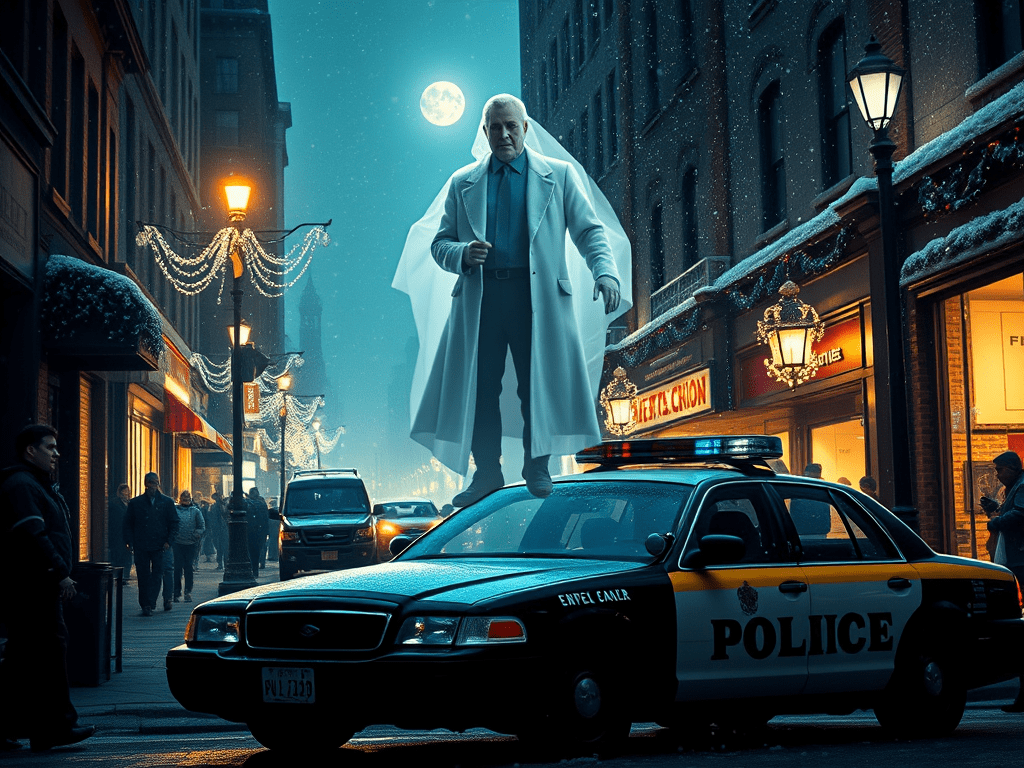
Miles Hanley was a tall and imposing figure. He had been the precinct’s first chief when the station was founded in the late 1800s. Known for his wisdom, he fiercely protected his officers. He carried his ghostly silver pocket watch. He used it to guide the others through the city. On this night, Hanley floated above a lone patrol car. It was parked at the edge of a dark alley. His translucent form shimmered in the moonlight.

“Johnson’s heading into a bad spot,”

Hanley muttered, watching the young officer approach a shadowy figure rummaging through garbage bins. With a flick of his watch, he whispered through the veil of time, nudging Johnson’s instincts. The officer hesitated, then called for backup—averting a potential ambush. Hanley grinned.

“Still got it.”


Officer Rosie McKinney

Rosie, affectionately called “Mama Mac” by her peers, had patrolled the city during the 1940s. She had an uncanny knack for reading people, even in death. Tonight, she hovered near a busy intersection where Officer Emily Torres was directing traffic midst a chaotic pile-up.

“Stay sharp, Emily,”

Rosie murmured, spotting a distracted driver barreling toward the scene. With a wave of her ethereal baton, she sent a gust of icy wind straight into the driver’s face. The man slammed on his brakes just in time, his car skidding to a halt inches from the officer. Rosie chuckled, tipping her ghostly hat. “That’s one less hospital visit tonight.”


Detective Lou Vargas

Lou had been a beloved detective in the 1970s, known for his quick wit and unshakable resolve. He now roamed the precinct’s cold case archives, whispering clues to frustrated officers. But tonight, Lou focused on Officer Brandon Lee. Officer Lee had just been called to investigate a suspicious package left near a crowded shopping district.

As Brandon approached the package, Lou materialized briefly behind him, a shadowy whisper in the winter night. “Check the wires, kid. Look left before you kneel.” Obeying the faint warning in his gut, Brandon discovered the package was harmless—a forgotten Christmas gift. Still, he felt the hairs on his neck stand like someone had been there with him.


A Christmas Morning Promise

As dawn broke over the city, the officers returned to the precinct, exhausted but safe. Unseen by human eyes, Miles, Rosie, and Lou gathered on the station’s rooftop, gazing at the snow-covered streets below.

“We did good,”

Lou said, leaning on his ghostly cane.

“Not a single officer lost,” Rosie added softly.

Miles held up his pocket watch, the spectral clock hands freezing as the sun rose. “Until next year,” he said, and the three faded into the morning mist.

Below, Officer Torres rubbed her arms against the chill. “Did you feel that?” she asked Officer Lee.

“Yeah,” he replied, staring at the horizon. “Like someone was watching over us.”

And so they were.

🐕‍🕯️ The Legend of the Kyrkogrim — Sweden’s Black Guardian of the Church

By Benjamin H. Groff II | Truth Endures | The Story Teller

2–3 minutes

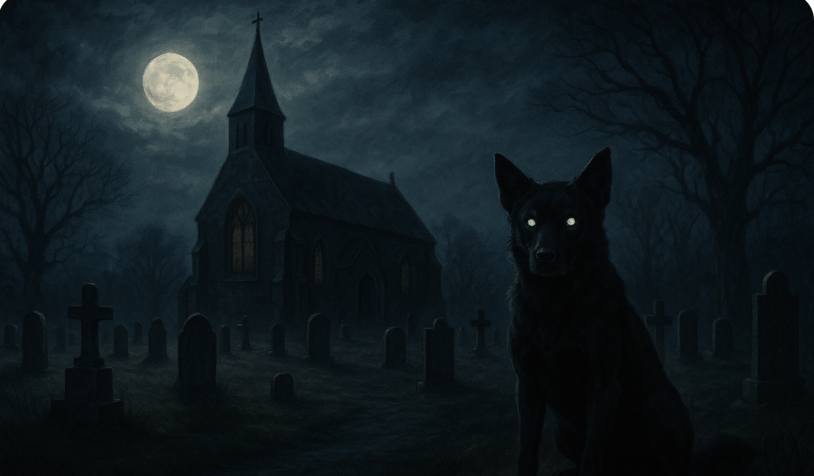
Tales are whispered across the cold stones of Scandinavia. They speak of an “evil dog” that once haunted the churches of Sweden. But those who truly know the legend say the creature was never evil at all. It was the kyrkogrim — a guardian spirit born not of sin, but of sacrifice.

A Dog Buried Beneath Holy Ground

In the centuries when churches first rose across the Nordic lands, builders followed a chilling custom. To guarantee their new sanctuaries would stand against evil, they buried a living creature beneath the cornerstone. This creature was often a black dog. Its final, terrified breath was thought to bind its soul to the ground, forming a spiritual sentinel.

That spirit became the kyrkogrim: the Church Grim. It was always black as midnight. It was condemned to patrol the churchyard. Its duty was to watch over the graves and keep the devil himself from defiling holy ground.

The Protector and the Omen

By day, the kyrkogrim was invisible. But when night fell and candles flickered low, villagers spoke of seeing the great black hound. It was pacing near the church doors. Its eyes glowed like coals in the dark. It was said to snarl at grave robbers and frighten off witches. Yet, for all its protection, it carried a darker burden.

To see the kyrkogrim was to get a warning. The watcher’s death, it was said, would soon follow. The same spirit shielded the church from evil. It also bore the scent of the grave. This grim paradox kept villagers both thankful and fearful of its presence.

The First Soul of the Graveyard

Long before Christianity spread through Scandinavia, ancient peoples offered animal sacrifices to bless new structures and sacred sites. Early Christian builders, inheriting these customs, altered them to fit their faith. The dog buried beneath the first church became “the first soul” in the graveyard. This ensured that no human would have to linger eternally as the church’s guardian.

Thus, the kyrkogrim was not a monster. Instead, it was a martyr. It symbolized the uneasy blend of pagan ritual and Christian devotion. It was the bridge between two worlds: the old gods of the land and the new God of the heavens.

Echoes Through Time

Even today, stories of the kyrkogrim persist in Swedish folklore. Some say the black dog still walks among the headstones on stormy nights, especially near churches centuries old. Others claim that every church has its own silent watcher — unseen, but always there.

What began as a superstition has evolved into something deeper. It reflects the human need to guard what we hold sacred. The kyrkogrim, once buried in darkness, lives on in story — a faithful spirit that never abandoned its post.


By Benjamin GroffMedia© | benandsteve.com | ©2025 

The Island – A Serialized Dystopian Story * Chapter Six 

1–2 minutes

Haven’s Reach: The Fracture

The Council had grown bolder. Every decree was sharper, every rule stricter. Posters lined the streets declaring “Silence is Loyalty” and “Order is Freedom.” 

The town square, which once hosted songs and dances, now echoed with speeches warning against disobedience.

But in the shadows, the first cracks in the island’s facade appeared. Whispers of a hidden circle spread. These were citizens who refused to bow. They scribbled forbidden words in chalk on walls at night. They dared to question the Council’s iron grip. They called themselves The Quiet Ones.

Harper, a baker’s daughter, stumbled upon their meeting one night while searching for her missing brother. What she found shocked her: not rebels with weapons, but ordinary people with books, old radios, and forbidden songs. They weren’t plotting war—they were keeping alive the memory of freedom.

The Council had crushed the voices in the streets, but underground, Haven’s Reach was beginning to murmur again.


By Benjamin GroffMedia© | benandsteve.com | ©2025 

The Day a House Fell: A Family Tale of Humor and Chaos

By Benjamin GroffMedia© | benandsteve.com | 2025 Truth Endures©

3–4 minutes

The Day a House Fell on My Mother’s Head

When we first moved to the farm, my father bartered for just about everything. It was the 1960s. He had a wife and six kids. My young uncle, who felt more like an older brother, was also part of the family. He had plenty of mouths to feed. There were also many projects to tackle.

One of his deals involved tearing down an old house on a neighbor’s property in exchange for the lumber. It wasn’t a one-man job—my three older brothers, my uncle, and even my mother had to pitch in. My two sisters and I were assigned a very important task: holding down the tailgate of the pickup truck.

We were told in no uncertain terms to stay put. We knew exactly what that meant. From our perch on the tailgate, we watched as our dad and brothers clambered across the roof, tossing down boards. My mother hustled to pick them up, stacking them onto a flatbed trailer and into another old truck.

I still don’t know exactly why my mother did what she did next. Maybe she wanted to check on us; maybe she wanted to warn us again. But as boards kept flying off the house, she walked around to where we sat—into what my dad had firmly declared “the danger zone”—and yelled:

“You three stay away from here, or you’ll get hit in the head with a board with a rusty nail!”

And no sooner had the words left her mouth than—WHACK! A board sailed down and smacked her right on the head. Of course, it had a rusty nail. Of course, she screamed. And of course, all three of us screamed right along with her.

Almost instantly, my dad’s head popped up over the roof’s edge.

“What the hell are y’all screaming about?”

We all shouted at once:

“Mama’s bleeding! A board hit Mama in the head! There’s a nail in her head!”

My dad scrambled down the ladder, muttering adult words under his breath.

“Shit. Goddammit, Marge, why the hell were you standing where we told the kids not to go?”

My mother, ever unflappable, shot back:

“You threw that board at me on purpose!”

He glared at her.

“Dammit, I didn’t even know where you were. Kids, get off the tailgate and sit on that log. I gotta take your mother into town.”

They drove off toward Doc’s office, leaving my brothers to finish tearing down the house and loading up the wood. The sun set. The old trucks were filled. My brothers piled us into the pickup. They drove the mile and a half back home.

When we pulled into the yard, our parents were just arriving. My dad helped my mom out of the truck and told us she was fine—just a scratch, he said. Doc had cleaned her up, given her a tetanus shot, and sent her home with something “to relax her.”

Naturally, we kids had to see the wound for ourselves. It didn’t look like much—just a small cut hidden in her hair, surrounded by a bruise. Not exactly a house falling on someone’s head. But it had bled plenty, enough to scare us all.

That night, we sat around eating a casserole that had baked while we were gone, everything back to normal. Or so it seemed.

Later, as my mom recounted what happened, the story took on a life of its own. Over the years, at family gatherings and on phone calls, we’d hear her say,

“Well, you know, the day that house fell on my head…”

In the background, my dad’s familiar sigh would follow:

“Dammit, Marge. It was just a board. And it wouldn’t have hit you if you’d stayed where I told the kids not to go.”

But she never wavered. Even now, at 95, if you ask her, she’ll tell you straight:

“A house fell on my head.”

A Love That Endures

GROFF MEDIA 2024© TRUTH ENDURES IMDBPRO

Presented by benandsteve.com By: Benjamin Groff II©

2–3 minutes

Anna sat on the edge of her porch swing, the crisp autumn air wrapping around her like a familiar shawl. She cradled a weathered photo album filled with snapshots of a life well-lived with her husband, Thomas. Though he had passed a year ago, his presence lingered in every corner of their home. She noticed the faint scent of his aftershave in the closet. The carved wooden birdhouse he made hung by the garden. The laughter seemed to echo from the walls.

The sun dipped below the horizon. It painted the sky in hues of orange and violet. Anna whispered, “Death have taken your body, Thomas, but you’re still here.”

In the quiet, she remembered the words their pastor had spoken at his funeral: *Death takes the body. God takes the soul. Our minds hold the memories. Our hearts holds on to the love. Our spiritual beliefs let us know we will meet again.

Her memories of Thomas were not just memories, they were vibrant, living moments. They replayed in her mind like a cherished movie. She saw how his eyes crinkled when he smiled. She heard his deep belly laugh. She felt the strength of his hand in hers as they danced in the kitchen.

Though grief often pressed against her chest, her heart was not empty. It was full of love—a love that hadn’t dimmed with time. She placed a hand over her chest and smiled. She knew it was where Thomas still resided. He was a glowing ember that would never go out.

Every Sunday, Anna would visit the little white church where they had exchanged vows so long ago. She found not just solace, but peace there, her faith bridging the earthly and the divine. She believed Thomas was in God’s care now, his soul at peace, waiting patiently for her.

One evening, as she closed the photo album, she noticed the first star twinkling in the sky. She gazed upward and whispered, “I’ll see you again, Thomas. Until then, I’ll carry you here.” She touched her head. “Here.” She placed her hand on her chest. “And here.” She folded her hands in prayer.

At that moment, Anna felt a warmth envelop her. It seemed like Thomas himself was reminding her. Real, enduring love that never truly is separated by time or space.

She smiled and rocked gently on the swing, humming the melody of their favorite song. The stars above her were a quiet witness to the eternal connection between two hearts.

A Letter From Paul Harvey, To His Grandchildren

GROFF MEDIA 2024© TRUTH ENDURES IMDBPRO

Presented by benandsteve.com By: Benjamin Groff II©

3–4 minutes

I am sharing a writing listed as “Paul Harvey’s Letter To His Grandchildren. It has been tucked away in a drawer. Finally I pulled it out and made use of it.

Paul Harvey was a news commentator for ABC NEWS in the United States and has been heard worldwide. He was known for “The Rest of The Story” and his Noon News Broadcast from the 1960s through the 1990s.. He provided updates well into his elder years, working from home a lot of the time. His son had built a studio in the Harvey Home. This studio allowed him to work as if he were in the News Room. Paul is always dressed in a suit and tie to report the news. Saying he had to look professional to sound professional.

Here is the letter that is attributed to him.

Grandchildren,

We tried so hard to improve our kids’ lives that we made them worse. I’d like better for my grandchildren.

I’d like them to know about hand-me-down clothes, homemade ice cream, and leftover meatloaf sandwiches.

I hope you learn humility by being humiliated and honesty by being cheated.

I hope you learn to make your bed, mow the lawn, and wash the car.

And I hope nobody gives you a brand-new car when you are sixteen.

It will be good if at least one time you can see puppies born. You should also witness your old dog being put to sleep.

I hope you get a black eye fighting for something you believe in.

I hope you have to share a bedroom with your younger brother or sister. It’s all right if you have to draw a line down the middle of the room. But, when he wants to crawl under the covers with you because he’s scared, I hope you let him.

You want to see a movie. If your little brother or sister wants to tag along, I hope you’ll let them.

You must walk uphill to school with your friends and live in a town where you can do it safely.

I hope you don’t ask your driver to drop you two blocks away on rainy days. It would be unfortunate if you didn’t want to be seen riding with someone as uncool as your Mom.

If you want a slingshot, I hope your Dad teaches you how to make one instead of buying one.

I hope you learn to dig in the dirt and read books.

When you learn to use computers, I hope you also learn to add and subtract in your head.

I hope you get teased by your friends when you have your first crush on a boy or girl. When you talk back to your mother, I hope you learn what ivory soap tastes like.

Try to skin your knee climbing a mountain. By accident burn your hand on a stove. Playing around try to you stick your tongue on a frozen flagpole.

I don’t care if you try a beer once. I hope you don’t like it. If a friend offers you dope or a joint, realize they are not your friend.

I sure hope you make time to sit on a porch with your Grandma or grandpa. I also hope you go fishing with your Uncle.

You will feel a mixture of emotions. Sorrow and joy will arise during the holidays at a funeral. You should stop and understand why.

I hope your mother punishes you when you throw a baseball through your neighbor’s window. I also hope she hugs you at Christmas. I hope she kisses you when you give her a plaster mold of your hand.

I wish you tough times and disappointment, hard work, and happiness. To me, these are the only ways to appreciate life!

The End.

Portions of this entry was edited to allow for space and grammar.

Dan the Electrician Saves Boone

Groff Media 2024© Truth Endures IMDbPro

Presented by benandsteve.com By: Benjamin Groff II©

3–4 minutes

The small town of Boone, nestled in the valley of snow-capped peaks, was no stranger to winter storms. But this one was different. The storm rolled in with icy winds that seemed to pierce every wall and seep through every seam. It coated the town in a thick, glittering layer of ice. The power lines sagged and snapped under the weight. This plunged Boone into darkness. The town’s survival hung in the balance, with temperatures plummeting to subzero.

The urgency of the situation was palpable. Dan Hayes, a seasoned electrician and father of two, was preparing for a quiet evening with his family. His phone buzzed incessantly. Calls came in from neighbors, then from Boone’s mayor himself. The town’s substation, already overwhelmed by the demand for heat, had succumbed to the relentless freeze. Ice had formed on critical equipment, blowing fuses and wiring, leaving the entire town powerless.

“Jimmy, grab my tool bag!”

Dan hollered to his teenage son, who quickly obeyed, bundling up in layers against the cold.

“We’re heading to the substation.”

Driving through the storm in his old but reliable truck, Dan and Jimmy barely see beyond the hood. Fallen branches and icy roads made the journey treacherous. When they finally reached the substation, the sight was worse than Dan expected. The entire structure got encased in ice. Its wires snapped like brittle twigs.

“Jimmy, this is going to take everything we’ve got,”

Dan said, his breath forming clouds in the freezing air.

“I’ll need your help every step of the way.”

Dan quickly assessed the situation, identifying the most critical damage. The main transformer was overloaded, and its fuses were blown. Wires leading to key circuits were severed, and ice threatened to collapse a vital power relay. Dan began carefully thawing the most delicate components using a portable heater from the truck. Meanwhile, Jimmy set up emergency lights and handed his dad tools as he worked.

Word spread that Dan was at the substation. Soon, a small group of townsfolk arrived. This group included the fire chief and a few volunteers. They formed a chain to bring sandbags and materials to reinforce the ice-laden structure. This was a testament to the resilience and unity of the community. One by one, Dan replaced the fried fuses and spliced wires, his fingers numb but his determination unshaken.

Hours passed, and the storm showed no mercy. Dan finished repairing the transformer. Then, the wind knocked a massive branch onto the newly restored lines. This snapped them again.

Dan didn’t flinch.

“We’ve got one shot to do this right,”

He muttered. Calling on his years of experience, he rigged a temporary bypass, rerouting power from a less-affected part of the grid. The fix have been made better, but it would hold until morning.

Finally, as dawn broke and the first rays of sunlight pierced the storm clouds, the lights flickered across Boone. Cheers erupted from the gathered crowd, but Dan was yet to finish. He double-checked every connection, ensuring no one would lose power again that day.

Jimmy looked at his dad with newfound admiration.

“You saved the whole town, Dad.”

Dan smiled, his face weary but proud.

“We did it together, son. Boone’s got a lot of heart, and so do its people. That’s what keeps us warm.”

Back home, Dan and Jimmy were comforted with hot cocoa and blankets from a grateful Mrs. Hayes. Outside, the storm subsided. It left behind a town that had endured the worst. This was thanks to the quiet heroics of a father who wouldn’t let the cold win.

The Story Of The Unchecked Mayor

Groff Media 2024© Truth Endures IMDbPro

Presented by benandsteve.com By: Benjamin Groff II©

In a small city, one man’s election as Mayor marked a drastic turning point. Traditionally, city decisions required approval from a council of six members, with a majority vote ensuring every person wielded only a little power. But soon after taking office, the Mayor and his political allies on the council pushed through changes that redefined his role. They granted him unprecedented authority to make sweeping decisions for the city and its residents, bypassing the usual oversight.

But that initial optimism soon eroded, giving way to a profound sense of disappointment and betrayal. The Mayor began filling oversight boards and committees with his chosen people—none of whom had relevant experience. They promised to “clean house” and end wasteful spending, but their true motives quickly surfaced.

The Commissioner of Streets and Lights, handpicked by the Mayor, promptly fired the street crew and supervisors, many of whom had worked for the city for over fifteen years and were approaching retirement. The Commissioner hired the Mayor’s son’s paving company in their place, and he also contracted two out-of-town electricians for lighting maintenance. These new hires lacked the skills to handle the city’s infrastructure needs, but the Mayor’s orders were clear. The supposed “savings” were diverted into three hidden accounts linked to companies the Mayor quietly operated on the side.

The Mayor restructured Water and Trash Services similarly. Water management was outsourced to a neighboring town with little regard for the community’s best interests. Trash collection was reduced to once a week, and a company from two towns away was hired, offering only minimal service. The Mayor’s promised savings got funneled into an account controlled solely by the Mayor.

Every city department followed the same grim trajectory. Once-dedicated employees were let go and replaced by disinterested newcomers complaining about their low wages and minimal benefits. City services deteriorated rapidly, with potholes on the streets, frequent power outages, and overflowing trash bins, leaving residents dismayed as their quality of life declined.

The townspeople soon noticed their bills creeping upward—first by ten dollars, then by thirty, with no explanation or improvement in service. This financial strain, coupled with crumbling city infrastructure, directly resulted from the Mayor’s unchecked power and self-serving decisions, placing a heavy burden and stress on the residents.

Residents registered with the opposing political party received letters citing dubious code violations and demanding fines. Those who contested were slapped with even more violations, driving many to leave the city altogether. Once most of his opposition had been driven out, the Mayor enacted a new ordinance requiring his remaining supporters to pay a “privilege to live here” fee. When citizens objected, he sent his security force to arrest vocal dissenters, warning others of eviction if they did not comply.

The Mayor’s reign of intimidation didn’t stop there. He established a “Mayor’s Court,” where anyone accused of a crime—even minor infractions—was jailed indefinitely. Their families could “buy” their release, but only at exorbitant prices, often reaching hundreds of thousands of dollars. The city had become a prison, and its leader was a dictator.

Many residents clung to the hope that this nightmare would end with the Mayor’s death. But when he passed away, the townspeople were horrified to learn that city law now dictated his son would inherit his office.

This tale serves as a stark warning: when voting, beware of who you trust with power. Sometimes, that choice can cost more than you ever imagined.

The world is going to POT, and we are watching it go!

A view of the world as it is today by: Benjamin Groff II© Groff Media 2024© Truth Endures IMDbPro

My dad and grandfather are gone now, but neither would support a liar, cheat, rapist, insurrectionist, dictator, or someone who supports one, or generally speaking, a creep or ‘weirdo.’ 

There are other reasons you can look at as well. For instance, a candidate such has a sexual offense judgment against him, and he is under indictment for countless federal crimes; in the last year, one of the candidates was in the air, flying, on their way to being arrested, just as much as he was campaigning at one point. 

One or more of those reasons would have been reason enough to consider looking into the person’s background. And three to four, would have been reason enough to reject a person all together. Someone who was strongly running for public office would have been rejected. Now, the GOP considers it a qualification required for all Republican candidates.

The candidates have endorsements from KKK members. They boast about, a presidential politician having endorsements from dictators. They wallow in such markings, and candidates publicly brag about laws they will violate first, if elected. And this makes them the most qualified candidate. Going as far as boasting about becoming a dictator. Going about telling people this is the last election they will have to worry about voting in. 

Why? Does that mean the Constitution is going to get ripped apart, shredded, and there will no longer be a United States where the people choose its leaders? It appears it doesn’t matter to the people who are numb and following this character. They appear to have zoned out of reality. 

My grandfather, father, uncles, aunts, and even a few dogs and horses I’ve had would not have allowed the goings on to persist. The greatest generation has died chiefly off; fewer of them now than ever are living, which sadly shows in our world. They were the ones who knew what happens when the world that falls to fascism. When reality hits and the world dies. It is beginning as America will turn grey; it will become a black-and-white construct of anything anyone remembers of its being, if these destructionists are permitted to have their way with the country. We only hope enough voters come to the polls and and vote, and save our America!

My dad had a favorite saying: the older I got, the wiser he’d get. And he was right; I wish he were here to help us out of this madness!

JD Groff At Rest And Getting Wiser Every Day!

The Pig That Hid Under The Table

By: Benjamin Groff II© Groff Media 2024© Truth Endures IMDbPro

Growing up, my trips to see my grandparents were always a highlight. We had moved to a farm about forty miles east of where they lived, and at least one weekend a month, I’d take a trip west on the Trailways bus. The bus, winding through the state highways, carried passengers to towns large and small, connecting lives along the way.

Fridays were my day of escape. School let out promptly at 3 PM, and I’d head straight to Mills Cafe to buy my bus ticket for $1. That single dollar bought me a ride and a weekend of stories, comfort, and understanding from my grandparents. After securing my ticket, I’d walk down the street to my dad’s barber shop, four doors from the cafe, to wait. Watching for the bus was a serious affair for me. I kept my eyes trained on the road, anxious I might miss it if I blinked. No bathroom breaks, no distractions. I had a mission: get to my grandparents.

Sometimes, folks in the barbershop would try to chat with me, but I was reserved, even standoffish. Sensing my focus, my dad would beam with pride as he explained to his customers,–––

“He’s waiting on the bus. He’s off to check on his grandparents for the weekend, ensuring they’re okay!”

The shop patrons would smile and nod, giving me a knowing look and sometimes adding, –––

“Well, you can’t interrupt a man on a mission.”

But there was another reason I didn’t engage in those conversations. I had a speech impediment that followed me until I was nearly twelve. My words tumbled out wrong, twisted by a thick Eastern accent that stood out in our small Oklahoma town. I’d say “Wooster” instead of rooster or “wise” instead of raise. It sounded right to me, but I was hard to understand to everyone else. My trips to my grandparents were a refuge from the teasing I often faced. They spoke like me, with the same accent, and they took the time to listen.

Bedtime with my grandmother always meant stories—real ones. One of my favorites was her early days with my grandfather when they lived on a farm in Illinois with his family. Not long after their wedding, my grandfather bartered with a neighbor, offering to harvest an acre of corn for a pig and a cow. The pig was young, newly weaned, and just learning to eat regular feed. The neighbor’s wife, however, was a bit unstable, though harmless—or so everyone thought.

One afternoon, while my grandfather and his brothers were out in the fields, my grandmother saw the neighbor’s wife marching down the road toward their home. In one hand, she held a knife, her face twisted in rage as she screamed, –––

“I want my pig!”

My grandmother was still young, not much older than a teenager, and alone in the house. Thinking quickly, she grabbed the little pig, rushed inside, and locked the door behind her. Huddling under the kitchen table, she threw a cloth over the pig, praying it would stay quiet. Outside, the woman’s footsteps grew closer, and her voice turned from angry to menacing.

“I’m going to kill you! I want my pig! Give me my pig!”

The door rattled under the force of the knife stabbing into it, and my grandmother could hear the woman’s curses, slurred with madness. Terrified, she clutched the pig tighter, knowing there was no way she’d give it up—not after my grandfather had worked so hard for it. The pig squirmed in her arms, and she whispered a desperate deal, promising it that if it stayed silent, it would never end up on the dinner table.

The minutes they stretched on like hours. It was sweltering in the kitchen, and my grandmother and the pig were sweaty. The woman outside kept up her assault, pounding on the door and shrieking threats. But the pig, to its credit, didn’t make a sound.

Finally, after an eternity, the woman’s husband happened by in his horse and buggy. He saw her crazed state and managed to coax her away, pulling her back home. My grandmother never saw her again, but for years afterward, she went out of her way to avoid passing that house. And as for the pig? It kept its end of the bargain—staying quiet—and lived to see another day, far from the breakfast table.

Hearing that story as a child gave me courage. Just as my grandmother had faced her fear, hiding under a table with a pig, I could face my challenges, too. Whenever I struggled with my speech, I thought of her and that pig. It gave me the strength to keep pushing forward, knowing that silence—and resilience—could sometimes be the best defense.

THE GOOD OLE DAYS – When Liquor And Smoking Was Looked Down On In The Church!

A Report By: Benjamin Groff© Groff Media 2024© Truth Endures

Back When It Was Wrong to Drink Alcohol if You Attended Church Regularly**

There was a time in America when attending church wasn’t just a Sunday ritual—it was a statement about your character and standing in the community. The church was not just a place of worship, but a social hub, a moral compass, and a powerful institution that dictated the norms of the society. If you were a regular churchgoer, there were unspoken rules about living outside church walls. Drinking alcohol or smoking cigarettes were two vices that could quickly bring judgment upon you, even if they were as commonplace as breathing for others.

In small towns, everyone knew each other, and word traveled fast. It wasn’t uncommon for whispers to start over something as innocent as being seen at a local diner that served alcohol. If you planned to go out on a Saturday night, you’d carefully choose your venue. Establishments that served soft drinks and burgers were safe zones. But heaven forbid you step into a place with a liquor license, even if you ordered only iced tea. The fear of being seen holding a bottle or sitting too close to someone who did would make you check the room every few minutes, scanning for familiar faces.

If someone from the church spotted you and word got back, there would be consequences. Churchgoers who believed themselves to be the guardians of morality would meet in hushed tones after Sunday service. By the following week, it wasn’t just an isolated incident but a full-blown scandal. Being blackballed from the church community was as much a social exile as a spiritual one. It meant being shunned by your friends, ignored by your neighbors, and excluded from community events. It was a scarlet letter that you wore for all to see.

For many, life revolved around the church. From social gatherings to community support, it was the center of life. If you fell out of favor, you might as well have packed your bags and left town. People would stop coming by your house. Your family would feel isolated, and worse yet, your reputation could be tarnished, so you’d be forever known as “the one who didn’t live right.”

What made it even harder was that many people did drink or smoke, just not publicly. Behind closed doors, whiskey bottles would appear, and cigarettes would be lit, but it was all secret. There was a fine line between private indulgence and public condemnation; walking that line required skill. Even the most upstanding churchgoers knew when to bend the rules to avoid exposure, but there was no forgiveness once caught.

This wasn’t just a rule enforced by the church leaders. It was ingrained in the fabric of the town. Even those who didn’t care much for the church often aligned themselves with its standards because the social costs of defying them were too high. Businesses knew to close down on Sundays, and local events were always planned around the church calendar. People were always watching, and it was the judgment of your peers that carried the actual weight.

But it wasn’t all rigid. A seismic shift was underway. The younger generation, starting in the 1960s and into the ’70s, began to question why the church had such control over their personal lives. They saw the church’s influence as oppressive, and they were determined to break free. Some moved away from the towns, hoping to escape the ever-present watchful eyes. Others rebelled quietly, choosing to live their lives in contrast to the expectations but always careful to avoid getting caught. Those who stayed and fought for change were few and far between, and the weight of tradition bore down on them heavily.

As time went on, the grip loosened, but for those who lived through it, the fear of social disgrace for drinking or smoking stayed with them long after the rules faded.

A Step Out of Time – The Day That Kept Repeating –– A Detective Wakes Up Lost In The Future 

Experiencing A Different Version Of The Same Day Over And Over.

A Story By: Benjamin Groff© Groff Media 2024 © Truth Endures

Detective James “Jimmy” O’Connor had seen it all—or so he thought. O’Connor had been on the force since 1951 when respect meant something and a good cop could solve a case with his wits and a firm handshake. But nothing could have prepared him for the day he woke up in 2024, a world so different from the one he knew. It was as if he had stepped into a parallel universe.

It started like any other morning. Jimmy rolled out of bed in his modest home, built solidly after the war when families were booming and life was good. He yawned, stretched, and reached for his old fedora, a relic from yesteryear that still sat faithfully on the bedpost. The sun streamed through the window, but something in the light felt –– off. A glance at the calendar confirmed it. The year read 2024.

“What in the Sam Hill…”

he muttered, running a hand through his graying hair. Had he been in a coma? Had he somehow slept through sixty years of his life?

Still dazed, he dressed in his usual attire: a crisp white shirt, suspenders, pleated trousers, and polished leather shoes. His well-worn and comforting hat sat snugly atop his head. The mirror reflected a man who had not aged a day since the early 1960s. Time had played its tricks, but Jimmy O’Connor remained the same.

Determined to make sense of things, he grabbed his keys and headed out. His faithful 1954 Chevrolet two-door coupe sat waiting in the driveway as he’d left it. The car was nothing fancy—back in the day, it had been the biggest clunker in the department. The boys at the station used to rib him about it, but Jimmy liked it just fine. It had character, just like him.

The drive to the station was surreal. Buildings towered over the officer, sleek and modern. People walked down the streets glued to strange devices, barely looking up. The air buzzed with a thousand sounds, none of which he recognized. And the cars—by God, the cars! They whizzed by silently as if propelled by magic. Jimmy’s old Chevy chugged along, a relic in a world that had moved on without him, a world that felt utterly alien.

When he pulled up to the station, he first noticed the gawking. A group of younger officers stood in the lot, eyes wide and mouths agape as they saw him and his car. One of them, a kid who couldn’t have been more than twenty-five, stepped forward.

“Is that…a ’54 Chevy?”

He asked, awe dripping from his voice.

Jimmy nodded, confused.

“Sure is. Why?”

“That thing’s a classic! How the hell did you get it in such good shape?”

“Just took care of it, I guess,”

Jimmy replied, still trying to process everything.

“Now, what in blazes is going on around here?”

Inside, the station was a hive of activity, but nothing looked the same. Computers sat on every desk, glowing with images Jimmy didn’t understand. Phones weren’t phones anymore; they were slim, glass rectangles everyone seemed glued to. And the fashion—if you could call it that—was wild—bright colors, strange fabrics, and hair that defied gravity.

Jimmy made his way to the chief’s office, nodding at a few familiar faces, now older men. They all stared back as if they’d seen a ghost. When he finally entered the door, Chief Morales looked up from his desk, his eyes nearly popping out of his head.

“Jimmy?”

Chief Morales croaked, his eyes nearly popping out of his head.

“What the hell?”

His voice was a mix of shock and disbelief, mirroring the sentiments of everyone who had laid eyes on the seemingly unchanged detective.

“Chief, I don’t know what’s happening, but I woke up this morning, and the whole world turned upside down. I need answers.”

Morales gestured for him to sit, still in shock.

“You mean to tell me you remember nothing past…when? The 1960s?”

“Last thing I remember, Kennedy was in office, and I was working a case with the old squad,”

Jimmy replied, sinking into the chair.

“Now it’s like I stepped into one of those science fiction movies.”

The chief rubbed his temples.

“Jimmy, it’s 2024. A lot has changed. I don’t know how or why, but you look like you haven’t aged a day.”

“Tell me about it,”

Jimmy grumbled.

“And what’s with the kids these days? I was on a case involving students before this, whatever it was. Are they all this –––different?”

The chief sighed.

“Different doesn’t begin to cover it. Kids these days are a whole new breed. They have connected to the world in ways we couldn’t have imagined in the 60s. Social media, smartphones, instant communication –– They’re more outspoken and more aware but more distracted. It’s a different world, Jimmy.”

Just then, a young officer burst into the room, his face excitedly lit.

“Chief, we’ve got a situation at the high school. Some fight—might be gang-related.”

Jimmy’s ears perked up. A case involving students? An assignment with students –– was familiar territory.

“I’ll go,”

he said, standing up.

“Jimmy, wait—”

Morales started, but Jimmy was already out the door.

On the Case

The high school was a chaotic scene. Teens were scattered everywhere, shouting and recording the commotion on their phones. Jimmy strode in, commanding attention despite the odd looks he received. He spotted a group of kids at the center of it all, some dressed in clothes he could barely comprehend, others with tattoos and piercings that would have been unthinkable in his time.

“Alright, break it up!”

Jimmy barked, his voice cutting through the noise like a knife. The kids looked at him, confused, but the tone was unmistakable. They started to disperse, grumbling under their breath.

A young girl with brightly colored hair and a nose ring approached him.

“Who are you supposed to be? You look like you just walked out of a history book.”

“Detective O’Connor,”

he replied gruffly.

“Now, what’s going on here?”

She shrugged, unimpressed.

“Just a fight. It happens all the time. We caught it on video if you want to see it.”

Jimmy blinked.

“Caught it on video? You mean you filmed it instead of stopping it?”

The girl rolled her eyes.

“Yeah, it’s what we do. Upload it to TikTok, get some likes.”

“Tik…what?”

Jimmy shook his head, feeling like he was slipping further into the twilight zone.

“Never mind,”

she said, dismissing him.

“You wouldn’t get it.”

As he tried to piece together what she meant, a senior officer approached, relieved to see him.

“Detective O’Connor, right? I’ve heard stories about you. The chief said you might be ––– helping out today?

“Helping out, yeah,”

Jimmy replied, still feeling out of place.

“What’s the story here?”

The officer explained the situation—two students from rival groups had fought over something posted online. Jimmy listened, but the details were baffling. Back in his day, fights happened face-to-face, not through the internet.

“Sounds like the same old story, just with a new twist,”

Jimmy said.

“I’ll talk to them.”

He approached the two students, who were now sulking on the sidelines. They looked up at him with a mix of defiance and confusion.

“Alright, you two,”

Jimmy started,

“what’s this all about?”

They exchanged glances before one finally spoke up.

“This boy posted some crap about my sister on Instagram. I wasn’t going to let that slide.”

“Instagram?”

Jimmy repeated, trying to keep up.

“Back in my day, you settled things like men. You talked it out—or, if it came to blows, you did it without an audience.”

The other boy scoffed.

“What do you know, old man? Times have changed.”

“Maybe so,”

Jimmy admitted,

“but respect doesn’t. You don’t solve problems by hiding behind a screen. If you’ve got an issue, you deal with it face-to-face, like men. And you sure don’t let it become a circus for everyone else to watch.”

The boys looked at him, considering his words. It was a message from another time, but something about it resonated. Eventually, they both nodded, muttering apologies under their breath.

As the situation defused, Jimmy felt a strange sense of accomplishment. The methods might have changed, but the core principles still needed to be. Respect, honesty, and responsibility still mattered, even in this brave new world.

The World Keeps Spinning

Back at the station, the day wound down, and Jimmy found himself in the parking lot, staring at his old Chevy. It was the one constant in this sea of change, a reminder of where he came from and who he was. But as he climbed in and turned the key, he couldn’t help but wonder how long he could hold onto the past in a world that seemed determined to move forward without him.

As the engine roared to life, Jimmy tipped his hat, adjusted his rearview mirror, and drove into the setting sun. The road ahead was uncertain, but he’d face it the only way he knew how—one mile at a time, just like he always had.

He’d find his place in this strange new world somewhere along the way. But for now, he was content to be a man out of time, doing his best to keep up with a world that had left him behind.

A Step Out of Time The Next Morning

Detective James “Jimmy” O’Connor had seen it all—or so he thought. O’Connor had been on the force since 1951 when respect meant something and a good cop could solve a case with his wits and a firm handshake. But nothing could have prepared him for the day he woke up in 2024, a world so different from the one he knew. It was as if he had stepped into a parallel universe, a world where the very fabric of society got rewoven.

It started like any other morning. Jimmy rolled out of bed in his modest home, built solidly after the war when families were booming and life was good. He yawned, stretched, and reached for his old fedora, a relic from yesteryear that still sat faithfully on the bedpost. The sun streamed through the window, but something in the light felt –– off. A glance at the calendar confirmed it. The year read 2024.

“What in the Sam Hill…it seems like I’ve been here before.”

he muttered, his voice trembling, running a hand through his graying hair. Had he been in a coma? Had he somehow slept through sixty years of his life?

Still dazed, he dressed in his usual attire: a crisp white shirt, suspenders, pleated trousers, and polished leather shoes. His well-worn and comforting hat sat snugly atop his head. The mirror reflected a man who had not aged a day since the early 1960s. Time had played its tricks, but Jimmy O’Connor remained the same.

Determined to make sense of things, he grabbed his keys and headed out. His faithful 1954 Chevrolet two-door coupe sat waiting in the driveway as he’d left it. The car was nothing fancy—back in the day, it had been the biggest clunker in the department. The boys at the station used to rib him about it, but Jimmy liked it just fine. It had character, just like him.

The drive to the station was surreal. Buildings towered over the officer, sleek and modern. People walked down the streets glued to strange devices, barely looking up. The air buzzed with a thousand sounds, none of which he recognized. And the cars—by God, the cars! They whizzed by silently as if propelled by magic. Jimmy’s old Chevy chugged along, a relic in a world that had moved on without him, a world that felt utterly alien.

When he pulled up to the station, he first noticed the gawking. A group of younger officers stood in the lot, eyes wide and mouths agape as they saw him and his car. One of them, a kid who couldn’t have been more than twenty-five, stepped forward.

“Is that…a ’54 Chevy?”

the young officer asked, his voice filled with awe and disbelief as if he had just seen a relic from a forgotten era.

Jimmy nodded, confused.

“Sure is. Why?

“That thing’s a classic! How the hell did you get it in such good shape?”

“Just took care of it, I guess,”

Jimmy replied, thinking he’d answered the same question a day before, he was still trying to process everything.

“Now, what in blazes is going on around here?”

Inside, the station was a hive of activity, but nothing looked the same. Computers sat on every desk, glowing with images Jimmy didn’t understand. He’d been here before. This is the same thing he had done yesterday. Phones weren’t phones anymore; they were slim, glass rectangles everyone seemed glued to. The fashion starkly contrasted Jimmy’s traditional attire—bright colors, strange fabrics, and hair that defied gravity. The world had become a place where technology and individual expression reigned supreme, a far cry from the simpler times Jimmy was used to. I am repeating yesterday in the future, Jimmy thought to himself.

Jimmy went to the chief’s office, nodding at a few familiar faces, now older men. They all stared back as if they’d seen a ghost, they hadn’t seen Jimmy looking that young in fifty years. When he finally entered the door, Chief Morales looked up from his desk, his eyes nearly popping out of his head.

“Jimmy?”

Chief Morales croaked, his eyes nearly popping out of his head. The shock and disbelief in his voice mirrored the sentiments of everyone who had laid eyes on the seemingly unchanged detective.

“Chief, I don’t know what’s happening, but I woke up this morning, and the whole world turned upside down. I need answers,”

he declared, his voice unwavering despite the chaos around him.

“We did this yesterday, and now it is happening again!

Morales gestured for him to sit, still in shock.

“Like I told you yesterday, when we went through this the last thing I remember, Kennedy was in office, and I was working a case with the old squad,” Jimmy replied, sinking into the chair. “Now it’s like I stepped into one of those science fiction movies.

The chief rubbed his temples.

“Jimmy, it’s 2024. A lot has changed. I don’t know how or why, but you look like you haven’t aged a day.”

“Tell me about it,”

Jimmy grumbled.

“And what’s with the kids these days? I was on a case involving students before this, whatever it was. Are they all this –––different?”

The chief sighed.

“Different doesn’t begin to cover it. Kids these days are a whole new breed. They have connected to the world in ways we couldn’t have imagined in the 60s. Social media, smartphones, instant communication –– They’re more outspoken and more aware but more distracted. It’s a different world, Jimmy.”

Just then, a young officer burst into the room, his face excitedly lit.

“Chief, we’ve got a situation at the high school. Some fight—might be gang-related.”

Jimmy’s ears perked up. A case involving students? An assignment with students –– was familiar territory.

“I’ll go,”

he said, standing up.

“Jimmy, wait—

” Morales started, but Jimmy was already out the door.

On the Case

The high school was a chaotic scene. Teens were scattered everywhere, shouting and recording the commotion on their phones. Jimmy strode in, commanding attention despite the odd looks he received. He spotted a group of kids at the center of it all, some dressed in clothes he could barely comprehend, others with tattoos and piercings that would have been unthinkable in his time.

“Alright, break it up!”

Jimmy barked, his voice cutting through the noise like a knife. The kids looked at him, confused, but the tone was unmistakable. They started to disperse, grumbling under their breath.

A young girl with brightly colored hair and a nose ring approached him.

“Who are you supposed to be? You look like you just walked out of a history book.”

“Detective O’Connor,”

he replied gruffly.

“Now, what’s going on here?”

She shrugged, unimpressed.

“Just a fight. It happens all the time. We caught it on video if you want to see it.”

Jimmy blinked.

“Caught it on video? You mean you filmed it instead of stopping it?”

The girl rolled her eyes.

“Yeah, it’s what we do. Upload it to TikTok, get some likes.”

“Tik…what?”

Jimmy shook his head, feeling like he was slipping further into the twilight zone.

“Never mind,”

she said, dismissing him.

“You wouldn’t get it.”

As he tried to piece together what she meant, a senior officer approached, relieved to see him.

“Detective O’Connor, right? I’ve heard stories about you. The chief said you might be ––– helping out today?”

“Helping out, yeah,”

Jimmy replied, still feeling out of place.

“What’s the story here?”

The officer explained the situation—two students from rival groups had fought over something posted online. Jimmy listened, but the details were baffling. Back in his day, fights happened face-to-face, not through the internet.

“Sounds like the same old story, just with a new twist,”

Jimmy said.

“I’ll talk to them.”

He approached the two students, who were now sulking on the sidelines. They looked up at him with a mix of defiance and confusion.

“Alright, you two,”

Jimmy started,

“what’s this all about?”

They exchanged glances before one finally spoke up.

“This boy posted some crap about my sister on Instagram. I wasn’t going to let that slide.”

“Instagram?”

Jimmy repeated, trying to keep up.

“Back in my day, you settled things like men. You talked it out—or, if it came to blows, you did it without an audience.”

The other boy scoffed.

“What do you know, old man? Times have changed.”

“Maybe so,”

Jimmy admitted,

“but respect doesn’t. You don’t solve problems by hiding behind a screen. If you’ve got an issue, you deal with it face-to-face, like men. And you sure don’t let it become a circus for everyone else to watch.”

The boys looked at him, considering his words. It was a message from another time, but something about it resonated. Eventually, they both nodded, muttering apologies under their breath.

As the situation defused, Jimmy felt a strange sense of accomplishment. The methods might have changed, but the core principles still needed to be. Respect, honesty, and responsibility still mattered, even in this brave new world.

The World Keeps Spinning

Back at the station, the day wound down, and Jimmy found himself in the parking lot, staring at his old Chevy. It was the one constant in this sea of change, a reminder of where he came from and who he was. But as he climbed in and turned the key, he couldn’t help but wonder how long he could hold onto the past in a world that seemed determined to move forward without him.

As the engine roared to life, Jimmy tipped his hat, adjusted his rearview mirror, and drove into the setting sun. The road ahead was uncertain, but he’d face it the only way he knew how—one mile at a time, just like he always had.

He’d find his place in this strange new world somewhere along the way. But for now, he was content to be a man out of time, doing his best to keep up with a world that had left him behind.

A Step Out of Time The Morning After

Detective James “Jimmy” O’Connor had seen it all—or so he thought. O’Connor had been on the force since 1951 when respect meant something and a good cop could solve a case with his wits and a firm handshake. But nothing could have prepared him for the day he woke up in 2024, a world so different from the one he knew. It was as if he had stepped into a parallel universe, a world where the very fabric of society got rewoven.

It started like any other morning. Jimmy rolled out of bed in his modest home, built solidly after the war when families were booming and life was good. He yawned, stretched, and reached for his old fedora, a relic from yesteryear that still sat faithfully on the bedpost. The sun streamed through the window, but something in the light felt –– off. A glance at the calendar confirmed it. The year read 2024.

“What in the Sam Hill…” he muttered, his voice trembling, running a hand through his graying hair. Had he been in a coma? Had he somehow slept through sixty years of his life?

Still dazed, he dressed in his usual attire: a crisp white shirt, suspenders, pleated trousers, and polished leather shoes. His well-worn and comforting hat sat snugly atop his head. The mirror reflected a man who had not aged a day since the early 1960s. Time had played its tricks, but Jimmy O’Connor remained the same.

Determined to make sense of things, he grabbed his keys and headed out. His faithful 1954 Chevrolet two-door coupe sat waiting in the driveway as he’d left it. The car was nothing fancy—back in the day, it had been the biggest clunker in the department. The boys at the station used to rib him about it, but Jimmy liked it just fine. It had character, just like him.

The drive to the station was surreal. Buildings towered over the officer, sleek and modern. People walked down the streets glued to strange devices, barely looking up. The air buzzed with a thousand sounds, none of which he recognized. And the cars—by God, the cars! They whizzed by silently as if propelled by magic. Jimmy’s old Chevy chugged along, a relic in a world that had moved on without him, a world that felt utterly alien.

When he pulled up to the station, he first noticed the gawking. A group of younger officers stood in the lot, eyes wide and mouths agape as they saw him and his car. One of them, a kid who couldn’t have been more than twenty-five, stepped forward.

“Is that…a ’54 Chevy?” the young officer asked, his voice filled with awe and disbelief as if he had just seen a relic from a forgotten era.

Jimmy nodded, confused. “Sure is. Why?”

“That thing’s a classic! How the hell did you get it in such good shape?”

“Just took care of it, I guess,” Jimmy replied, still trying to process everything. “Now, what in blazes is going on around here? This has got to stop!”

Inside, the station was a hive of activity, but nothing looked the same. Computers sat on every desk, glowing with images Jimmy didn’t understand. Phones weren’t phones anymore; they were slim, glass rectangles everyone seemed glued to. The fashion starkly contrasted Jimmy’s traditional attire—bright colors, strange fabrics, and hair that defied gravity. The world had become a place where technology and individual expression reigned supreme, a far cry from the simpler times Jimmy was used to.

Jimmy went to the chief’s office, nodding at a few familiar faces, now older men. They all stared back as if they’d seen a ghost. When he finally entered the door, Chief Morales looked up from his desk, his eyes nearly popping out of his head.

“Jimmy?” Chief Morales croaked, his eyes nearly popping out of his head. The shock and disbelief in his voice mirrored the sentiments of everyone who had laid eyes on the seemingly unchanged detective.

“Chief, I don’t know what’s happening, but I woke up this morning, and the whole world turned upside down. I need answers,” he declared, his voice unwavering despite the chaos around him.

Morales gestured for him to sit, still in shock. “You mean to tell me you remember nothing past…when? The 1960s?”

“Last thing I remember, Kennedy was in office, and I was working a case with the old squad,” Jimmy replied, sinking into the chair. “Now it’s like I stepped into one of those science fiction movies.”

The chief rubbed his temples. “Jimmy, it’s 2024. A lot has changed. I don’t know how or why, but you look like you haven’t aged a day.”

“Tell me about it,” Jimmy grumbled. “And what’s with the kids these days? I was on a case involving students before this, whatever it was. Are they all this –––different?”

The Chief sighed. “Different doesn’t begin to cover it. Kids these days are a whole new breed. They have connected to the world in ways we couldn’t have imagined in the 60s. Social media, smartphones, instant communication –– They’re more outspoken and more aware but more distracted. It’s a different world, Jimmy.”

The Chief then confided to Jimmy, only to tell people two years ago that I came here in 1972. Nixon was still in office. I have no idea what happened, but like you, this day of mine has repeated; until you came, I thought I was going looney. Now I know it is something else.

There is a glitch in the world’s timeline, and it is realigning where everyone is supposed to be. A clerk in fingerprints came here from a 1910 timeline; she has to have had that, or she has nasty tastes in clothing styles. It is all that I can conclude. I wonder if this is a broad-spread matter, and besides the two of us, who would we bring the matter to the attention of? They would lock us up in the looney house if we went to higher-ups and tried to explain this issue.

For now, we should try to blend in and manage it between us and be there for others we suspect of being travelers like us. Detective O’Conner, for the first time, realized that he was no longer in his time and had somehow been moved through generations and life to end up in a year he would probably not have lived to see. He and the Chief had an opportunity to share their values with a generation that sorely needed guidance, and the Chief felt a deep sense of responsibility to do so.


that Man Is Dead! a small victory in the shadow of a dark night

A Story By: Benjamin Groff© Groff Media 2024© Groff Media

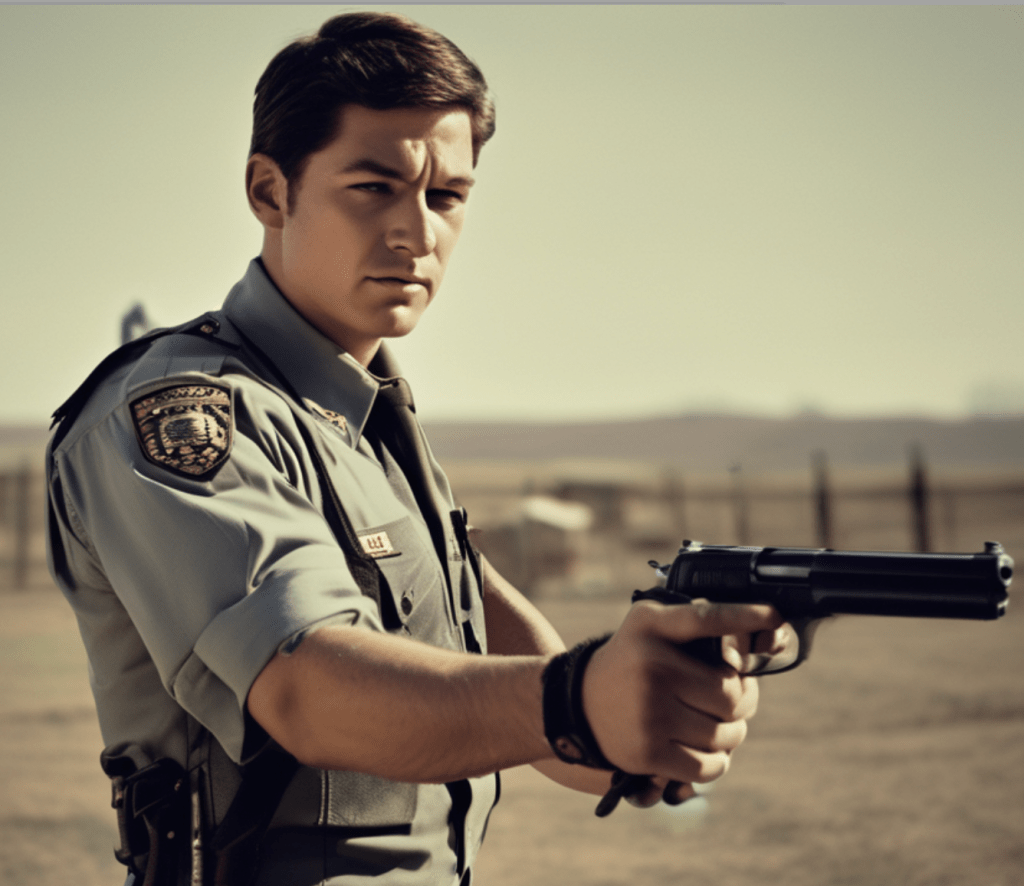
It was a windy afternoon, and the Kid decided to get some practice in at the shooting range before his night shift began at 8:00 PM. He had picked up a couple of bags of reloaded .38s for his .357 Magnum and figured he could get through them if he hurried. The range was just beyond the gates at the end of the city trailer park, where he and other police officers lived as a perk of working for the city.

As he drove down the lane towards the range, he noticed a small plane taking off to the north from the nearby municipal airport. He parked his car at the furthest shooting post, grabbed a paper target from the back seat, and stapled it to a board in the turnstile. Returning to the ten-yard line, he swapped out his duty loads for the reloads and closed the cylinder. Using the post for support, he lined up his shot but paused, holstering his gun instead.

He needed to practice reloading without looking, a crucial skill in a high-stress situation. He loaded his belt’s bullet loops, checked his watch, and started when the second hand hit twelve. Six shots, unload, reload, six more shots. But when he looked down, twenty seconds had passed, and he was off-target.

“Shit. Double shit!”

he yelled, frustration bubbling over.

Just then, two marked patrol units and the Chief’s car pulled up behind the range. The Kid knew that when others arrived, he had to stop shooting. Were they there to mock his poor shooting? No, they wanted to practice too. Who was going to run the tower? One of the officers asked, and the Chief responded, 
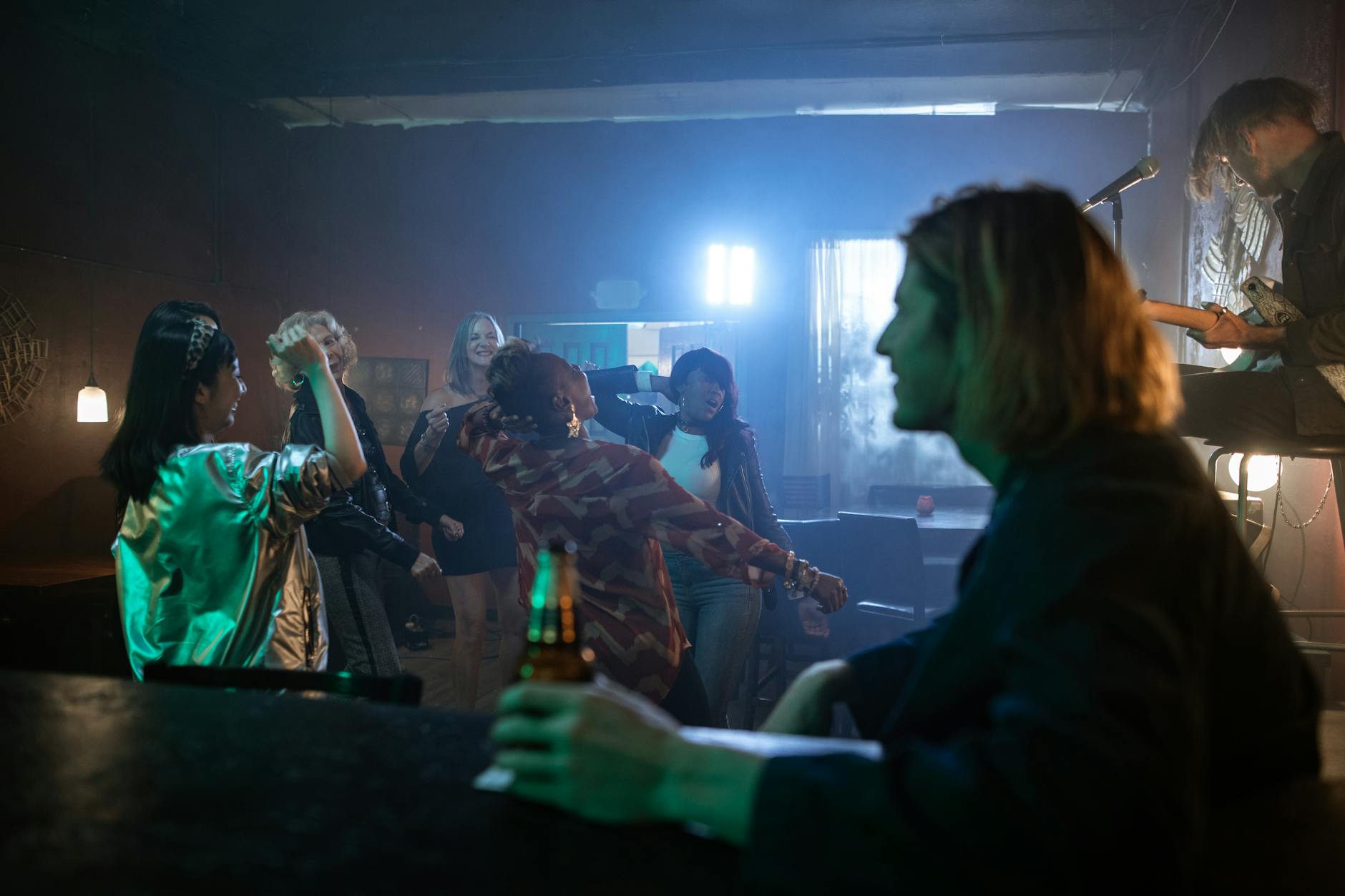
“I’ve got it covered!”

The Kid muttered to himself, annoyed. This evening was supposed to be his time. Now, everyone would see how bad his eyesight had gotten. The officers set up new targets and returned to the ten-yard line.

The Chief’s voice cracked through the speaker: 

“We’re shooting six, reloading six, shooting six, reloading six, shooting six, and reloading six. Then, leave your cylinder open. Ready on the Right, Ready on The Left, Ready on The Firing Line—fire!”

The range erupted in gunfire, reminiscent of Melvin Purvis taking down Pretty Boy Floyd in the cornfield. The Kid managed to get through his first loop, fire again, reload, and leave his cylinder open just as the others finished. They moved forward to check their targets.

“Now, gentlemen,” 

The Chief announced, 

“we will shoot from the hip, reload, and holster.”

“Ready on the left, ready on the right, ready on the firing line. Fire!”

Six shots rang out almost in unison, like something out of Gunsmoke. The officers reloaded and holstered their weapons.

Then the Chief called out, 

“Lanes four and five, you’re marked for looking while loading your ammo.”

The officers on lanes four and five protested, 

“Chief, you’re killing us!”

The Chief looking at the officers ––

“No, officers,”

the Chief replied with a sly grin, 

“I’m keeping you alive.”

As the banter continued, a call came over the car radio, 

“Headquarters to all available units. Unit 203 requests backup at SIR-DIXIE QUICK-STOP on a 10-48. Three subjects in a vehicle.”

A 10-48 indicated a National Crime Information Center Want or Warrant on the vehicle or its occupants. The practice ended abruptly as everyone rushed to their cars, eager to respond.

Knowing the city’s streets like the back of his hand, the Kid took a shortcut through alleys and arrived at the Quick Stop within minutes. By the time the other officers arrived, the Kid and the officer on the scene had all three suspects handcuffed and in the patrol unit.

It turned out the first suspect, identified as Ed, was wanted in Texas for nearly beating a State Trooper to death and tying him to a barbed-wire fence. The second suspect, Poncho, had a Tucumcari, New Mexico, address and was wanted for questioning in a murder. The third, known only as Thistle, was simply drunk and likely would have been killed by the other two had he not been arrested. All three got booked on public intoxication charges, with more serious charges pending confirmation from the respective states.

The Kid had been on desk duty after surgery a month earlier, so despite his initial involvement, he got relegated to working the radio and tending to the jail for the rest of the night. The shift was uneventful, with only the usual disturbance and prowler calls.

The Kid had a routine of checking the jail cells at irregular intervals—never on the hour, always keeping the prisoners guessing. At 2:15 AM, he made an unscheduled check. He opened the drunk tank window and saw the three occupants spaced apart: Poncho on the south wall, Ed against the west cell bars, and Thistle on the north side. Above Ed, a shirt was tied to the bars, seemingly his.

The Kid’s first thought was that the shirt might be bait to lure him in. But as he examined the scene, it appeared all three men were sleeping. He returned to the radio office and called his Lieutenant, explaining the situation. They got back to the cell together, and the Lieutenant instructed the Kid to untie the shirt. As the Kid began to do so, the Lieutenant bumped him and whispered,

“That man is dead. Put the shirt back.”

The Kid complied, leaving the shirt as he had found it. They moved the two living prisoners to separate cells and locked the tank holding Ed. The Kid, the only one with the key, went downstairs to call detectives, the Chief, and an ambulance.

The fire department, located across the hallway, had already been roused by the commotion. The assistant fire chief speculated that the incident might have been a failed sexual exploitation attempt that ended in death. When the ambulance arrived, the task of bringing a dead body down the stairs was both problematic and unsettling.

Within twenty-four hours, the Oklahoma Bureau of Investigation (OSBI) arrived, and obscene, harassing, and threatening phone calls began pouring into the station. After a thorough investigation by the OSBI, local sheriff’s department, and media scrutiny, the exact cause of Ed’s death remained a mystery.

Some speculated that one of the other prisoners had helped Ed end his life, while others thought he might have done it himself, with the knot slipping loose. In the end, the Kid learned a hard lesson: sometimes, even a villain meets a dead end.

But there was a silver lining. In the aftermath, the Kid finally mastered the skill he had been struggling with—reloading his revolver from his loops without looking—a small victory in the shadow of a dark night.

 A Blinding Prank That Wasn’t FoolProof

A Story By Benjamin H Groff© Groff Media Copyright 2024©

In the small town of Havenbrook, two blind men, Al and Bert, were renowned for their cunning and mischievous antics. Despite their lack of sight, they possessed a sharp wit and an uncanny ability to navigate the world around them. They orchestrated elaborate practical jokes daily, relishing in the townspeople’s reactions.

Yesterday, Al and Bert made an unusual purchase: a driverless car. They had saved up for months, and now their latest scheme was about to unfold. The sleek, shiny vehicle arrived at their doorstep, and the two friends couldn’t contain their excitement.

“This is going to be legendary!” Al exclaimed, his face lighting up.

Bert nodded, grinning from ear to ear. “Let’s give Havenbrook a show they won’t forget.”

That morning, Al and Bert put on a show. They dressed in a deliberately disheveled manner, with their clothes inside out and their hair tousled. They staggered down the street, feigning confusion and disorientation. The townspeople looked on in bewilderment as the two blind men stumbled around, bumping into things and seeking directions.

“Excuse me, can you help us? We seem to have lost our way,” Bert asked a passerby, his voice trembling with fake desperation.

The kind-hearted woman pointed them in the right direction, her face filled with concern. Al and Bert thanked her profusely before stumbling off in the opposite direction, leaving the woman and the other townspeople in a state of amused bewilderment.

Their antics continued throughout the day, with Al and Bert putting on an Oscar-worthy performance. They wandered into shops, interrupted conversations, and generally caused chaos wherever they went. Each time someone offered help, the duo responded with exaggerated confusion, leaving the townspeople scratching their heads and bursting into laughter at the same time.

By midday, they decided it was time to unveil the pièce de résistance. Al and Bert climbed into their driverless car, pretending to argue about who should take the wheel.

“You drive, Al! I can’t see a thing!” Bert insisted, his voice rising in mock panic.

“Neither can I, you fool! We’re both blind!” Al shot back, throwing his hands up in frustration.

The car, programmed to respond to voice commands, smoothly pulled out of the driveway and began its route through town. The sight of two blind men driving a car sent shockwaves through Havenbrook. People gawked, some laughed, and others chased after the vehicle, shouting warnings and pleas for them to stop, adding to the chaotic and humorous scene.

Inside the car, Al and Bert were beside themselves with laughter. They marveled at the chaos unfolding outside, their faces aching from so much smiling.

“Look at them! They think we’re driving!” Al gasped, clutching his sides.

Bert nodded, tears of joy streaming down his cheeks. “Best prank ever!”

The car continued its journey, obediently following its pre-programmed path. Realizing they got duped again, the townspeople couldn’t help but chuckle at the elaborate ruse. Al and Bert’s reputation as the town’s resident tricksters became cemented even further.

As the day drew close, the car returned to their home, and the two friends climbed out, exhausted but exhilarated. They high-fived each other, basking in the success of their latest prank.

“Well, Bert, we’ve done it again,” Al said, a satisfied smile on his face.

Bert nodded in agreement. “Indeed we have, Al. Indeed we have.”

In the days that followed, the story of the blind men and their driverless car became the stuff of legend in Havenbrook. Al and Bert continued their daily pranks, always finding new ways to keep the townspeople on their toes. And though their sightless eyes never saw the results of their efforts, their hearts were full of the joy and laughter they brought to their beloved town.

Political Mission Set In Fictional future Yet Sparks Of Reality Shines Through!

A Story By Benjamin H Groff© Groff Media Copyright 2024©

The tides of change swept through every street, home, and heart in the nation’s heart. It was an era marked by uncertainty and tension as a rising conservative movement began to reshape the very fabric of society. The once-balanced scales of politics now tipped heavily in favor of those who believed in tradition, order, and a return to what they called “the good old days.”

~
Emma Caldwell, a liberal activist and journalist, sat in her small apartment, the glow of her laptop illuminating her worried face. She had spent years fighting for progress—campaigning for equal rights, environmental protection, and social justice. But now, every headline seemed to bring another blow to the causes she held dear, intensifying the urgency of her mission.

~


The latest news was the most disturbing yet: a proposed amendment to the constitution that would severely restrict freedom of speech and assembly, effectively silencing dissent and opposition. Emma’s fingers flew across the keyboard as she typed out an article, her words mixing passion and desperation. She knew that getting the truth out was more important than ever.


Across town, in a grand office overlooking the city, Senator Marcus Reid, a leading figure in the conservative movement, reviewed the day’s agenda. He believed sincerely in his cause, convinced the country had lost its way in a maze of liberal policies and needed to return to its core values. To him, the changes were necessary, even if they were painful.


As the days passed, protests erupted across the nation. Streets filled with a sea of faces—young and old, united by a shared fear of losing their rights. Emma was among them, her camera capturing the raw emotions of the crowd. She interviewed people from all walks of life: the single mother worried about her children’s future, the college student anxious about the loss of academic freedom, the elderly couple who had fought for civil rights decades ago and now saw history repeating itself.


Despite the growing unrest, the conservative agenda pushed forward relentlessly. The lawmakers passed laws at a dizzying pace, each chipping away at the freedoms many had taken for granted. These laws included [specific laws], which directly affected [specific groups of people]. The country seemed to be spiraling into a new era of authoritarianism, and the hope that once burned brightly in the hearts of liberals began to dim.


Emma found herself at a crossroads. Her work was censored, and her voice was stifled by the very government she had once trusted to protect her freedoms. But she refused to give up. Gathering a small group of like-minded individuals, she formed an underground network dedicated to preserving and disseminating information. Their determination was a silent but powerful force, inspiring others with their unwavering resolve.


Senator Reid, now one of the most powerful men in the country, began to sense the growing resistance. He dismissed it at first, confident that his vision was the right path. However, as the underground movement gained momentum, Senator Reid realized that silencing dissent was more complex than passing laws. The human spirit, he discovered, was not so quickly subdued.
One evening, Emma received a message from an anonymous source—a high-ranking government official who had grown disillusioned with the conservative regime. The source provided her with classified documents detailing the administration’s plans to tighten their grip on power further.

These documents revealed [specific details], a dangerous revelation, but Emma knew it was the spark needed to ignite a more significant movement.


She leaked the documents to the public with the help of her network. The revelations shook the country, and the streets again filled with protesters. This time, their numbers were more significant, and their resolve was more robust, demonstrating the potential impact of collective action. The conservative government, facing unprecedented pressure, began to falter.


Senator Reid watched as the country he had tried to reshape slipped from his grasp. He had underestimated the people’s power and ability to unite and fight for their rights. As the conservative movement began to crumble, a new era of political awakening dawned.


Emma stood on the capitol’s steps, her camera in hand, capturing the momentous events unfolding before her. She knew the battle was far from over, but she felt a glimmer of hope for the first time in a long while. The changing times had tested the nation’s spirit, but in the end, its people’s resilience and determination prevailed.

The Comm Commander Tells About Jailing His First Arrest

A Story By Benjamin H Groff© Groff Media Copyright 2024©

It was slightly after 2 AM, and the calls had slowed to officers making traffic stops. They were watching for drunk drivers. The local bars closed then, and the streets would fill with drivers hitting light posts and speed signs.


Keeping track of their locations was a breeze, and the Comm Commander kept a log with details, including every detail radioed over the airwaves. The gals had been egging the Comm Commander to tell them one of his stories about his time at the other departments he had worked at. With a lull in activity, he thought, well, now is as good a time as any.

Edna and Gail had stayed over from their earlier shifts for the occasion. They were both much older than the Comm Commander, and he liked to tease them whenever he could pull a good trick on them. They, in turn, returned the favor. Edna, a divorcee, was snappy and wise. Gail was from the deep South and had a twang in her voice. Plus, she talked of her roots and Alabama every chance she got.

Well, ladies, the Comm Commander began,
“my first arrest was when I was barely 17. I arrested a man known as 15,000. The nickname 15,000 had been given him for the many times he had been arrested for public intoxication. Anyway, he walked into the police department and nearly fell over the dispatch desk. I told him he was going to the tank, and he thanked me. Then he tried to resist arrest when I got the door to the drunk tank open. I got him in there, and he went to sleep. A few days later, after seeing the judge, he was sentenced to two weeks in jail. I was checking on him, and he was having D.T.’s Delirium Tremens”

“Yes, we know what they are Comm Comm.” The ladies interrupted.

The Communications Commander continued,

“Well, I told our Chief JR Toehay, and he said give him a cup of liquor. So, I went to the evidence vault and found the alcohol bottle with the lowest proof that wasn’t evidence for court. I poured a shot into a cup and went to his cell. I opened the door and said hey Wallace, I have a drink for you. He lapped it up. Within a few minutes, he settled down. Over a week, I did that until he was clean, and when he left jail, he was sober. He stayed sober for the first time in years; he had never taken another drink, and he would come by the police department and thank me every night when I was working. He would thank me for being kind to him and helping him. That was when I thought I had finally reached someone doing this job.”

The next guy I arrested came into the police department like that; I had to fight and call for help. He started throwing things over the counter at me and going wild. When we got him into the cell, the Chief told me he was the suspect believed to have beaten a man to death behind the jail not long before I went to work for the department. There wasn’t enough evidence to support an arrest, and he would never have admitted to doing it. I asked if anyone had ever asked him when he was drunk and got told anything he admitted to being intoxicated wouldn’t hold up as a confession. The girl’s eyes were wide and expecting something more, so I said the biggest thing that happened was when the Chief and I helped in a kidnapping.

WHAT? The two ladies both said?

The Comm Commander explained it was under pretenses that a judge got brought to the jail. Five people with Federal Identifiers and Bureau of Indian Affairs Police Badges brought a lady to the town’s jail; the jail was contracted with the BIA as a facility for their agency. They provided legal paperwork authorizing the detention of a lady they had in custody as a material witness. She was to have no visitor, and no one was to know she was in our protective custody. The police department secured her in a female cell with the paperwork signed and sealed by a judge. She did not talk to anyone at the police department.

Two days later, while the Communications Commander was working, he happened to read in the paper that unknown people had kidnapped a federal judge from the Commanche Indian Tribal Headquarters. It also showed the picture of the lady we had in custody. He went to the Chief and told him to show him the newspaper article. The Chief said several colorful words and then called the city attorney. The Chief and Comm Comm, went to the cell, removed the lady, and told her they believed they knew who she was and that she was safe. They also said she could make a phone call and encouraged her to call anyone she thought she could trust. She could stay with the police department and only leave once she knew who she was going with could be trusted. Eventually, the Oklahoma Highway Patrol and a Federal Bureau of Investigation Agent arrived. The Communications Commander explained he stayed by the radio. And said he knew she left with a massive group of people around her, which shows how easy it can be for someone to be falsely locked up in a small town.

The ladies said –– “all this happened in that small town where you came from?”

The Comm Commander said ––

“oh, there was much more that happened while I was there. These are just a few of the things that happened at the jail. We did so much more out on the street. I will have to save for another time because I have three units bringing in prisoners, and I have to go to book them!”

Victor: A Man of Mystery and Resilience | Uncovering the Lost Relic in Haunting Mansion

A forgotten mansion, shrouded in mystery, stood in the heart of the old city, nestled among the cobblestone streets and gothic architecture. Its grandiose facade, though worn by time, still retained an enigmatic elegance. On a stormy evening, Victor, a man of mystery and resilience, found himself drawn to this mansion, its secrets whispering to him.

Victor, a man of mystery and resilience, had always been a seeker of the unusual, the arcane. His latest obsession had led him to this mansion, rumored to be the repository of a lost relic. He was a formidable presence in his black leather attire, adorned with silver studs and zippers. His attire, a blend of functionality and style, spoke volumes of his readiness for whatever the night might bring.

The mansion’s interior was a haunting blend of past grandeur and eerie decay. The flickering candlelight cast eerie shadows on the portraits of stern-faced ancestors that lined the walls, their eyes seeming to follow him as he made his way through the dimly lit halls. The air was thick with the scent of old books and the faint, lingering traces of incense, and the floorboards creaked under his weight.

Victor’s destination was the study; a room said to contain a hidden compartment where the relic was concealed. He had done his homework; old blueprints and cryptic notes had led him here. With a determined stride, he entered the study, its heavy wooden door creaking ominously.

The room was a testament to the mansion’s former glory, with rich mahogany shelves lined with ancient tomes, a grand fireplace, and a massive desk that dominated the space. Victor approached the desk, his leather-clad fingers tracing the intricate carvings on its surface. He had a hunch that the key lay in the hidden compartment of the desk itself.

After a meticulous search, Victor’s fingers found a small, concealed latch. A secret drawer slid open with a soft click, revealing a velvet-lined compartment. Inside lay an ornate box, its surface inlaid with mother-of-pearl and silver filigree. Victor’s heart raced as he carefully lifted the box and opened it.

Inside, nestled in velvet, was the relic: an ancient amulet, its center a polished obsidian stone encircled by symbols of power and protection. As Victor held it, a surge of energy coursed through him, confirming the amulet’s authenticity; this was what he had been searching for. The amulet, rumored to hold the key to immortality, was a prize coveted by many.

His triumph was interrupted by the sound of footsteps echoing through the hall. Victor quickly stashed the amulet in his belt pouch and closed the drawer, his senses on high alert. He had been cautious, but it seemed he was not alone in his quest.

The door to the study burst open, and a figure clad in dark robes stepped in. ‘You have something that belongs to me,’ the intruder hissed, eyes glinting with malice. ‘You’re too late,’ Victor replied, his voice steady. ‘The amulet is mine now.’

Victor stood his ground, his hand instinctively moving to the hilt of his concealed dagger. “The amulet is not yours to claim,” he replied coolly. “It belongs to no one but itself.”

A tense silence filled the room, broken only by the distant rumble of thunder. The intruder moved with surprising speed, lunging towards Victor. But Victor was ready. In a swift, fluid motion, he drew his dagger and deflected the attack, the blade glinting in the dim light. His heart pounded in his chest, his senses heightened as he focused on the task at hand.

The fight was a whirlwind of intensity. Victor’s combat training and the intruder’s desperate aggression clashed in a flurry of movement. The air crackled with tension as they circled each other, each seeking an opening. In the end, Victor’s skill and determination prevailed. The intruder, defeated and disarmed, lay on the floor, gasping for breath.

Victor looked down at his defeated opponent, his eyes a mix of pity and resolve. ‘Leave now and never return,’ he ordered, his voice firm but tinged with a hint of sadness. ‘The amulet’s power is beyond your understanding.’

The intruder, cowed and beaten, scrambled to his feet and fled into the night. Victor watched him go, his eyes filled with a mix of pity and resolve. He knew his journey was far from over. The relic’s true power and purpose were yet to be revealed, and he was resolute in his determination to unravel its mysteries.

With the amulet safely in his possession, Victor left the mansion and stepped into the stormy night. Lightning illuminated his path, and the rain washed away the remnants of the battle. As he disappeared into the shadows, one thing was sure: Victor’s legend was only beginning.

Solemn Reflections: Memorial Day and the Spirit of Sacrifice

As the sun rose over the small town of Oakwood, its warm rays illuminated the rows of white headstones in the Oakwood Cemetery. The city, steeped in a rich history of honoring fallen soldiers, had always observed Memorial Day with solemn pride. This day, originally known as Decoration Day, was established after the Civil War to commemorate the Union and Confederate soldiers who died in the war. It has since evolved to honor all Americans who have died in military service.

Sarah Thompson stood at the cemetery’s gate, holding a bouquet of red, white, and blue flowers. She was in her late thirties, her eyes reflecting sorrow and strength. Visiting the cemetery was her yearly ritual—a pilgrimage to visit the grave of her brother, Daniel, who had died in Afghanistan a decade ago.

As Sarah walked along the gravel path, she remembered the day they received the news. It had been a bright summer afternoon, much like today. Daniel had always been a source of light and joy in their family, with his infectious laughter and boundless energy. The knock on the door that day had shattered their world.

Sarah reached Daniel’s grave and knelt, gently placing the flowers in front of the headstone. She traced her fingers over his name etched in the cold stone and whispered a prayer. Memories flooded back—playing tag in the backyard, late-night talks about their dreams, and the tearful goodbye when he left for his final deployment.

The cemetery, a place of collective grief and remembrance, began to fill with others who had come to pay their respects. Families, friends, and fellow veterans moved among the graves, their shared sorrow palpable in the air. Some walked in silence, their thoughts a private tribute, while others shared stories, their voices a collective echo of the lives lost.

A familiar voice broke Sarah’s reverie. “Hey, Sarah.”

She turned to see Tom, one of Daniel’s best friends from high school, standing nearby. He held a small American flag, which he placed at the base of the headstone. Tom had served alongside Daniel and had been with him during his last moments.

“It’s good to see you, Tom,” Sarah said, her voice soft.

Tom nodded, his eyes filled with shared grief. “I come here every year. Feels like the least I can do.”

They stood in silence for a moment, their hearts heavy with the weight of their loss. Each lost in their thoughts, memories of Daniel flooding their minds. Then Tom began to speak, his voice steady but emotional, his words a testament to the bravery and selflessness of their fallen friend. ‘Daniel was the bravest person I knew,’ he said, his voice breaking with emotion. ‘He always put others before himself. Even in the end, he worried more about us than his safety.’

Sarah smiled through her tears. “That sounds like him.”

The morning wore on, and more people arrived, each carrying their own memories and gratitude. A group of children from the local school, accompanied by their teachers, placed flags on the graves of all the fallen soldiers, a symbol of their respect and understanding of the sacrifices made. The town’s mayor gave a short speech, his words echoing with the collective gratitude and remembrance of the community. A local choir sang ‘America the Beautiful,’ their voices a poignant reminder of the unity and strength that comes from shared values. The collective remembrance was a powerful testament to the sacrifices made by so many.

As the ceremony ended, Sarah and Tom lingered by Daniel’s grave a little longer. They shared stories, laughed, and cried, finding comfort in each other’s company.

“Thank you for being here,” Sarah said as they prepared to leave.

“Always,” Tom replied. “He was my brother, too.”

They returned to the cemetery gate together, the sun now high in the sky. As Sarah looked back one last time at the sea of white headstones, she felt a sense of peace. Memorial Day was not just about remembering the fallen; it was about celebrating their lives and the values they stood for.

Driving home, Sarah contemplated the significance of this day and how she would pass on its importance to her children. She understood that as long as they remembered, Daniel’s spirit would continue to live on. Every Memorial Day, she would return to this hallowed ground, ensuring that the memory of her brother and all those who had made the ultimate sacrifice for their country would never fade.

In checking references part of this story may include referencese similar to others found on the internet. The simularities are incidential and are not included intentional. You can find more these simularities RE: New York. Memorial Day. Monument. Dead Soldier. Wheelchair. Handicapped Boy. | Didier Ruef | Photography. https://www.didierruef.com/gallery-image/Aura/G0000Is39GN2Av9w/I0000aHlCvWVZLNc/C0000EU0LcXmMzWo/