Why Language Choice Is Crucial in Events

3–5 minutes

(inspired by Daria Knupp’s piece at Personify)
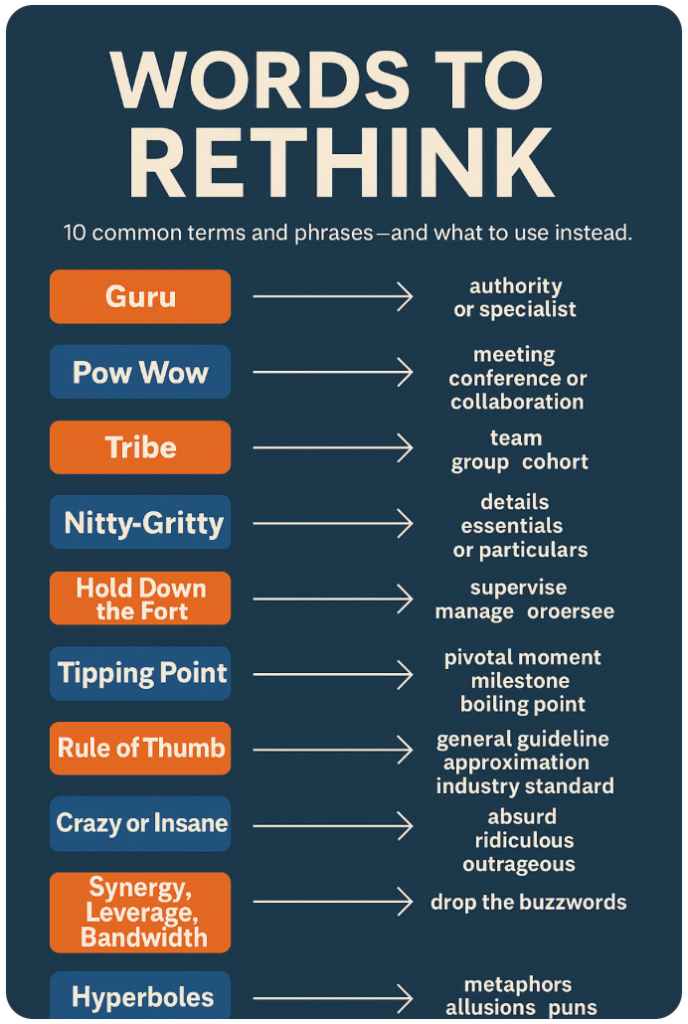
We all know words can inspire, connect, and excite—but they can also alienate, offend, or sound tired. Daria Knupp, Sr. Content Marketing Manager at Personify, recently published a thoughtful article. It lists 10 words and phrases we should stop using in the events industry. We should consider avoiding them everywhere. Her list stopped me in my tracks—and it will surprise you, too.

We use these terms often at conferences, in meetings, and in our everyday work to convey intelligence, wit, and creativity. Nevertheless, some have roots in stereotypes, outdated social theories, or even deeply offensive historical contexts. Here are highlights from Knupp’s list. I also include my own reflections on why they matter. Additionally, I explore how we can do better.

  • “Guru” Originally, the title of the highest spiritual leaders in Hinduism and Buddhism. Using it casually—“event planning guru”—can trivialize a sacred role. Try “expert” or “specialist” instead.
  • “Pow Wow” is not just a “quick meeting.” It’s a sacred Native American gathering of community and celebration. Try “meeting” or “collaboration.”
  • “Tribe” is often used to describe a network or support, but it is tied to outdated and harmful stereotypes. Swap in “team,” “group,” or “cohort.”
  • “Nitty Gritty” Commonly meant “the essentials,” but it was rooted in references to the slave trade. Use “details” or “essentials” instead.
  • “Hold Down the Fort” Seems harmless, but it was initially tied to colonial conflicts with Native Americans. Consider “supervise” or “manage.”
  • “Tipping Point” was popularized by Malcolm Gladwell, but historically referred to racial “thresholds” in neighborhoods. Try “pivotal moment” or “milestone.”
  • “Rule of Thumb” Linked—to wife-beating folklore. Safer to say “general guideline” or “industry standard.”
  • “Crazy” or “Insane” Using mental illness terms casually undermines efforts to destigmatize. Replace with “absurd,” “outrageous,” or “ridiculous.”
  • Buzzwords like “Synergy,” “Leverage,” and “Bandwidth” Overuse makes you sound like a cliché. Switch it up with plainer language.
  • Hyperboles. Nothing wrong with exaggeration—but when overdone, it can make you less credible. Mix in metaphors or puns for variety.

I’ve had very close Native American friends who have been like family to me for nearly fifty years. Through countless conversations, shared meals, and life’s ups and downs, similar concerns about language never arose. We always spoke openly and comfortably with one another, and I thought we understood each other fully.

Now, reading about the origins of these words and their potential to harm, I have to ask myself—was I wrong? Did I unintentionally cause pain, even to the people I love and respect? This personal reflection can make the audience feel empathetic and introspective. Did my long-held assumptions give me a sense of being “above” the issue when in reality I wasn’t?

This is why articles like Daria Knupp’s matter. They challenge us to reevaluate. They help us check our blind spots. They make us confront how easy it is to inherit language without questioning it. This can make the audience feel motivated and empowered. I hope that in sharing this, readers will pause. I hope they think: if language is so powerful, what can we do to use it better?

As Knupp points out, we interact with thousands of attendees, exhibitors, colleagues, and friends. Every word choice carries weight. Being mindful of language isn’t about being “too sensitive”; it’s about making sure everyone feels respected and included. And honestly? It makes us sound more intelligent and up-to-date.

For me, this list was surprising because so many of these phrases have been normalized. Seeing their origins laid out in one place makes me rethink my own habits. It also makes me curious—what other everyday expressions are we using without realizing their history?

Language evolves, and so can we. By phasing out these outdated or offensive terms, we show ourselves as thoughtful professionals and better human beings. Words shape experiences. They can also change them—for the better.


By Benjamin GroffMedia© | benandsteve.com | ©2025 

NOTE: We live in a time when there’s a relentless push to roll back equality. Efforts aim to undo hard-won progress toward balancing the scales between the haves and the have-nots. Reports like this stand as a vital reminder. There will always be voices, somewhere, willing to rise for decency, fairness, and moral courage.


Finding Common Ground: Building Bridges in Polarized Times

1–2 minutes

Photo by cottonbro studio on Pexels.com

Finding Common Ground in a Divided Nation

Everywhere we look, the signs of division are clear. Our conversations have turned into shouting matches, our communities into factions, and even the smallest differences into battle lines. A nation divided can’t stand strong. But there is another path. It does not ask us to agree on everything. Instead, it asks us to bring ourselves into spaces that center peace and shared purpose.


The Power of a Centered Community

When we step away from division and enter a group that is centered and peaceful, something remarkable happens. The noise quiets down. Respect returns to the conversation. We start to see each other not as opponents. Instead, we see each other as fellow human beings. We recognize struggles, joys, and hopes that are more alike than different. These kinds of communities create an environment where empathy can thrive—and empathy is the root of unity.


A Call to Unite Around a Common Cause

Now more than ever, we need to reclaim what unites us. Not political slogans, not party lines—but a shared wish for dignity, fairness, and belonging. The call is simple: bring yourself, with open hands and an open heart, to a group that fosters peace. Choose to engage in a way that builds bridges instead of burning them. Let’s unite around the common cause of healing our communities, so that we can heal our nation.


Closing Thought

Division is loud, but peace is stronger. Every voice that chooses compassion over conflict adds weight to the side of unity. The choice begins with each of us—will we contribute to the noise, or to the harmony?


By Benjamin GroffMedia© | benandsteve.com | 2025 

How Western Movies Perpetuate Harmful Stereotypes of Indigenous Peoples

By Benjamin GroffMedia© | benandsteve.com | 2025 Truth Endures©

3–4 minutes

I was watching an old Western on television this past weekend. You know, the kind—cowboys and Indians. Or, as we might say today, American Ranchers and Indigenous Peoples.

The film, likely made in the 1950s, had the signature gloss of that era’s post-war cinema. Still, something about it suggested it was possibly shot even earlier, maybe in the 1940s. It was only later spliced, refitted, and packaged for the screen. The costumes, dialogue, and scenery all hinted at a time when the stereotypes were deeply ingrained in the script. They weren’t even questioned.

I probably watched that movie as a kid. I was sitting next to my father, not giving it a second thought. Back then, it was just another Western. But this time around, with a different set of eyes, what I saw was jarring.

It followed the predictable narrative: the cavalry riding in to tame the West and keep the “Indians” under control. Two delicately dressed white heroines were caught in the middle of a brewing conflict. A white doctor stood out as the lone character who dared to see Native people as human beings. He was mocked and ostracized for his compassion. This was especially true when a malaria outbreak swept through the tribe. He insisted they deserved treatment.

At one point, he stood in a room full of fellow whites. He asked,

“Do you think Indians are not human beings? Human beings like you and me, who deserve to live and be healthy?”

And one of the prim ladies, her hair perfect and her face untouched by empathy replied:

“I don’t know… how could they be?”

To which others in the room nodded and added, 

“That’s right.”

“Of course, they’re not!”

“No way, in God’s name.”

I sat there stunned, wondering:

“How did a line like that ever make it into a movie script?”

Even more troubling:

“How did it get past editors, producers, censors—only to be broadcast, repeated, and absorbed by generations?”

It wasn’t just offensive. It was abusive. And it made me sad.

Is there a historical context to such language? Possibly. But what would a young Native American child feel sitting in front of that screen? Would they see their life reflected as something lesser—something not worthy of protection or dignity? Listening to the white characters, it certainly felt that way.

And it took me back to where I grew up.

I’m from the Kiowa and Comanche Counties area in Oklahoma—Caddo County, specifically. I was raised alongside Native American children, many of whom I called friends.

Later in life, I worked in law enforcement and came to know tribal members through both personal and professional relationships. I learned a great deal from them—about their culture, their pride, their pain.

When I started in law enforcement, the department had an initiation ritual. It involved arresting a man nicknamed Fifteen Thousand. He was a Native man, around 50 years old, who’d been detained countless times—hence the name. His real name was Thomas Kamaulty Sr.

He was the first person I ever arrested as an officer. 

And, in time, Thomas became the first person I ever saw get sober. That meant something.

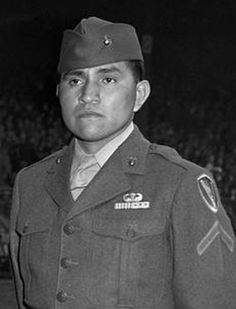
Ira Hayes

I also think about people like Ira Hayes. He was a Pima Indian from Arizona. Ira helped raise the flag at Iwo Jima during World War II. A hero by every standard. And yet, like Thomas, Ira suffered. Both carried the scars of discrimination and trauma. Both turned to alcohol as a way to numb the soul-deep wounds this country handed them.

We often ask why these cycles exist—but we rarely admit the truth: it’s because we’ve designed them to. We’ve placed people like Thomas, like Ira, into roles and systems. Their suffering can be managed. Their voices are diminished. Their lives are controlled. That was always the plan. And until we stop pretending it wasn’t, the script will keep playing—over and over again.

LOVE ENDURES THE TEST OF TIME ESPECIALLY DURING A TIME WHEN LOVE COULD BE CHALLENGED

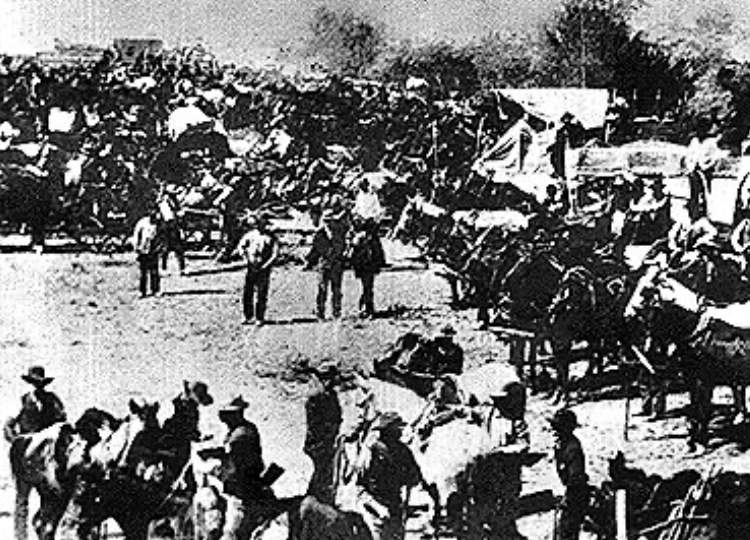
In the vast expanse of the Indian Territory, amidst the rugged terrain and the promise of new beginnings, two souls found each other amidst the chaos of land claims and dreams of prosperity. Vol Wilhelm Groff, a spirited young man with a penchant for adventure, and Joseph McElroy, a quiet and contemplative soul, crossed paths in the unforgiving landscape of Oklahoma in the year 1905.

The Indian Territory was a land of opportunity, where dreams clashed with harsh reality, and where individuals staked their claims in the hopes of carving out a future for themselves. Val and Joseph were among those brave souls, drawn to the promise of a better life on the frontier.

Their meeting was serendipitous, a chance encounter amidst the chaos of land rushes and bustling settlements. Val, with his infectious enthusiasm, captured Joseph’s attention from the moment they first locked eyes. Despite their differences in temperament, they found a deep connection that transcended words.

Val and Joesph
Photo Taken In Okarche Oklahoma

As they worked side by side, staking their claims and building their homesteads from the ground up, their bond grew stronger with each passing day. Amidst the challenges of frontier life, they found solace in each other’s presence, drawing strength from their shared dreams and aspirations.

But theirs was a love that dared not speak its name in the harsh reality of the early 20th century. In a world where societal norms dictated strict conformity, Val and Joseph had to tread carefully, concealing their love from prying eyes.

Yet, despite the obstacles they faced, their love endured, a beacon of hope in a world fraught with uncertainty. Through the trials and tribulations of frontier life, they remained steadfast in their devotion to each other, finding solace in the quiet moments shared beneath the starry Oklahoma sky.

As the years passed and the Indian Territory evolved into the state of Oklahoma, Val and Joseph’s love stood the test of time, a testament to the enduring power of love in the face of adversity. And though their names may have been forgotten by history, their love story lived on, a reminder that true love knows no bounds, not even the vast expanse of the American frontier.

Trying To Make It In The City Angels. L.A., California, Where A Good Job Paying Enough To Afford A Good House Is Hard To Find. Some People Work For The American Dream and Others Find Ways To Get What They Want By Taking From Rightful Owners.

finance.yahoo.com/news/professional-couple-over-200-000-115752472.html

THE DAY YOU DECIDED…

We will take care of our sins. You tend to yours…

About Gays And Why Laws, Book Bans, School Boards, And Other Restrictions Attempting To Bash And Attempted Genocide Against Queer Peoples Won’t Stop More People From Increasing The Populations In The LGBTQI Community!

The Day You Decided Who You Are
Photo by cottonbro studio on Pexels.com

We all remember that day. It may be a Spring afternoon following a light rain shower, with flowers peaking from beneath their winter hiding place for a first glimpse of the season’s sun. There we sit. We were pondering between the two choices. Will we be straight or gay? Surely everyone remembers that day, for if it is a choice, everyone faces the same options. You can choose both, they say. That needs to be clarified.


To be or not to be, when we were teens, first discovering who we were, for some, it was challenging to accept, and it took years for those who grew up in communities that were closed-minded and set to one way of life to finally get into their head that they were who they are and not who others expected them to be. They had tried to take the path of least resistance and attempted to take the straight route, not given another choice. But every piece of their biological body screamed at them, telling them something wasn’t right. They were misleading others, lying every minute of their life, and never being their true selves. They either had to leave and be their authentic self or die. Some tried to marry, but after a period, the inner madness kept them from carrying on, and their either killed themselves, came out and took the hell and damnation from the small communities in which they lived, or packed up and disappeared. Many may have turned to alcohol or drugs, appearing to believe it was better to be an addict than what they felt was their true self. If they were lucky, they met their soul mate and were rescued from the prison that so many are forced into by a society that is cruel and judgmental of others. Fortunately for others, they meet their lifemates just out of high school. They seem to know how to manage the world around them and find a world to live and operate in a life they would have otherwise missed out on, creating long-term relationships and being grateful things turned out as they do. They would not have wished to miss on so much love and so many adventures.


Forty-one years later, another couple still see simple rights afforded to their neighbors, rights that are threatened to be stripped from them by bigoted and power-hungry maga-republicans. So a question is asked to these groups suggesting they can kill off the gays. When did they choose to be straight? And, why is allowing this couple to live in peace so bad?

Photo by Joshua Mcknight on Pexels.com

All the books, movies, and internet sites in the world may get banned; however, that will not stop the same amount of new homosexual and bisexual men and women from populating the earth each year. Some evil act does not make them. They are born, just like the couple you are reading about. Just like you!

One couple originates from small towns in Western Oklahoma. Growing up, they were never acquainted with gay anything. Both were church-attending, straight-laced lads all the way. Still, each began slowly dying from living in a suppressive community that had conditioned them to believe they were the worst people on the earth and were going to Hell. That worked until they met after high school and finally began to breathe life through one another. It took a lifetime to overcome the damage God-fearing sermons placed on them. They chose to move to a larger city and begin to grow privately, not making themselves the center attraction of life, but their community knew they coupled. As life continued, so did their love and energy, and now they live in a retirement community. But their rights are under threat daily. Because their property, retirement, and physical and fiscal security are in danger by daily threats of changing laws and bigotry. Research has discovered there should be signs on every front door of any religious establishment reading “for entertainment purposes only, because it does not produce a benefit for the community as a whole, just for the few!”

So When Did You Choose Your Sexual Preference?

And To Screw With It Would Cause Extinction!

This passionate talk from Dr. James O’Keefe, MD, gives us a deeply personal and fascinating insight into why homosexuality is a necessary and instrumental cog in nature’s perfection.

Research shows those making up the LGBTQI Communities are responsible for keeping the human race alive.

So When Did You Decide? When Did You Make Your Decision On Who To Be?

LGBTQI? It Is Natures Response To Maintaining The Magic Balance In Life – And To Screw With It Would Cause Extinction.

Maintaining The Magic Balance In Life

For those desiring more proof that the existence of gays is “born” to history and that the members of the LGBTQI Community do not simply choose to be Gay, this history lesson may help if you are an individual with a mind with enough room to learn new and factual information. 

Another way to arrive at the understanding of whether LGBTQI members are born or are made of people choosing a lifestyle, ask yourself when you decided to be heterosexual (straight). What day did you choose between the options available and determine what life you wanted? Then consider who would ever pick a life where their being would face prejudices, denial of employment, housing, and services if they had a choice not to have to face the constant bigotry bashing them daily. 

If you believe in a Higher Authority, a God. If this is your premise and you still object to these beings walking the earth, take it up with Him. When you do, if you believe scripture, consider Genesis 1:26-28, which announces that human beings are unique and all are in the image of God.

§Then God said, 'Let us make man in our image, according to our likeness, and let them rule over the fish of the sea and the birds of the sky and the cattle and over all the earth.  Genesis 1:26-28

IF HE IS TRUE. AND THERE IS AN ALMIGHTY. AND HE DID SOMETHING WRONG IN DESIGNING CERTAIN INDIVIDUALS TO BE DIFFERENT. THEN YOU SHOULD TELL HIM HE IS WRONG!


Viewing the windows to the right will allow the Facebook Posting to open so the original content can be read.

Remember It…The Day You Decided!

This Is Not A Paid Advertisement

If you are God Fearing, then this message is for you! Our supposed sins will not send you to Hell. But God will ask about yours, i.e., judging others, planting seeds of strife. So the sins you commit are the only ones you should be concerned with. We are fine in answering to the top, should there be anything to comment on. You take care of your side of the street. We will tend to ours!

The Reverend Groff