The Hot Dog Santa Which Warms Children’s Hearts

This story is pulled from the archives as a celebration for the season edition.

Groff Media 2024© Truth Endures IMDbPro

Presented by benandsteve.com By: Benjamin Groff II©

~ When Santa Claus Stopped Coming To Town ~

From the original Hot Dog Santa Brings Christmas Cheer to Children, originally posted on December 10, 2024, by Jenny Ashcraft

On Christmas Day in 1921, a Swedish immigrant named Axel Bjorklund quietly pushed his hot dog cart to a corner in Boston’s North End. There, he handed out 500 steaming hot dogs to cold and hungry children, a simple act of kindness that would leave a lasting legacy.

Axel knew what it meant to struggle. He barely scraped by himself, but his heart ached for the impoverished children he saw daily. Hundreds of children, some as young as five, lined up in their threadbare clothes that chilly Christmas morning, shivering against the cold.

Despite their hunger and hardship, their faces lit up with joy as Axel handed each one a hot dog. Though the food quickly ran out, Axel’s resolve did not. He was determined to make this a yearly tradition. Over the next eight years, he gave away an astonishing 10,000 hot dogs before passing in 1930.

Axel was born on August 6, 1869, in Gothenburg, Sweden. In 1889, he immigrated to America and eventually settled in Boston’s North End, a neighborhood brimming with immigrants striving to build better lives.

Yet, poverty was rampant, especially after the devastating Spanish Flu pandemic left many families destitute and orphaned children wandering the streets. Amid this suffering, Axel’s generosity shone like a beacon of hope.

After a brief and unhappy marriage, Axel lived alone and decided to start a hot dog stand at the busy corner of Blackstone and Hanover Streets. The simple job gave him a sense of purpose, but seeing the hunger around him determined him to do more. He vowed that no child would go hungry if he had food to offer. His first Christmas giveaway in 1921 was a success, and he expanded the effort the following year, doubling the number of hot dogs to 1,000.

His annual giveaway grew as word of Axel’s kindness spread, eventually reaching 3,000 hot dogs yearly. The children affectionately began calling him “Hot Dog Santa.” Newspapers from across the United States and even Sweden shared his story, celebrating his selfless tradition.

Over time, Axel moved his hot dog giveaway to New Year’s Day, but the event remained a cherished occasion for the children who eagerly awaited it. However, Axel’s health began to deteriorate. Rheumatism caused frequent hospital visits, and his financial situation worsened. Struggling to pay his rent, Axel reached out to the public for help, determined to continue his tradition despite his hardships.

In December 1928, just before the giveaway, Axel’s landlady evicted him for failing to pay rent. The Salvation Army provided temporary support, but Axel’s circumstances grew increasingly dire. Over the next two years, he bounced between shelters, the poorhouse, and the Cambridge Home for the Aged, relying on the generosity of strangers. Even so, in 1929, he hosted one final hot dog giveaway.

On November 10, 1930, Axel Bjorklund passed away in a Massachusetts hospital, penniless and alone. He had no family and was destined for a pauper’s grave until news of his death reached the public. Outraged by his fate, citizens rallied together to give the man they called “Hot Dog Santa” a proper burial. Axel Bjorklund’s legacy of compassion and selflessness reminds us of the power of small acts of kindness during difficult times.

Remember, this holiday season, while times may feel joyful and bright for you, they could be challenging and somber for someone else. Offering a helping hand isn’t always a handout—it’s a gesture of humanity and compassion. Let’s take a moment to consider the needs of our fellow human beings, not just during the holidays but every day of the year.

Read original story about the Hotdog Santa Claus Here

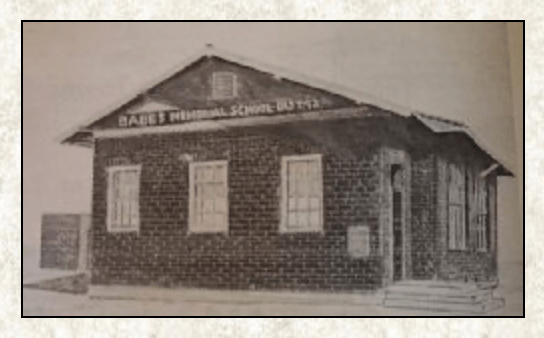
The Christmas Eve Babbs Switch School Fire

This story is pulled from the archives as a celebration for the season edition.

Groff Media 2024© Truth Endures IMDbPro

Presented by benandsteve.com By: Benjamin Groff II©

3–5 minutes

Every year at this time, I am reminded of a harrowing story. It is deeply etched into Oklahoma’s collective memory: the Babbs Switch School Fire of Christmas Eve, 1924. It stands as a tragic lesson in safety, humanity, and resilience.

The Fire

On that bitterly cold night, with heavy snow and sub-zero temperatures, 200 residents gathered. They met in Babbs Switch’s one-room schoolhouse for a Christmas Eve program. The school was tightly packed with engaged couples, grandparents, mothers, fathers, and children. The building’s windows were secured with wire mesh to deter intruders from the nearby railroad tracks. The sole exit—a door that opened inward—would soon become a deadly trap.

The program concluded with a teenage boy dressed as Santa Claus. He handed out toys and candy beneath a cedar Christmas tree. The tree was decorated with paper, tinsel, and lit candles. One of these candles brushed against the tree’s dry needles, igniting it instantly. Mrs. W.G. Boland, whose three children perished that night, later recounted the horror. 

“I tried to beat it out with a paper sack,”

she said, 

“but it did no good.” 

Initially, the crowd laughed, believing the small blaze was being contained. But within moments, the flames engulfed the tree, the ceiling, and the entire structure.

Panic erupted.

The sole exit became a bottleneck as the crowd surged toward the door. Those at the back pushed forward, while the unlucky at the front got crushed in the chaos. Some attempted to pry open the wired windows, but their efforts were futile. Trapped inside, children, parents, and neighbors succumbed to the smoke and flames. Witnesses recalled the horrifying scene of people clawing at the exit. Bodies piled atop one another, and the acrid stench of burning flesh.

The Survivors

Among those who escaped was Lillie Biggers. She crawled out from under a desk clutching a doll she had just received. Her mother, Margaret, managed to get out but suffered severe burns to her hands and arms. Tragically, Lillie’s brothers, William, 9, and Walter, 15, did not survive. The Biggers family’s grief mirrored that of the entire community, where 36 lives were lost—half of them children. The belongings later identified the bodies of William and Walter. They carried a toy gun and a belt buckle.

The injured and deceased were transported to Hobart, the nearest town, where makeshift morgues were set up. The community’s response, known as the “Hobart Spirit,” saw residents drop everything to give aid and comfort. Newspaper accounts likened this effort to the Oklahoma Standard that emerged decades later after the Oklahoma City bombing.

Julie Braun with Mother
Lillie’s Doll That Survived Fire

The Aftermath

The tragedy prompted a wave of reforms. Oklahoma legislators enacted fire safety laws requiring outward-opening doors, multiple exits, and accessible window screens in schools. Open flames were banned, and fire extinguishers became mandatory. The reforms eventually spread nationwide, though it would take more tragedies before they were fully adopted.

The morning after the Babbs Switch School Fire

A Missing Child

The story took a strange twist that turned it into a lingering mystery. Among the victims was three-year-old Mary Edens—or so it was believed. Her aunt, Alice Noah, escaped the building. She died days later. She claimed she had handed Mary to an unknown person outside the burning building. Mary’s body was never recovered, leading her family to hope she had survived.

In 1957, decades after the fire, a woman named Grace Reynolds came forth. She was from Barstow, California. She claimed to be the long-lost Mary. The Edens family reunited with her on Art Linkletter’s House Party television program, believing their prayers had been answered. Reynolds even wrote a book about her experiences. It is titled Mary, Child of Tragedy: The Story of the Lost Child of the 1924 Babbs Switch Fire.

But only some were convinced. A local newspaper editor who investigated the claim questioned its validity. 

Skeptics noted inconsistencies in Reynolds’s story, but no definitive evidence confirmed or debunked her identity. To this day, the truth remains elusive.

Legacy

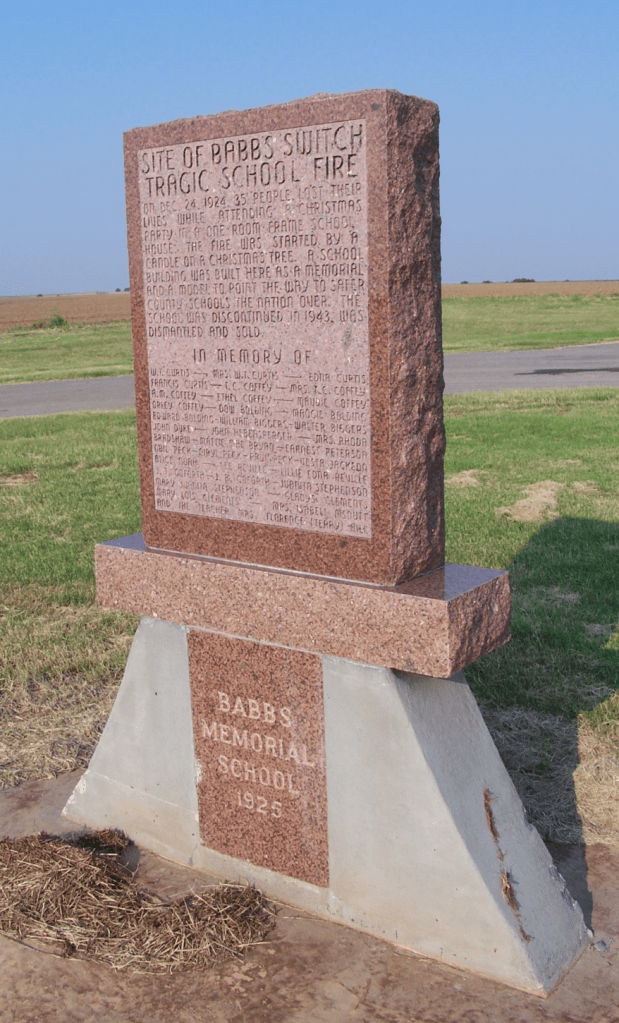
The Babbs Switch School Fire is remembered as one of the deadliest school fires in U.S. history. A stone monument now stands where the schoolhouse once stood, a quiet marker of lives lost and lessons learned. The physical scars of the tragedy have faded. Yet, its memory endures. It serves as a poignant reminder of the fragility of life and our enduring hope for safety and change.

References for this writing can be found at – 

https://blogoklahoma.us/place/394/kiowa/site-of-babbs-switch-tragic-school-fire

https://www.thesirenspodcast.com/post/case-files-babbs-christmas-fire

https://genealogytrails.com/oka/kiowa/babbsfire.html

https://en.wikipedia.org/wiki/Babbs_Switch_fire

Former Zamalek Midfielder Dies in Car Accident at 51

Groff Media ©2025 benandsteve.com Truth Endures

2–3 minutes

🕊️ Mohamed Sabry (1974–2025)

Mohamed Sabry, Former Zamalek Midfielder, Dies at 51

Mohamed Sabry Former Zamelek Midfielder, Dead at Age 51.

The Egyptian football community is deeply saddened to mourn the loss of Mohamed Sabry. He was the former Zamalek and Egypt national team midfielder. He died in a car accident in Cairo’s Fifth Settlement on Thursday. He was 51. Sabry’s untimely passing marks the end of a remarkable life. He dedicated his life to the sport he loved. He helped define it for a generation of fans.

Sabry was a central figure in Zamalek’s golden era throughout the 1990s and early 2000s. This was a decade of triumphs. It cemented the club’s legacy in African football. Between 1993 and 2003, he lifted 15 major titles. These included three CAF Champions League trophies and two Egyptian Premier League championships. Known for his fierce determination, vision, and leadership on the pitch, Sabry was instrumental. He led Zamalek through some of its most celebrated victories. He earned admiration from teammates, opponents, and supporters alike.

Mohamed Sabry

After news of his passing, tributes poured in from across Egypt and beyond. Zamalek icon Mahmoud Abdel-Razek “Shikabala” described Sabry as “a legend of Egyptian football.” He also called him “a symbol of loyalty and devotion to his club and supporters.” His words reflected the views of many who admired Sabry for his exceptional talent. They saw him as a model of dedication and humility. Fans, former teammates, and rival clubs alike joined in remembering a man whose passion for football transcended the game’s rivalries.

Condolences also came from key figures within Egyptian football. Hossam Hassan, the national team coach, offered his sympathy to Sabry’s family. Al Ahly president Mahmoud El Khatib also conveyed his condolences to the wider football community. Tributes continue to flow. Mohamed Sabry will be remembered as one of Zamalek’s most influential midfielders. His achievements, sportsmanship, and loyalty to his club left an indelible mark on Egyptian football history.


Groff Media ©2025 benandsteve.com Truth Endures

Mohamed Sabry (1974–2025): Remembering a Zamalek Legend

The Island – A Serialized Dystopian Story * Chapter Seven

2–3 minutes

Haven’s Reach: The Fracture Extended

By the time autumn winds rolled across Haven’s Reach, something in the air had shifted. The Council’s decrees were no longer whispered with unease. They were shouted from wooden platforms. The decrees were painted on walls and nailed to doors. “Obedience is Freedom,” one sign read. “Order Before All,” declared another. The rules had once been tolerated as minor irritations. Now, they pressed down like a boot on the neck of the people.

It began with curfews. Families were ordered indoors at dusk, lanterns extinguished by the ninth bell. Then came the bans. First, there was one on foreign books. Next, gatherings of more than five were forbidden. Finally, music played in public squares was banned. One by one, pieces of life that had once defined Haven’s Reach fell away. The Council insisted it was “for safety.” But everyone knew better—fear was safer for rulers than for the ruled.

Harper saw it most clearly when her younger brother, Eli, vanished. One evening, he was at the bakery kneading dough by her side. The next morning, his cot was empty. Blankets were folded neatly as though no one had ever lived there. Whispers reached her ears: Eli had spoken too freely about the Council in the market, and someone had reported him. Now he was “detained for questioning.” No one who had been questioned ever came home the same.

Harper’s grief sharpened into something more complex. She began wandering beyond her bakery’s door after curfew, listening at corners, watching shadows. That’s how she stumbled across The Quiet Ones. It was a ragtag circle of neighbors, merchants, and teachers. They took it upon themselves to preserve what the Council feared most: memory. They hid forbidden books in flour sacks. They scribbled children’s rhymes on the backs of ledgers. They whispered songs under their breath in defiance.

When Harper revealed her brother’s name, the Quiet Ones did not look away. An older man with ink-stained hands touched her shoulder and said, 

“You’re one of us now, whether you meant to be or not. The fight isn’t about one boy. It’s about all of us.”

The fracture had come—not just between ruler and ruled, but within the people themselves. Some chose silence and survival. Others, like Harper, chose risk and resistance. Haven’s Reach was no longer simply an island under rule. It was a tinderbox, waiting for a single spark to ignite.


By Benjamin GroffMedia© | benandsteve.com | ©2025

October 10 in History: Key Milestones and Cultural Impact

3–4 minutes

Oct 10th a good day for history
How history can pile up on any day of the year.

How did we arrive at our current state? It is a question a lot of people are asking. It didn’t happen all at once. Getting to where we are, was forever in the making. Before anyone alive today was here. There have been people making decisions, some not so great. Life happens. It is a popular saying for some people. And as you can tell through this date in history. October 10th was a great day for history to be set. It doesn’t explain everything that has happened. But it does give one an idea of how history can pile up on any given day.

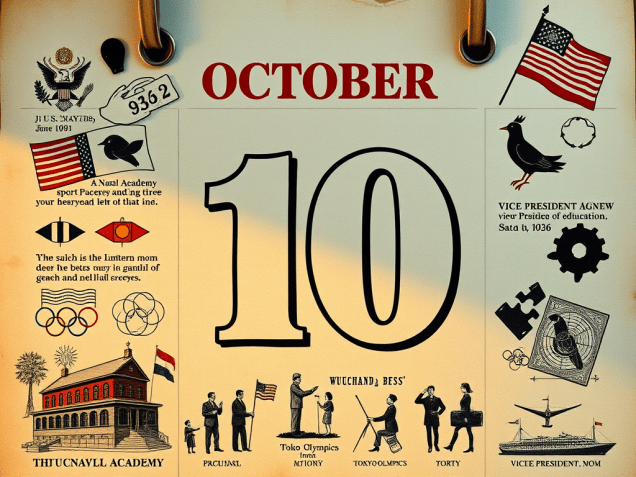
Here’s an evocative image of a calendar marking October 10. It serves as a visual prompt for a day rich in history. This day includes milestone events and global observances.

  1. 1845 – U.S. Naval Academy Founded
    • In Annapolis, Maryland, the Naval School opens with its first class of 50 midshipmen. This event lays the foundation for the modern U.S. Naval Academy.(1)
  2. 1911 – Wuchang Uprising Ignites Revolution This bold move sets the stage for the fall of China’s Qing dynasty. It also leads to the emergence of the Republic of China.(2)
  3. 1935 – ‘Porgy and Bess’ Debuts on Broadway
    • George Gershwin’s groundbreaking opera, featuring an all-Black cast, premieres to widespread acclaim.(3)
  4. 1964 – Tokyo Olympics Start: A Global Broadcast
    • Making history, these Summer Games are the first to be televised live worldwide.(4)
  5. 1973 – Vice-President Agnew’s Resignation
    • Spiro Agnew steps down amid tax evasion charges, a rare and dramatic political moment in U.S. history.(5)

October 10, 1973: A Domino That Changed the Presidency

On October 10, 1973, U.S. Vice President Spiro T. Agnew resigned in disgrace. He pleaded no contest to tax evasion charges. These charges stemmed from a bribery scandal dating back to his time as Maryland’s governor. A sitting Vice President had never stepped down under criminal accusations before. This event sent shockwaves through American politics.

The resignation created an immediate power vacuum. Under the 25th Amendment, passed just six years earlier, President Richard Nixon was capable of nominating a new Vice President. His choice was Michigan Congressman Gerald R. Ford, a steady Republican leader respected across party lines. Congress confirmed him in December 1973, setting in motion a sequence of events no one predicted.

Only months later, the Watergate scandal deepened. Nixon’s credibility unraveled under the weight of investigations into the cover-up of the break-in at the Democratic National Committee headquarters. With impeachment looming, Nixon resigned on August 9, 1974—the first U.S. president to ever do so.

In that instant, Gerald Ford became president. He told the American people in his swearing-in speech: 

“Our long national nightmare is over.” 

Ford’s ascent to the Oval Office was accidental. He became the only person to serve as both Vice President and president without being elected to either office.

Looking back, it’s clear that Agnew’s resignation on October 10 wasn’t just a scandal. It was a turning point in American history. Had he remained Vice President, Agnew—not Ford—would have been next in line when Nixon resigned. The nation, already reeling from Watergate, faced the reality of a president tainted by his own corruption charges. Instead, Ford’s calm, if brief, presidency offered a bridge back to stability.


👉 OCTOBER 10, 1973 stands as proof of how a single resignation reshaped the presidency. It altered the line of succession. It changed the course of American political history.

October 10 is more than a date—it’s a living mosaic of pivotal moments, human emotion, progress, and remembrance. It reflects how history shapes us and how we, in turn, continue writing it.

By Benjamin GroffMedia© | benandsteve.com | ©2025 

Leif Erikson Day: Honoring Exploration and Heritage and World Post Day Both From A Very Long Time Ago – Especially Now!

2–3 minutes

October 9 is more than just a date on the calendar. It’s a day rich with meaning. The day celebrates global communication. It also honors the spirit of exploration. Here are two powerful ways this day reminds us of human connection:


In 1874, the Universal Postal Union (UPU) was founded in Switzerland. This event marked the beginning of the modern era of global communication. Today—World Post Day—we honor the postal service’s vital role in connecting communities, families, and hearts across the globe. Post offices celebrate with stamp exhibits, open houses, and even letter-writing competitions for young people. (1)


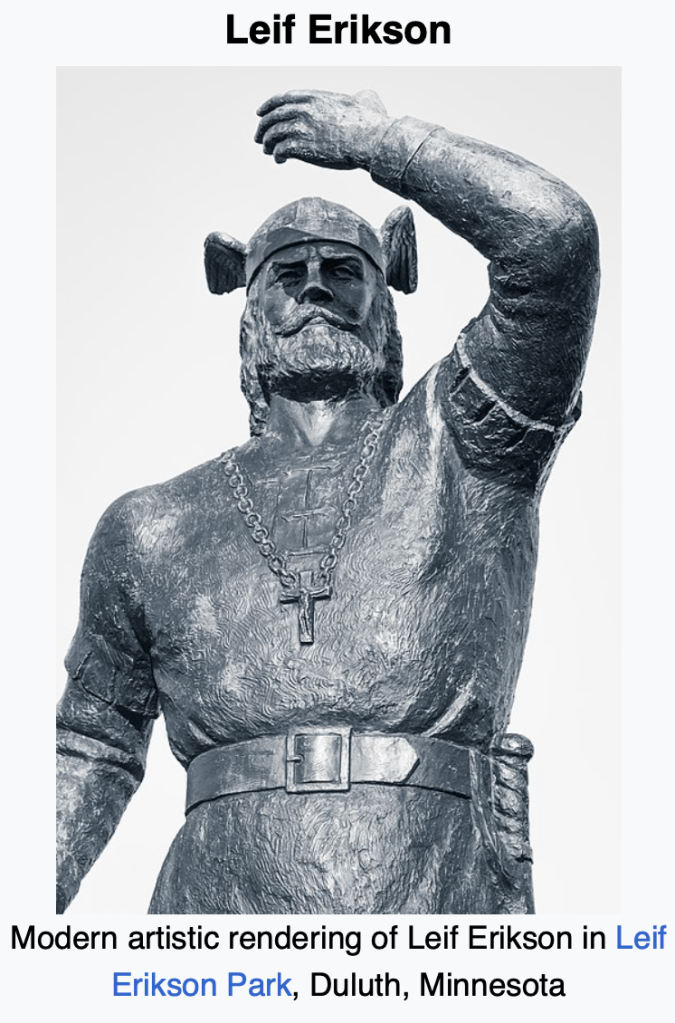
Leif Erikson Day is also celebrated today. This day honors the Norse explorer. He is believed to be the first European to reach North America. Established in the early 20th century and federally recognized in the U.S. in 1935, the day is especially cherished in communities of Nordic heritage. It’s a celebration of bravery, curiosity, and the timeless call of new frontiers.(2)

In 1929, the Wisconsin Legislature passed a bill to make 9 October “Leif Erikson Day” in the state. In the years after, several other states adopted laws to celebrate the day.[81] In 1935, legislation was introduced to the United States Congress requesting federal observance of the day. Before the legislation was passed, it was amended so that the observance would only occur in 1935. [82]  Which it was, after a proclamation that year by President President Franklin D. Roosevelt).[83] In future decades, many attempts to pass legislation were unsuccessful. They sought to have Leif Erikson Day proclaimed annually by the president.[84]Proponents eventually succeeded. In 1964, the Congress authorized and requested the president to proclaim 9 October of each year as “Leif Erikson Day”.[19]In the years since, each president has issued an annual proclamation calling for observance of the day.[85]. (3)


These historic observances brought to mind a personal story I experienced just last weekend:

Visiting the grocery store, I ran into a long-forgotten neighbor—someone I’d only exchanged waves with in passing. We chatted by the fruit stand for several minutes, sharing news, laughter, and even some life advice. When I left, I carried more than groceries. I carried renewed warmth. It was a reminder that connection doesn’t have to be epic to be meaningful.


  • Send a letter or thank-you note—traditional or digital. Let someone know how much they matter.
  • Reach out to someone you haven’t spoken to in a while. A simple chat can rekindle connection.
  • Think about exploration—big or small. Whether learning something new, trying a recipe, or visiting a new place, celebrate the courage that brought you there.

On this October 9, let’s honor our past. Let’s look ahead with open hearts. We will celebrate the small connections that make life rich and whole. Especially if countries around the world are shipping to America again. If not, keep an eye on history. It happened once. It will happen again. Maybe.


By Benjamin GroffMedia© | benandsteve.com | ©2025 

Riding The Lie Down The Elevator

1–2 minutes

The Lie in the Elevator

It began as nothing more than a joke. A character on television—smug, ridiculous—coasted down an elevator while declaring something so absurd that everyone laughed. It was too silly to be taken seriously, too exaggerated to live beyond the moment.

But no one challenged it. And why would they? It was just a laugh, a one-liner, a small puff of smoke that seemed harmless. Yet smoke drifts. It clings. The joke became a line repeated at dinner tables, then in office chatter, then across social media. What started as comedy grew like a weed, tangled and persistent.

You knew it was a lie. You knew from the very beginning. But saying something meant being the one to ruin the joke, the one to argue when everyone else was smiling. It was easier to let it go. Easier to think, Surely this will fade away.

Except it didn’t. The lie ballooned. It threaded itself into conversations, policies, schools, and pulpits. Suddenly your neighbors were quoting it as if it explained the world. Your family repeated it without hesitation. They did not repeat it because they believed it. They found it easier than fighting for the truth.

And now here you are. Watching as the lie isn’t just smoke anymore—it’s a fire, raging and indiscriminate, swallowing millions in its path. The streets fill with people repeating the words that started as a smirk on an elevator ride. And they look to you, because they trust you. Because they think you see what they see.

But you don’t. You know better.

The question is no longer whether the lie is funny. The question is whether you will stand against it now. It is late, but not too late. Otherwise, silence will make you part of it.

What would you do?


By Benjamin GroffMedia© | benandsteve.com | ©2025

Warning Signs: What Recent Shootings Reveal About America’s Pressures

4–6 minutes

When Politics Turns Deadly: What Recent Shootings Reveals About America’s Pressures

Political Violence in the U.S.: A Historical Lens Political Pressure Pots That Are Exploding

On September 10, 2025, conservative activist Charlie Kirk was fatally shot while speaking at Utah Valley University. The attack shocked audiences nationwide and revived a painful question: Is political violence becoming more common in the United States? While the details of this case continue to unfold, history offers context. The Kirk shooting is tragic, but it’s not unprecedented—political assassinations and attacks have occurred before. Understanding that history can help us prevent future violence.

Throughout U.S. history, public figures have been targeted for their beliefs, activism, or positions of power. These events—though rare—often show deep social, political, or cultural tensions. Below is a timeline of key moments, followed by how they compare to today.

Year / Victim / Role / Context / Motive

On April 14, 1865, Abraham Lincoln, the U.S. President, was assassinated by John Wilkes Booth, a Confederate sympathizer.

1901 William McKinley, U.S. President, was killed by anarchist Leon Czolgosz.

1935 Huey Long, U.S. Senator / LA Governor, was shot by Carl Weiss amid political turmoil in Louisiana.

1963 Medgar Evers, a Civil Rights Activist, was shot outside his home for his activism in Mississippi.

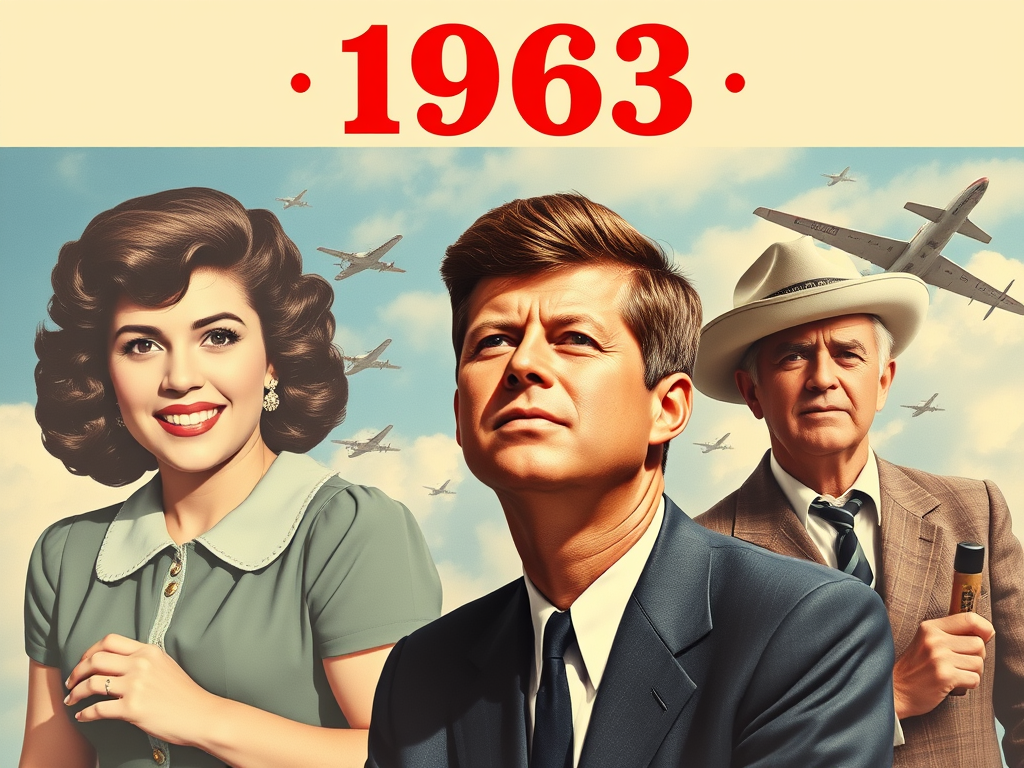
In 1963, President John F. Kennedy was assassinated while riding in a motorcade in Dallas, Texas. Lee Harvey Oswald was arrested for the crime. He was shot and killed by Jack Ruby before standing trial. The official record names Oswald as the lone gunman. The motive has remained an issue of widespread debate and speculation for decades.

1965 Malcolm X, a Civil Rights Leader, was killed during a public speech in Harlem.

1968 Robert F. Kennedy, the Presidential Candidate, was shot after a campaign rally in Los Angeles.

On April 4, 1968, Dr. Martin Luther King Jr.—American Baptist minister, civil rights leader, and Nobel Peace Prize laureate—was assassinated. He was standing on the balcony of the Lorraine Motel in Memphis, Tennessee when it happened. James Earl Ray, an escaped convict, was arrested for the murder two months later and later pleaded guilty. Ray claimed he was part of a larger conspiracy. He later tried to recant his confession. Nonetheless, the official record names him as the assassin. The motive remains the topic of debate. King led the civil rights movement. He opposed systemic racism. These actions made him a frequent target of threats and hostility.

1969–70s Various bombings & shootings Political & protest-related Weather Underground, far-right and far-left extremist groups.

2011 Gabrielle Giffords (survived), U.S. Representative, was shot at a constituent event in Arizona; six others were killed.

High profile, targeted instances of political violence

Charlie Kirk shooting*

Killed

Orem, Utah

Kirk was shot and killed while speaking at an event on the campus of Utah Valley University. Kirk was a well-known conservative activist who founded Turning Point USA.

Sept. 2025

*Officials have not confirmed that the shooting was politically motivated.

*Officials have not confirmed that the shooting was politically motivated.

Minnesota lawmaker shootings

2 killed, 2 injured

Minneapolis, Minnesota

A gunman targeted several Minnesota election officials. He killed Minnesota House of Representatives member Melissa Hortman and her husband Mark Hortman in their home. State Sen. John Hoffman and his wife Yvette Hoffman were shot and injured in their home.

June 2025

Minnesota lawmaker shootings

Two killed, two injured

Minneapolis, Minnesota

A gunman targeted several Minnesota election officials. He killed Minnesota House of Representatives member Melissa Hortman and her husband Mark Hortman in their home. State Senator John Hoffman and his wife Yvette Hoffman were shot and injured in their home.

June 2025

Minnesota lawmaker shootings

Two killed, two injured

Minneapolis, Minnesota

A gunman targeted several Minnesota election officials. He killed Minnesota House of Representatives member Melissa Hortman and her husband Mark Hortman in their home. State Senator John Hoffman and his wife Yvette Hoffman were shot and injured in their home.

June 2025

Pennsylvania Gov. Josh Shapiro’s home arson

No injuries

Harrisburg, Pennsylvania

The Pennsylvania Governor’s Residence was set on fire while Shapiro and his family slept inside.

April 2025

Pennsylvania Gov. Josh Shapiro’s home arson

No injuries

Harrisburg, Pennsylvania

The Pennsylvania Governor’s Residence was set on fire while Shapiro and his family slept inside.

2025 Charlie Kirk, Conservative Activist, was shot while speaking at Utah Valley University; investigation ongoing.

Timeline of Notable Political Murders And Attacks In The U.S. (1865-2025)
  • Public Rhetoric Matters: In nearly every case, rhetoric and polarization preceded the violence.
  • Violence Rarely Comes From Nowhere: These events are almost always linked to broader grievances, social tensions, or extremist ideologies.
  • Modern Amplifiers: Today’s social media, 24/7 news, and intense partisanship can supercharge grievances faster than in past eras.

The Kirk shooting reflects how quickly divisions can escalate. This happens when marginalized or politically active groups feel threatened. It also occurs when public discourse frames opponents as existential enemies. Left unchecked, the result can spill over from online posts and protests into public spaces and deadly attacks.

History shows that violence rarely ends the debate—it deepens it. The antidote is not silence but inclusion, dialogue, and guardrails on how we treat one another, even when we disagree.

The U.S. is not doomed to repeat its worst moments, but it does need to recognize them. Political violence grows where alienation and fear fester. The Charlie Kirk tragedy, like earlier assassinations, should not only shock but also instruct. By confronting polarization and reinforcing democratic norms, communities can prevent these cycles from repeating.


About the Author:

Benjamin Groff is a former police officer and radio news anchor. He has hosted programs for CNN and ABC News affiliates in Colorado and Wyoming. His career in law enforcement began in 1980 and lasted more than two decades. This gave him firsthand insight into the criminal mind and public safety. Moreover, it provided him with an understanding of the human stories that often go untold. His writing draws on these experiences, blending street-level truth with a journalist’s eye for the bigger picture.

By Benjamin GroffMedia© | benandsteve.com | ©2025 

The Power of Actuality Reporting in Journalism

1–2 minutes

I came across this news report and was genuinely impressed by its craftsmanship. The reporter doesn’t just tell the story. They show it. They use actuality reporting and a wraparound technique that gives the piece depth and authenticity. It’s the type of journalism that doesn’t just inform—it immerses you. This level of storytelling should be seen and appreciated by more people.

Man From MRI Accident – Update

A sad update, the man in a report here a few days ago has died.


61‑year‑old Keith McAllister died after being violently pulled into the MRI scanner at Nassau Open MRI in Westbury, Long Island. He entered the MRI room on Wednesday, July 16, while his wife was undergoing a knee scan. McAllister wore a heavy-weight-training chain (~9–20 lb/4–9 kg) around his neck. Despite prior discussions about the chain with staff, he was allowed in.

When he approached the machine, the strong magnetic field latched onto the chain, yanking him into the scanner. His wife and the technician attempted to free him, but he collapsed in her arms. She recounted shouting, “Turn this damn thing off! Call 911!”.

McAllister was rushed to the hospital, where he suffered multiple heart attacks and was pronounced dead on Thursday, July 17. His wife emotionally described the moment: “He went limp in my arms… I can’t wrap my head around it”.

The Nassau County Police Department is investigating the incident, and experts are emphasizing the critical need for strict MRI safety protocols, especially regarding metal screening. Past tragedies—including a 2001 case involving a child and an oxygen tank—highlight the grave risks of metallic objects around MRI machines.

Summary of key points:

Victim: Keith McAllister, 61

Date of incident: July 16, 2025 (MRI room event)

Date of death: July 17, 2025 (hospital)

Cause: Pulled into MRI by heavy metal chain (~9–20 lb)

Response: Wife and technician tried to assist; police are now investigating

Safety concern: Highlights critical importance of enforcing metal screening protocols

www.cnn.com/2025/07/20/health/mri-machine-death-long-island

From the Pages of History: July 11, 1955 — “Nightfall Over Wichita”

By Benjamin GroffMedia© | benandsteve.com | 2025 Truth Endures©

1–2 minutes

Wichita, Kansas – July 11, 1955

The heat had been unrelenting for days. By the evening of July 11th, something darker than the weather was brewing in the Kansas sky. Just after 6:30 p.m., local news reports began buzzing with concern. A fast-moving system was developing west of the city. Radar, still new technology for military meteorologists, was showing rotation in those days it wasn’t shared like it is now.

At 7:04 p.m., a Category F4 tornado touched down near the town of Udall, Kansas. It was the same town that had been devastated just two months earlier in the deadliest tornado in state history. This one skirted the more populated areas. Still, damage was widespread. Barns were flattened, power lines twisted, and wheat fields scraped bare. Miraculously, only minor injuries were reported. Many locals said they were prepared this time, keeping radios on and basements cleared after the trauma of May 25.

The Wichita Eagle published a late edition the next morning. The headline read

“Twister Brushes Wichita – City Spared, Farms Not So Lucky.” 

File Photo

A black-and-white photo captured a twisted silo lying like a crushed can under a red-orange sunrise.

Looking back, July 11, 1955, was a reminder that in the American Midwest, nature rarely knocks. It kicks in the door, and you learn to be ready.

What the world needs now? Is Love Sweet Love! It isn’t too late for the United States?

By Benjamin GroffMedia© | benandsteve.com | 2025 Truth Endures©

2–3 minutes

The most significant cultural threat to occur in my lifetime is occurring as I write today. It deals with our nations stability. The threat to our democracy doesn’t come from a single event—it happens every day. It happens when we ignore what’s unfolding in our city councils, our state legislatures, and in the halls of Congress. It happens when we assume that honorable people are safeguarding our federal institutions.

That complacency is how we arrived at the crisis point we face in 2025.


In the early 1970s, President Richard Nixon was implicated in one of the greatest political scandals in U.S. history: Watergate. His aides admitted to orchestrating a break-in at the Democratic National Committee headquarters. They attempted to steal information to sabotage a political opponent. The House of Representatives held impeachment hearings. Nixon was on the brink of being impeached. He resigned before the Senate took up the case. He was never prosecuted—pardoned instead by his successor, Gerald Ford. That decision set a precedent: presidents commit crimes without real consequence.


Had Nixon faced justice, we wouldn’t be watching the unraveling of the United States today. In 2025, we are witnessing a troubling surge of pro-white nationalist influence within our government. Supremacist ideologies are fueling misinformation campaigns and choking the truth that help heal and unite our country. This is one of the most perilous chapters in our nation’s history. It spells the end of the United States as we have known it.

Ulrich Groff I.


Ironically, the Groff family once fled an oppressive regime in the 1850s, seeking liberty and justice in America. Now, in a cruel twist of history, a direct descendant of Ulrich Groff I —faces a difficult consideration. Will he see himself returning to the very region his ancestors left in search of freedom. Or hope for a miracle. We must not allow the hard-won promises of our democracy to slip away through silence and inaction.

What the world—and especially the United States—needs now is love, sweet love. Not the kind that’s fleeting or sentimental. It should be the steady, courageous kind that listens more than it lectures. It seeks understanding over dominance. Our nation was once bound together by a shared belief in the promise of unity. Now, it is splintered by division. Mistrust and fear further divide us. Political rage, social distrust, and cultural isolation have made enemies of neighbors and strangers of friends.

But love, in its truest form, has the power to mend what anger tears apart. It begins with kindness in daily life—treating others with respect, even when they disagree with us. It grows in empathy—stepping into anothers shoes rather than judging them from afar. If we can choose love over fear, we can start to heal this fractured country. Hope must prevail over hate. Connection should be preferred over separation. This healing won’t happen overnight. It will occur heart by heart, one act at a time.

Understanding U.S. Immigration Raids: Obama vs. Trump

By Benjamin GroffMedia© | benandsteve.com | 2025 Truth Endures©

2–4 minutes

I received a question yesterday about the United States. They asked why so many people are up in arms over the current immigration raids taking place across the country. Especially after President Obama, during his term in office, removed over 3 million undocumented individuals. Many of whom they claimed never had a hearing. 

I wanted to conduct some research to learn more about it for myself. 

Understanding Immigration Enforcement: Obama vs. Trump

During his eight years in office (2009–2017), President Barack Obama led an administration that deported over 3 million noncitizens. These deportations were conducted through formal removal proceedings. A formal removal involves a legal process. This process results in a court order for deportation from the United States.

If we include “returns”, the total number of departures exceeds 5 million under the Obama administration. These returns are cases where individuals either voluntarily left the country or were denied entry at the border. They agreed to withdraw their application to enter. Many of those individuals were turned away at the border before ever entering the U.S. Because they were not formally admitted into the country, they were not entitled to a court hearing. These actions, while recorded as enforcement events, differ significantly from deportations after internal apprehensions.

It’s important to note that Obama’s enforcement focused heavily on border security. It prioritized the removal of individuals with serious criminal records. Despite this, he faced criticism from immigrant rights advocates for the high number of deportations. At the same time, Republicans attacked him for not doing enough to secure the border.

In contrast, the Trump administration adopted a far more aggressive and indiscriminate approach. Immigration and Customs Enforcement (ICE) agents under Trump routinely apprehended individuals from homes. They were also taken from workplaces, schools, churches, or even while walking with family. Many were detained without prompt access to legal counsel. They were transferred long distances from their communities. In some cases, they were deported without ever appearing before a judge. This represented a sharp departure from the enforcement priorities of earlier administrations.

It’s worth remembering that President Obama did not pursue mass interior deportations without due process. He implemented programs like DACA (Deferred Action for Childhood Arrivals). These programs offer relief to specific undocumented individuals who were brought to the U.S. as children.

Obama never had to use the military. He deported nearly 8 million non-documented individuals. This includes those he sent back and others never allowed in through customs at airports, ports of entry and borders. He used the border patrol and immigration officials on a budget provided by Congress. Trump has spent more on advertising. He talks about what he is going to do or what he has done. This spending is more than any earlier administration spent deporting a person. He has had to send in the National Guard and Marines. As of this report, 118 immigrants have been apprehended in Los Angeles. It is true they will not get a hearing if their incarceration follows the path of others.

I want to thank the person who asked to stay anonymous for bringing this issue to our attention. It’s vital to understand the differences in immigration enforcement approaches. While no administration is perfect, how a President handles immigration reflects not just policy but a nation’s values.

There has to be a better way!

When Radios Fell Silent: The 1978 Trooper Tragedy

By Benjamin GroffMedia© | benandsteve.com | 2025 Truth Endures©

4–6 minutes

The Day the Radios Fell Silent: A Personal Account of May 26, 1978

It was a warm May morning in 1978. I was 15 years old, working the phones at my dad’s office at Camp Red Rock in western Oklahoma. For several days, law enforcement radio traffic had been intense—more active than usual, more urgent. Something serious was happening.

An All-Points Bulletin had been issued statewide: two inmates had escaped from the Oklahoma State Prison in McAlester. They were described as extremely dangerous men, capable of committing horrific crimes. The Oklahoma Highway Patrol (OHP) and local authorities launched a massive manhunt, focusing on the southeastern region of the state. While there were scattered reports from other areas, the belief was that the fugitives remained nearby and on foot.

Trooper Houston F. “Pappy” Summers,
Motor Vehicle Inspection (MVI) Division in Enid.

Still, troubling reports emerged—houses broken into, firearms stolen, and even a car gone missing. An army of troopers scoured the countryside. The fugitives had to move carefully, methodically, to avoid detection. The search had only been underway for days, but it felt like weeks.

May 26, 1978, arrived. It would become one of the darkest days in the history of the Oklahoma Highway Patrol.

Although I was hundreds of miles away from the action, the search was broadcast live to my ears. The ranger office where I worked was equipped with radios that picked up all law enforcement frequencies. I heard it all: the calls, the coordination, the chaos.

Trooper Billy G. Young, Woodward MVI detachment.

That morning, a somber message came over the radio from Highway Patrol District Headquarters:

“Attention all stations and units: All nets are 10-63 until further notice.”

In plain terms, this meant that the radio network was reserved exclusively for emergency traffic related to the escapees. No unnecessary chatter. But maintaining a “10-63 net” requires constant reinforcement. Officers rotate shifts. New dispatchers come on duty. Without reminders, the rule starts to fade, and soon enough, radio traffic returns to normal. That’s exactly what happened.

As the air unit tried to communicate with ground teams, their messages were drowned out by unrelated conversations. Then, something chilling unfolded.

Lieutenant Pat Grimes,
Internal Affairs.

I listened in real time. The air unit tried to warn a team of troopers. They had approached a area. The escapees were hiding—just beyond the trees, lying in wait. The troopers, thinking it was a routine check, got out of their car casually. Suddenly, gunfire erupted. It was an ambush.

One of the troopers managed to retreat to his vehicle and tried to call for backup. The air unit, having seen everything from above, struggled to get through. The radio frequencies were jammed with idle chatter. It was a communications nightmare that have cost lives.

I sat there, helpless, listening to the air unit reporting the tragedy to headquarters. The dispatcher pleaded for all units to clear the net so emergency aid is dispatched. I was stunned—devastated. This moment became a lasting lesson in why radio discipline can be a matter of life and death.

Later that day, I was shocked again—two more troopers had been shot in the same area. And then, I heard the message that signaled the manhunt was over:

“Be advised, the search for the escapees is over. All units and stations can return to regular assignments.”

That phrase said it all. The escapees were no longer a threat. They hadn’t been captured—they were dead. Had they been taken alive, the dispatch would have named the unit responsible for their arrest.

The Fallen

Three troopers lost their lives that day:

  • Trooper Houston F. “Pappy” Summers, 62, a 32-year veteran stationed with the Motor Vehicle Inspection (MVI) Division in Enid.
  • Trooper Billy G. Young, 50, with 25 years of service, attached to the Woodward MVI detachment.
  • Lieutenant Pat Grimes, 36, from Internal Affairs, nearing his 12th year with the Patrol.

Summers and Young died in a gunfight on a rural road near Kenefic. This occurred after the escapees stole a farmer’s truck and weapons. The troopers, unaware of what they were driving into, were ambushed.

Later that day, in the small town of Caddo, Lt. Grimes and his partner, Lt. Hoyt Hughes, were searching a residential area when they, too, came under fire. Grimes was fatally shot. Hughes was wounded but managed to exit the vehicle and return fire at close range, killing one of the fugitives.

Just moments later, Lt. Mike Williams of the Durant detachment arrived. He fatally shot the second escapee. This action brought an end to a 34-day reign of terror that had stretched across six states.

The two escapees caused the deaths of eight people. This number includes the three troopers. They also injured at least three others during their violent run from justice.


Final Thoughts

What I heard that day shaped me. During my time in the police academy, I learned something important. My account of the events closely aligned with what was eventually confirmed. The tragedy of May 26, 1978, became a case study. It highlighted the importance of radio discipline. The event also emphasized operational coordination and situational awareness.

But for me, it was more than that. It was personal. I was there—listening. And I will never forget the sound of silence that followed.

Jason Conti’s Impact on MLB History

January 27, 1975 – May 17, 2025

By Benjamin GroffMedia© | benandsteve.com | 2025 Truth Endures©

1–2 minutes

Jason Conti, AZ Diamondbacks

Stanley Jason Conti was a former Major League Baseball outfielder. He was known for his defensive prowess. He contributed to several MLB teams. Conti passed away on May 17, 2025, his cause of death has not been disclosed.

Conti was born on January 27, 1975, in Pittsburgh, Pennsylvania. The Arizona Diamondbacks drafted him in the 32nd round of the 1996 amateur draft. He came from the University of Pittsburgh. He made his highly anticipated MLB debut with the Diamondbacks on June 29, 2000, filled with excitement and promise. He played for the Tampa Bay Devil Rays, Milwaukee Brewers, and Texas Rangers over a five-year major league career. Known for his strong throwing arm, Conti made memorable defensive plays. He threw out Atlanta’s Brian Jordan at third base on consecutive nights. He also gunned down Chicago’s Frank Thomas at home plate in back-to-back games. He appeared in 182 MLB games, recording a .238 batting average with six home runs and 47 RBIs.

After his time in the majors, Conti continued his baseball career in the minor leagues, even taking his talent overseas. He played in Italy for the Bologna Italieri of the Series 1-A Championship League during the 2007 season. His performance on the field showcased his skills on a global stage.

Conti’s passion for baseball and his memorable moments on the field left a lasting impression on fans and teammates alike. He is remembered for his athletic achievements and unwavering dedication to the sport, a commitment that inspired many.

He is survived by his family, friends, and countless fans who appreciated his contributions to baseball.


A memorial service will honor Jason Conti’s life and career.

Learn About The Lady In Mickey Gilley’s Song – The Girls All Get Better At Closing Time.

‘I know Robert Redford, even Lola Hall…’

By Benjamin GroffMedia© | benandsteve.com | 2025 Truth Endures©

4–6 minutes

Lola Hall: Oklahoma’s Weather Girl Who Became a Legend

In the heart of America, television was becoming the central storyteller of the modern household. During this time, one woman in Oklahoma City quietly became a beloved figure. She was cherished across living rooms, farms, and small-town diners alike. Her name was Lola Hall, the poised and personable weather girl for KWTV Channel 9. Through the 1960s and 1970s, Lola transitioned from forecasting the weather. She began anchoring the morning news. She carved out a legacy of warmth, professionalism, and unexpected celebrity.

A Humble Start on Channel 9

Lola Hall wasn’t born into the limelight. She was raised in Oklahoma. She considered herself an ordinary woman. “I’m just a plain girl with a good work ethic,” she once said. She never imagined she would become a fixture in households across the state. She also didn’t foresee that her name would one day be immortalized in a hit country song.

She started at KWTV in the early 1960s. Television was still finding its footing then. Local personalities were becoming stars in their own right. Initially billed as a “weather girl,” a common term at the time, Lola did more. She did more than point at cloud symbols and smile at the camera. She brought a genuine understanding of weather patterns. Her calm demeanor during storms was notable. She had a natural charisma that made viewers trust her.

The Weather Girl also known as the Weather Lady, and Lola Hall

Lola quickly stood out not only for her delivery but for her grounded, approachable nature. She didn’t talk down to viewers or play a character. She was simply Lola — smart, steady, and relatable.

Rising to Anchor the Morning News

As her popularity grew, so did her responsibilities. By the early 1970s, Lola earned a promotion to co-anchor the morning news. This was a significant achievement for a woman in broadcasting. In that early morning slot, she became the face viewers saw as they sipped coffee. People watched her while packing school lunches. They prepared for long days on the farm or at work.

Her calm voice and natural empathy helped set the tone for the day. But it wasn’t a solo act.

Near the end of her career, she welcomed two of Oklahoma’s most trusted newsmen. Bill Haire and Wayne Lyle joined her on the morning show. Both were widely respected for their skill in agricultural reporting — essential content for Oklahoma’s large farming population. The trio became a necessary part of daily life for rural viewers. Farmers tuned in for weather and headlines. They also relied on Bill and Wayne for dependable reports on crop forecasts. Their reports covered market conditions and farming trends.

Lola, Bill, and Wayne worked together to form an Oklahoma morning news trifecta. They delivered information with clarity, sincerity, and a deep respect for their audience. They weren’t just broadcasters; they were neighbors.

A Country Music Cameo

But, Lola’s story wouldn’t be finished without an interesting twist. One of her career’s most surprising moments was an unexpected brush with country music fame.

Lola Hall, KWTV Channel 9′s beloved weather girl and morning news anchor, pictured during a 1970s broadcast. Her calm presence and signature charm made her a household name across Oklahoma.

During an interview with country star Mickey Gilley, Lola found herself momentarily flustered. Gilley, known for chart-topping hits and honky-tonk swagger, was in Oklahoma City promoting his music when he confessed on air.

He told Lola that back in his younger days, he grew up in rural east Texas. KWTV Channel 9 was one of the few stations they could pick up. And Lola Hall, with her grace and good looks, was a celebrity to the local boys.

“You were the hottest thing we’d ever seen,” 

Gilley smiled, adding that Lola had made such an impression that he mentioned her by name in his song.

 “The Girls All Get Prettier at Closing Time.”

For a brief moment, Lola lost her composure — laughing, blushing, and turning to the crew off-camera. It was a rare crack in her usually calm exterior, and viewers loved it. She quickly recovered, continuing the interview with her usual charm, but later admitted she was shocked.

“I thought I was just the girl telling them to grab an umbrella,” 

She joked.

A Lasting Legacy

Lola Hall stepped away from the news desk eventually. She left behind a legacy built not on flash or fame. Instead, it was built on trust, relatability, and professionalism. During an era when women in broadcasting often had to work twice as hard, Lola rose through the ranks. Her long-lasting connection with viewers stood as a quiet revolution.

She may never have considered herself glamorous. She may not have thought of herself as remarkable. But, to thousands of Oklahomans—and at least one country legend—she was both.

You know it each time you hear the song and Gilley sings the line,

“I know Robert Redford even Lola Hall!”

Lola Hall wasn’t just the weather girl. She was part of the fabric of Oklahoma life. Her name, her voice, and her smile are still remembered by those who welcomed her into their homes each morning.

For a personal take on her career click here and be taken to an interview with Lola Hall!

To truly dive into the story of Lola Hall and other trailblazing women of the 1950s and ’60s, prepare yourself. They were often known then as “weather girls.” Grab your favorite refreshment and settle in. This captivating podcast offers a rich glimpse into their rise to popularity. Back in the day, we just called it a recording—but whatever the name, you’re in for something special.

From Cotton Fields to Sheriff: The Story of Jess Bowling

By Benjamin GroffMedia© | benandsteve.com | 2025 Truth Endures©

4–5 minutes

Sheriff Jess “Pooch” Bowling, Jr.: From Cotton Fields to County Leader

Jess ‘Pooch’ Bowling

Jess Bowling, Jr. was born in Binger, Oklahoma, on August 23, 1924. At just 11 years old, he left behind half his family. He also left the dusty plains of Oklahoma. He sought a new beginning in California. With his father and brother, young Jess traveled west in a weathered 1929 Buick. They finally settled in the small agricultural town of Dos Palos. His mother, two sisters, and another brother stayed behind in Oklahoma—a family split by circumstance but not by love.

Life in California was anything but easy. Jess Jr. rose with the sun. He toiled in the cotton fields until it set. He contributed what he could to help his family survive. It was hard work—grueling and endless—but there was resilience in the struggle. Sheriff later joked, “We did live in the biggest tent in Dos Palos!”

His father, Jess Sr., quickly became a cornerstone of the growing town. He opened a grocery store, invested in rental properties, and became active in local politics. His leadership and business savvy earned him a seat on the city council and, eventually, the title of Mayor.

Jess Jr. worked in the family store while attending school. He graduated from Dos Palos High School with a reputation for dependability and quiet strength. Not long after, fate stepped in when he met Darlene, a young woman from Iowa visiting relatives. The two married in 1945 and raised three children—Sharlynn, Shirley, and Michael.

The Badge and the Beat

Simulated Photo

Jess Bowling’s journey into law enforcement began in 1953 when he joined the Dos Palos Police Department. His first assignment? Tackling the town’s parking problem. Officer Bowling issued dozens of citations, doing so with a steady hand and a sense of duty. He even issued one to his father, the Mayor. Years later, he found that very ticket among his father’s possessions, a keepsake of humor and integrity.

Although that first stint in law enforcement was brief, it planted a seed. After returning to the family store, Bowling joined the Atwater Police Department in 1956. In 1958, he made the move that would define his career: joining the Merced County Sheriff’s Department.

Simulated Photo

In 1963, Bowling became the department’s first-ever canine handler, partnered with a large, loyal German Shepherd named Jim. Together, they helped pioneer a new era of policing.

By 1974, Jess Bowling had risen to the rank of Lieutenant when tragedy struck—the sudden passing of Sheriff Earl McKeown. In the aftermath, Bowling was appointed interim Sheriff. The people had already decided by the time the special election rolled around in May 1975. Bowling’s steady leadership and quiet competence earned him the Sheriff’s badge in his own right.

Reformer, Leader, Trailblazer

Sheriff Bowling led the department through six transformative years. He spearheaded major innovations that professionalized law enforcement in Merced County. Under his administration:

  • The Corrections Division was established, moving jail staffing from deputies to trained corrections officers.
  • Dispatch services were assigned to civilian professionals, freeing up sworn deputies for fieldwork.
  • He launched the county’s first-ever 24-hour patrol, marking the end of the “resident deputy” model.
  • He hired Merced’s first female deputy, breaking gender barriers in local law enforcement.
  • The department acquired its first handheld radios, enabling Bowling to reintroduce the classic “walking beat cop” in areas like Winton.

These weren’t just administrative changes but foundational shifts that shaped the Sheriff’s Department into a modern, responsive force.

His achievements were not only admired—they were preserved. Jess “Pooch” Bowling’s remarkable career is documented in a collection. His family lovingly maintains it as a tribute to a life of service.

Legacy and Final Salute

I had the privilege of knowing the Bowling family. One of my sisters even married Jess’s nephew. Every time he returned to town, Sheriff Bowling brought a yearbook from the department he once led. He proudly pointed out the growth and accomplishments of his former team. The department’s scope, the number of divisions, and the professionalism he helped instill always struck me, as did his accomplishments.

1974 – The first female deputy was sworn in

1974 – First portable transceivers issued to deputies

1974 – The first 24-hour patrol begins

1977 – First Special Emergency Response Team (SERT) organized

1977 – Marshal’s Office established

1980 – Hostage negotiators were trained and included on the SERT team

Merced County Sheriff’s Office, California

But behind the badge was a man who never forgot where he came from. Before the titles and the accolades, Jess “Pooch” Bowling was a boy in a Buick. He was a cotton picker working under the sun. He was a young man doing what he could to help his family survive.

After a doctor advised him to retire due to a serious heart condition, Sheriff Bowling stepped down in 1980. He lived to celebrate his 80th birthday during Merced County’s 150th anniversary in 2005. This honor was fitting for a man who helped shape its modern history.

Jess “Pooch” Bowling passed away on April 18, 2007. He was laid to rest beside his beloved Darlene in Dos Palos Cemetery.

His story is one of grit, integrity, and service. It is a journey from the cotton fields to the highest badge in the county.

Sgt. Steve Mahan: A Line of Duty Sacrifice

Benjamin GroffMedia© | benandsteve.com | 2025 Truth Endures©

4–6 minutes

The Sgt. Steve Mahan StoryElk City, Oklahoma

Sgt. Steven L Mahan

Steve Mahan was a laid-back guy — the sleepy type. He rarely overreacted, and getting him excited about anything was hard. One day, Sgt. Mahan responded to a bomb threat at a local school. When he found the suspicious device, he calmly picked it up. He put it in the trunk of his patrol car. Then he drove it back to the police station.

He carried it inside without much fuss and placed it on the booking counter.

I had never seen the top brass lose it all at the same time. The Chief, the Major, and the Captain were all upset at once. They cussed and yelled in perfect unison, ordering Mahan to promptly take the device back outside. Then they called the fire department, which, ironically, was located right next door.

The fire department’s first response? 

“Have him bring it over.”

The Chief shut that idea down on the spot.

If I remember right, Mahan took it to the shooting range. The three top brass joined him there with rifles in hand. They tried to get it to explode.

It turned out to be a dummy.

Thankfully, it was because I was working on the other side of that booking counter the whole time.

Sgt. Steven Mahan was killed in the line of duty on January 5, 1983. That night, his girlfriend was working at the police department. Another female dispatcher was also there. He drove upon an armed robbery in progress at a local hotel. Unbeknownst to him, he was moving into an ambush.

After handing over the cash, the hotel clerk ducked behind the counter and observed the unfolding scene. She promptly called the police, reporting that an officer had been shot in the head. She couldn’t recognize the unit number but noted the word “Supervisor” on the vehicle’s front panel.

Upon realizing it was him, Sgt. Mahan’s girlfriend became understandably distraught. The other dispatcher maintained composure under extreme pressure. She coordinated response units. She relayed critical information from the hotel clerk to surrounding agencies. The suspects were taken into custody within the hour thanks to swift action and coordination.

Sgt. Mahan had been overpowered and shot in the head with a .25 caliber pistol, then fatally shot again in the back of the head with his service weapon. The officers rushed him to the local hospital in the back of a patrol unit. Dense fog made air transport impossible. An ambulance was then dispatched for the nearly three-hour drive to the nearest trauma center. It traveled through whiteout conditions with visibility near zero.

I arrived at the station about an hour after the shooting. I was designated as the point of contact for media outlets. They were calling nonstop. I remained in contact with the ambulance, his girlfriend, and a fellow officer riding alongside Sgt. Mahan. The driver reported struggling to reach even 35 mph on the fog-covered interstate.

Steven L. Mahan
Killed In The Line Of Duty – Elk City, Oklahoma

Roughly thirty miles from the trauma hospital, I heard the ambulance driver radio for local police assistance. They needed help to reach the nearest hospital. The ambulance had to exit the highway. I knew what that meant. I called the Chief’s office. I delivered the news. We had just lost our first officer in the line of duty.

  • Official Summary –

Bobby Lynn Ross was convicted of the 1983 murder of Elk City Police Sgt. Steve Mahan, who was 30 years old at the time. Two co-defendants were also convicted of second-degree murder in connection with the case.

On January 5, 1983, Sgt. Mahan was conducting a routine check when he drove up to the Los Quartos Inn in Elk City, Oklahoma. Unbeknownst to him, an armed robbery was already in progress. Mahan interrupted the robbery, during which Bobby Lynn Ross had already threatened to kill the motel clerk.

Ross disarmed Sgt. Mahan and ordered him to lie on the ground. Although the officer complied, Ross shot him multiple times at close range with a .25-caliber pistol—then took Mahan’s service weapon and shot him again.

Ross was convicted of first-degree murder and robbery with firearms on October 21, 1983.

During a failed clemency hearing before the Oklahoma Pardon and Parole Board on November 19, Ross asked for forgiveness. He addressed Mahan’s family. He claimed he had changed. Sgt. Mahan’s daughter, who was only 18 months old when her father was killed, submitted a heartfelt letter to the board:

“I missed out on all the opportunities that most children had. My father was stolen from me before I even had a chance to know him. My father was doing his job, not out trying to disrupt people’s lives. All I ask for is justice to be served.”

That night, Elk City police detective Jim LaFarlette sped through the darkness. His dying colleague was in the back of a patrol car. A family lost a son. A child lost her father. A community lost a hero.

“We all under the badge were deprived of a brother,”

LaFarlette said of the murder of Elk City police Sgt. Steven Mahan on Jan. 5, 1983. Ross was put to death by lethal injection on December 9th, 1999. Ross had lived 11 years longer than Mahan was allowed.

It was the day of Bobby Lynn Ross’s execution. I called Elk City Police Chief Bill Putman to confirm that the execution was moving ahead. He assured me that it was. He informed me that he and Officer Jim LaFarlette would attend to witness it themselves. Indeed, they did.