John Owsley Manier, Beloved Nashville Music Entrepreneur, Dies at 77

In Memoriam By: Benjamin H Groff II© Groff Media 2024© Truth Endures

John Owsley Manier, a beloved figure in the Nashville music scene and co-founder of the legendary Elliston Place nightclub, The Exit/In, passed away at his home in Dowelltown, Tennessee, on Friday, October 1. He was 77.

A native of Nashville, Owsley’s passion for music was evident from an early age. 

In the 1960s, he was a member of the rock band The Lemon Charade, but his entrepreneurial spirit left an inerasable mark on the city’s cultural landscape. 

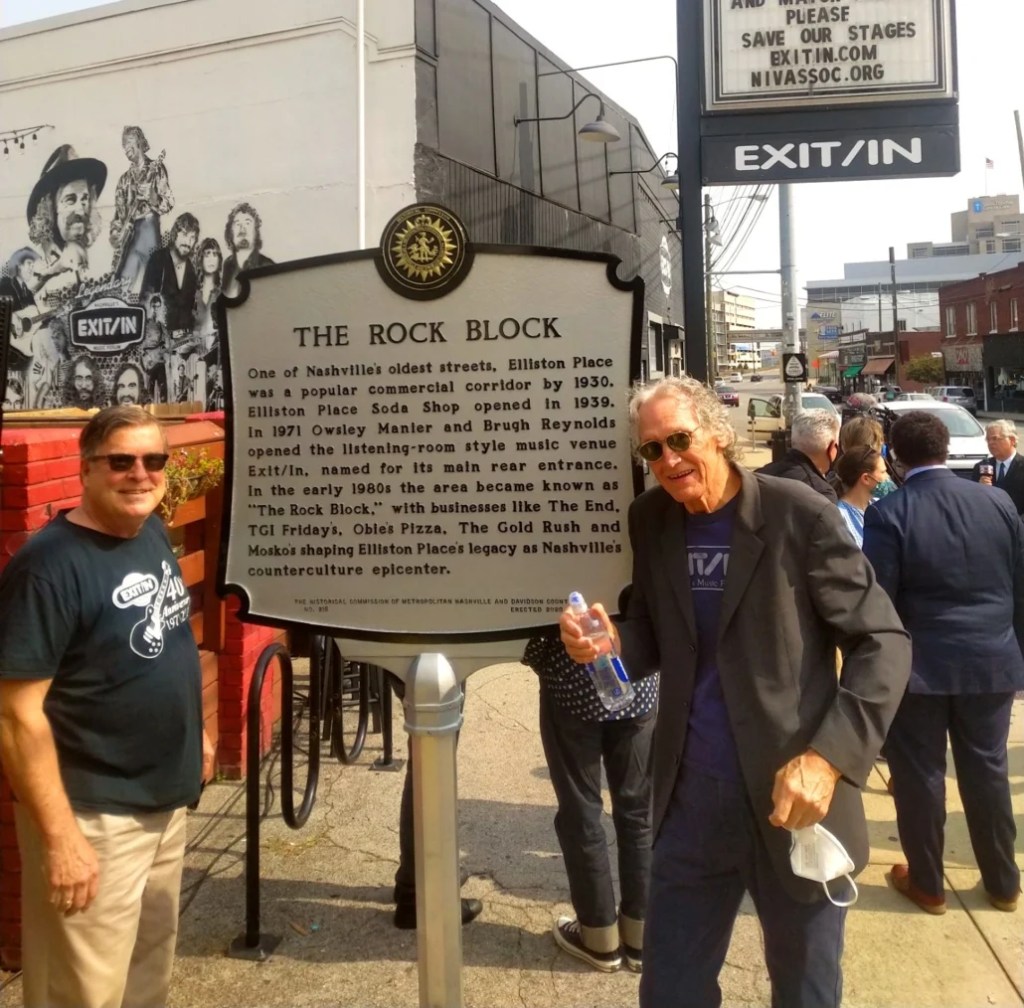
In 1971, alongside Brugh Reynolds, he co-founded The Exit/In, a venue that would become one of Nashville’s most iconic music clubs. What began as a small listening room for local songwriters soon transformed into a celebrated 500-person capacity rock venue in the 1980s.

The Exit/In was not just a stage, but a platform for both local talent and global superstars, hosting a diverse array of artists over its 50-plus years. From The Red Hot Chili Peppers to Etta James, Johnny Cash to R.E.M., The Allman Brothers to Willie Nelson, Linda Ronstadt, and many more, the venue welcomed all, fostering a sense of inclusivity and diversity in Nashville’s music scene. 

It was also the site of numerous memorable moments, such as comedian Steve Martin leading the crowd into the streets for a parade or the venue’s feature in Robert Altman’s 1975 film Nashville.

Over the years, The Exit/In solidified its place in Nashville’s music history and became the anchor of the city’s “Rock Block” on Elliston Place. In 2023, it became listed on the National Register of Historic Places, proof of its enduring cultural significance. 

While the club has seen over 25 owners throughout its history, its influence on the local music scene has remained constant, a testament to its enduring legacy.

Owsley is survived by his son, Aaron Manier, sisters Cynthia Barbour and Helen Bryan, and niece McKeen Butler. A Celebration of Life will be held at The Exit/In on Sunday, October 13, at 3:00 PM, honoring his legacy with the music and stories that shaped his life and career. 

This event is a fitting tribute to a man who has left an indelible mark on Nashville’s music scene.

John Owsley Manier’s contributions to Nashville’s music community will not be forgotten. His enduring legacy continues to reverberate through the legends of artists and enthusiasts passing through the entrances of The Exit/In, leaving a lasting impression that commands respect and admiration.

Joseph Noyes “J.J.” Jeffrey, Beloved DJ and Broadcasting Pioneer, Passes Away at 84

In Memoriam By: Benjamin H. Groff II© Groff Media 2024© Truth Endures

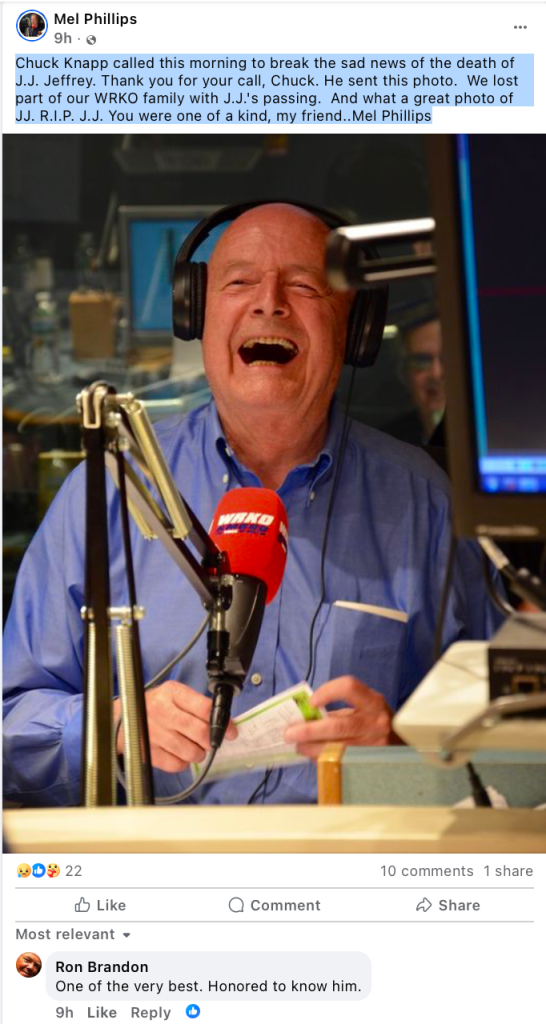
Joseph Noyes “J.J.” Jeffrey, a renowned DJ who became a respected station owner, passed away at the age of 84 following a brief battle with cancer. A native of Portland, ME, Jeffrey began his broadcasting career in his home state in the 1950s. His early career included stints at various local stations, where he honed his signature high-energy style and developed a deep passion for Top 40 radio.

Jeffrey’s career took off when he became the afternoon host at WRKO Boston, one of the nation’s premier Top 40 stations. His success in Boston led to similar roles at two of the biggest Top 40 powerhouses of the time: WFIL in Philadelphia and WLS in Chicago. Known for his vibrant personality and memorable catchphrases, Jeffrey quickly became a household name in each of these markets.

In 1975, Jeffrey transitioned from behind the mic to station ownership, partnering with Bob Fuller to launch Fuller-Jeffrey Broadcasting. Their first acquisition was 102.9 WBLM in Lewiston/Portland, ME. Over the next two decades, the company expanded its reach, owning clusters of stations across the country, including in Modesto, Sacramento, Santa Cruz, Santa Rosa, CA, and Des Moines, IA. Fuller-Jeffrey Broadcasting’s portfolio was sold to Citadel in 1999, forming what is now largely Townsquare Media’s clusters in Portland and Portsmouth, NH.

Not one to rest, Jeffrey and Fuller immediately launched Atlantic Coast Radio, building another prominent radio group in Portland, ME. Their stations included the Sports format “WEEI” on 95.5 WPPI Topsham and 95.9 WPEI Saco, “The Big Jab” 96.3 WJJB-FM Gray, and Conservative Talk 1310 WLOB.

J.J. Jeffrey will be remembered for his contributions to the radio industry, both as a beloved on-air talent and as a visionary station owner. He leaves behind a legacy of passion, innovation, and an enduring impact on the world of broadcasting.

What Happens When the Country is Closed for Average Americans?

A Report By: Benjamin Groff© Groff Media 2024© Truth Endures

A Shift in the Landscape of Freedom

Amid political upheaval, the everyday American—who works a regular job, pays taxes, and seeks a life of routine and stability—may question their future in an increasingly polarized society. As extreme political movements push for agendas that center around ideas of “Project 25” or the return of Trump, advocating for a strict interpretation of Christianity, suppression of women’s rights, and an aggressive nationalistic framework, the real impact may be felt most by the “regular Joe”—the one who wants to live a quiet, predictable life.

For the average person, life may close in on them in such a scenario. The country may become unrecognizable, not in a dystopian fantasy, but in subtle, pervasive ways. It might start with the suppression of individual freedoms—targeting what people can say, wear, or how they worship. Religious dogma could permeate public life, not as a choice but as a mandate, affecting schools, workplaces, and government institutions. The Bible in every building might become symbolic and a requirement, with legal frameworks promoting a particular religious view while leaving others on the margins.

Erosion of Women’s Rights

Regular Americans might witness fundamental changes in the status of women while going about their daily lives. With growing pressure from ultra-conservative elements, efforts to curtail women’s autonomy could accelerate. The reversal of women’s rights, particularly reproductive rights, is already in motion. In this new political order, women might have even fewer choices about their bodies, careers, and participation in public life. For many, this will mark a turning point when personal freedom can no longer be taken for granted.

The Fear of the Unknown

Fear might become customary for those not part of this hard-right movement. The “regular Joe” will likely feel caught between competing narratives. On one side, there is the quiet desperation of wanting to hold on to their everyday life, and on the other, the nagging sense that the world is changing in ways that might soon render them powerless. Whether one is bisexual, straight, or simply someone with no interest in pushing their identity into the political arena, they might start feeling stalked by the system—monitored, judged, and left wondering if their way of life is still valid.

A New “American Dream?”

In this environment, the American Dream could become narrow. No longer about opportunity for all, it may become a dream only accessible to those who fit the suitable mold—racially, religiously, and socially. If one does not align with the ideals of whiteness or conservative sexuality, they could find themselves increasingly ostracized, with opportunities drying up. The path to success might depend less on hard work and more on conformity to ideals driven by far-right ideologues.

The reality could become darker for the person who comes home daily, pats their dog on the head, and watches the news. The content of that evening television might change, with media outlets pushing extreme viewpoints or censorship becoming the norm. Growing anxieties about what tomorrow holds could interrupt quiet moments of relaxation.

Where Do They Go?

If the country starts closing itself to all but those who align with this rigid agenda, the regular Joe may ask, “Where do I go?” It is hard to imagine a physical place for escape in a country that feels increasingly closed off to dissent. For many, the answer might not be in leaving the country but in finding a way to resist quietly—by forming communities with others who feel left behind, advocating for empathy and open-mindedness, and holding on to the idea that the heart of America lies not in exclusion but inclusion.

The danger is not just in the policies themselves but in the erosion of what makes America a place where people of all walks of life can live freely, with differences embraced rather than punished. When that idea is under attack, the question of “Where will you go?” takes on a much deeper meaning because the honest answer is about preserving a sense of home, not just for oneself but for everyone.

In this potential future, where does the regular Joe go? Perhaps they remain right where they are, standing in quiet defiance, continuing to pay their taxes, pat their dog, and live with the hope that balance will one day return to a nation at risk of losing itself.

Here Comes Hurricane Milton But Not Before CNN and FOX Can Mull It Over

A Review By Benjamin Groff© Groff Media 2024© Truth Endures

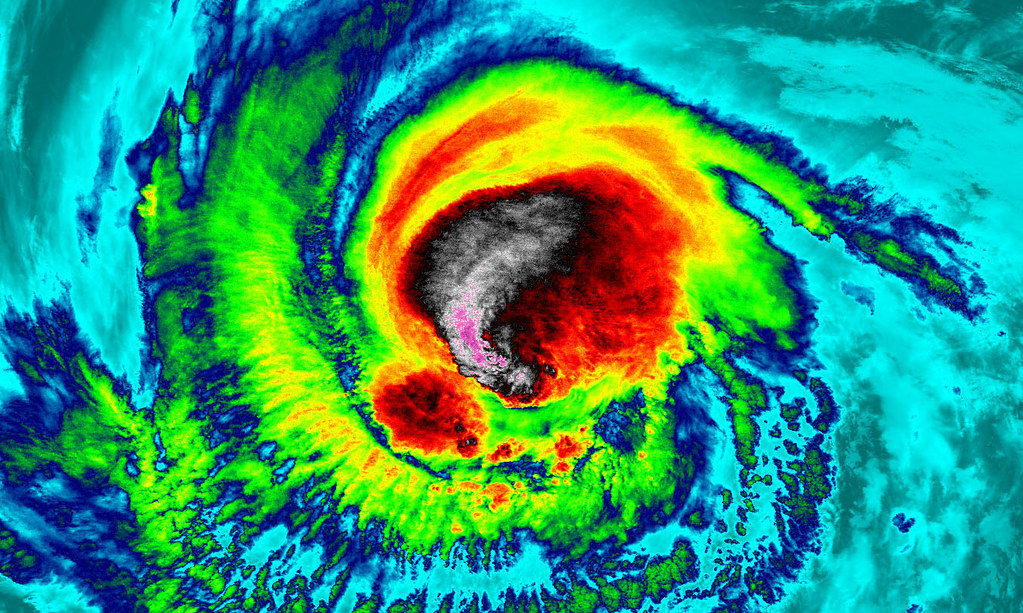
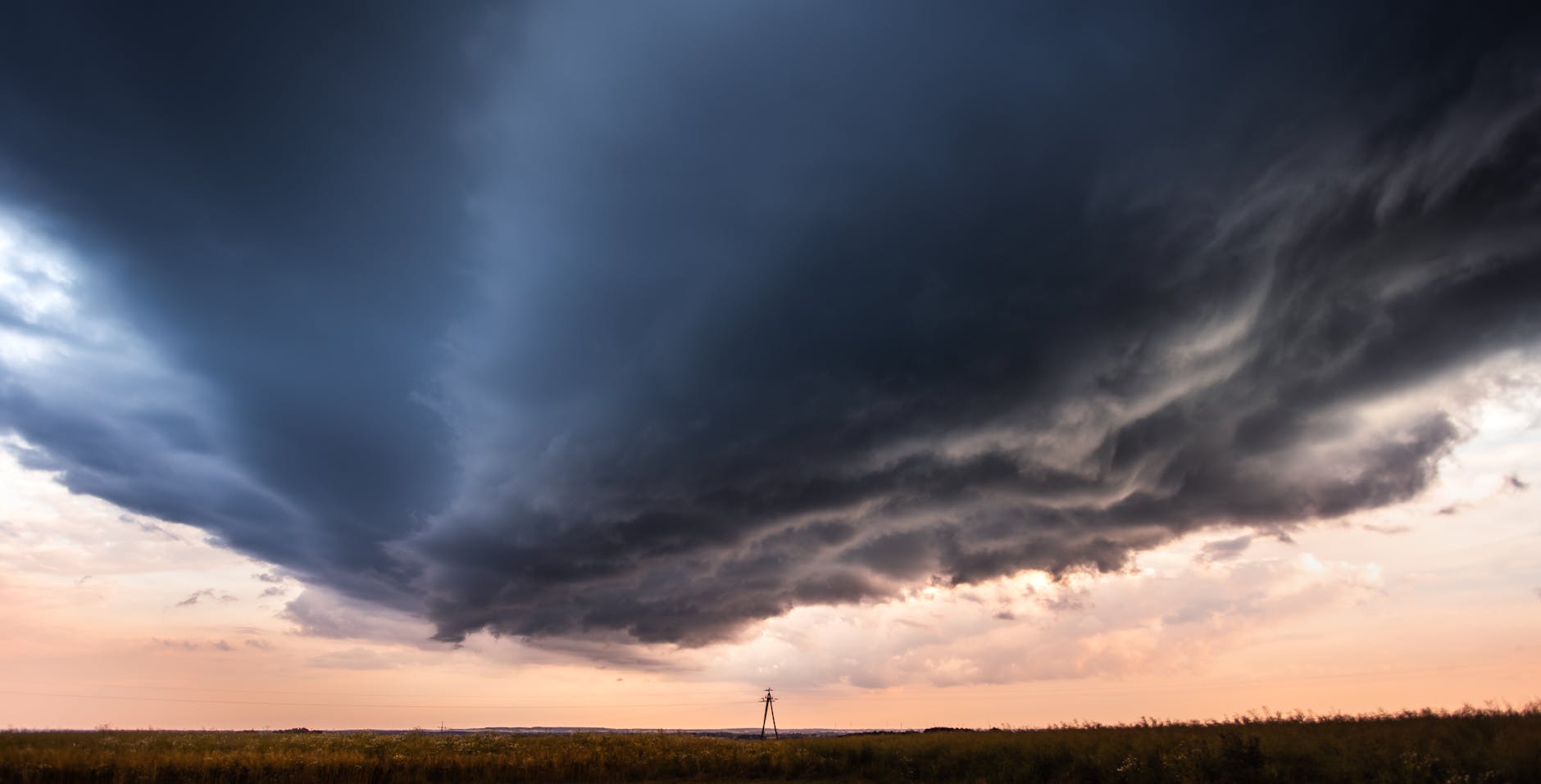
As tropical activity in the Atlantic Ocean quiets down, meteorologists are turning their focus to the Caribbean and Gulf of Mexico, where conditions appear increasingly favorable for the development of the next named storm, possibly forming as early as next week. The National Hurricane Center (NHC) has officially begun monitoring this area, giving it medium odds for tropical development over the next seven days. Beyond that timeframe, forecasters from the FOX Forecast Center suggest that the potential for further intensification exists.

The outlook, however, varies across networks. FOX Weather’s Bryan Norcross reported that while the storm’s primary threat zone stretches from Panama City around the Big Bend of Florida to Sarasota, the possibility of dangerous storm surges could extend even further, particularly into Southwest Florida. Norcross emphasized that while the storm has followed predictions so far, the forecast cone might shift more than usual, leaving some uncertainty. “Nobody should be surprised by sudden changes,” he noted, highlighting the importance of staying prepared.

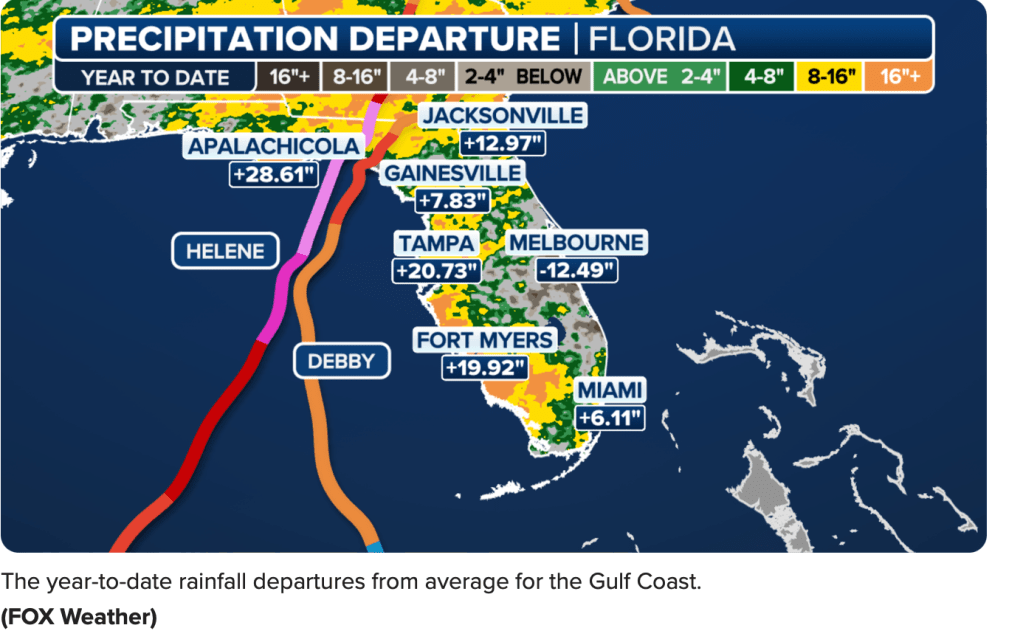
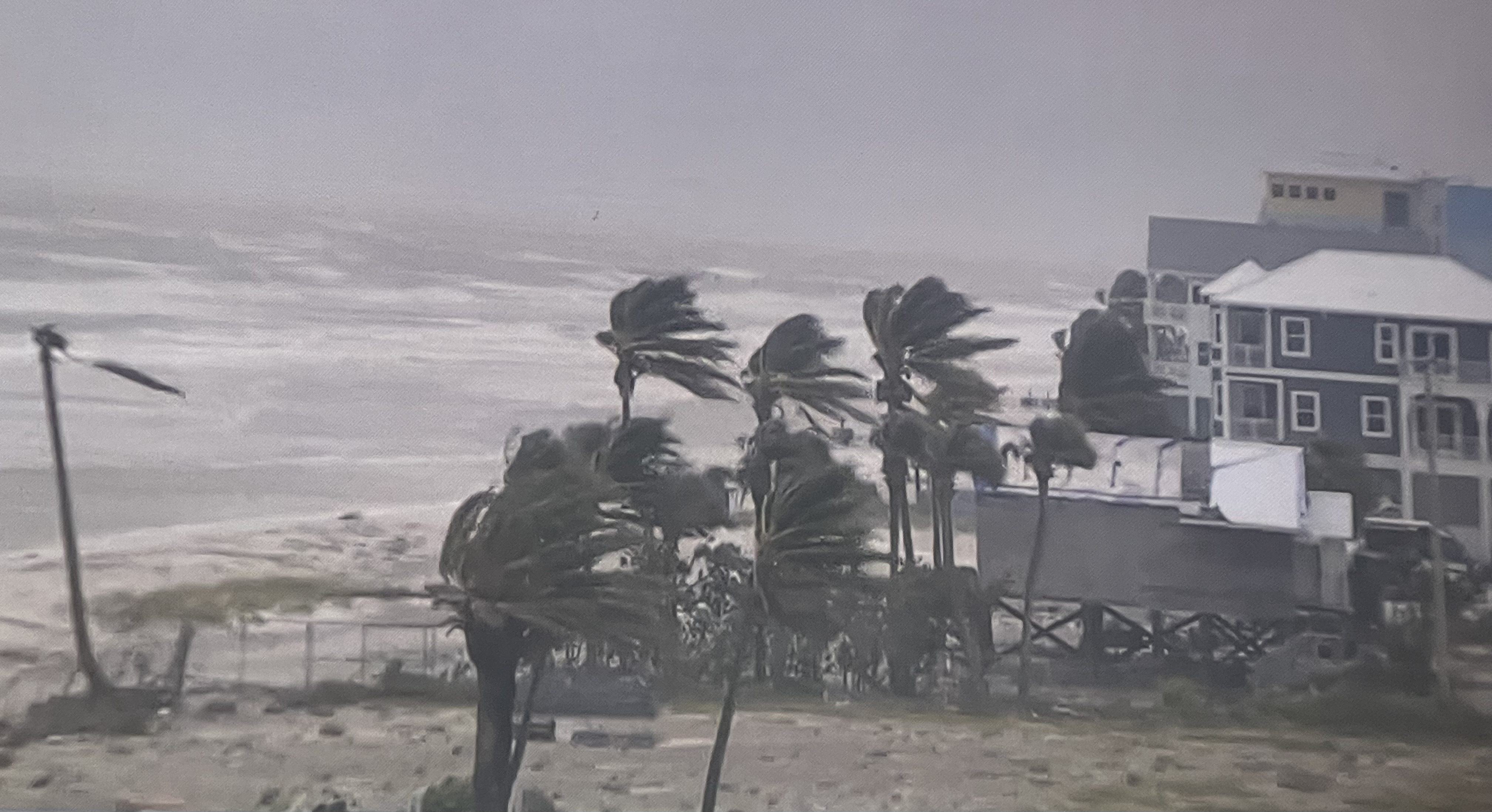
Meanwhile, CNN’s coverage presented a more urgent scenario, especially concerning a separate storm, Hurricane Helene, which recently prompted evacuations in Florida. Helene’s accelerated approach forced residents to brace for high winds, torrential rainfall, and potentially life-threatening storm surges. With shifts in the storm’s track possible, officials stressed the importance of preparation across the Southeast. Mandatory evacuations were ordered in several coastal counties, including Pinellas, Hernando, and Sarasota, as officials anticipated widespread impacts, including power outages and tornado threats.

While both networks offer different perspectives, the consensus is clear: residents in the affected regions must remain vigilant and ready for the worst, even if the forecast models evolve over time.

CLICK ON THE IMAGE TO VISIT NATIONAL OCEANIC AND ATMOSPHERIC ADMINISTRATION
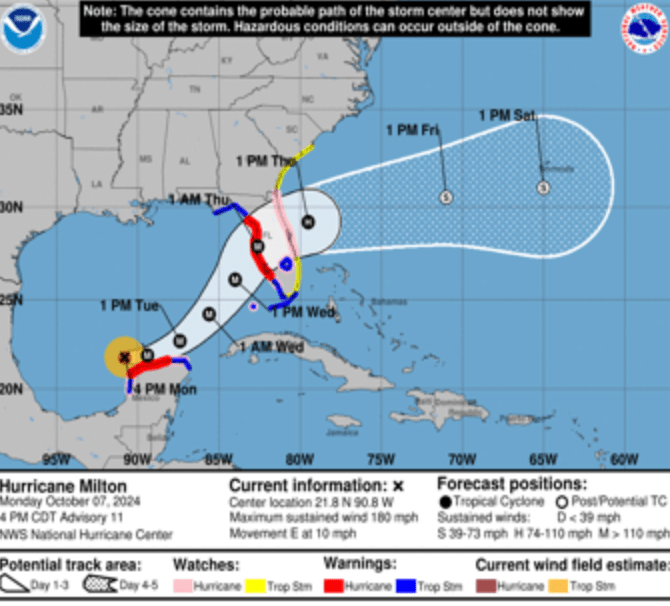
  1. Damaging hurricane-force winds and a life-threatening storm surge with destructive waves are expected across portions of the
  2. northern coast of the Yucatan Peninsula through tonight.
  3. Milton is expected to grow in size and remain an extremely dangerous hurricane when it approaches the west coast of Florida on Wednesday. A large area of destructive storm surge will occur along parts of the west coast of Florida on Wednesday. This is an extremely life-threatening situation and residents in those areas should follow advice given by local officials and evacuate
  4. immediately if told to do so.
  5. Potentially devastating hurricane-force winds are expected along portions of the west coast of Florida where a Hurricane Warning is in effect. Milton is forecast to remain a hurricane as it crosses the Florida Peninsula and life-threatening hurricane-force winds, especially in gusts, are expected to spread inland across a portion of the entire Florida Peninsula.

Preparations to protect life and property in the warning areas should be complete by Tuesday night since tropical storm conditions are expected to begin within this area early

Wednesday.

4. Areas of heavy rainfall will impact portions of Florida today well ahead of Milton, with heavy rainfall more directly related to the system expected later on Tuesday through Wednesday night.

This rainfall will bring the risk of considerable flash, urban, and areal flooding, along with the potential for moderate to

major river flooding

CLICK ON IMAGE TO VISIT NATIONAL HURRICANE CENTER

Ifigenia Martínez y Hernández, 99, Mexican politician and diplomat, senator (1988–1991, 2018–2024), president (since 2024) and four-time member of the chamber of deputies

Ifigenia Martha Martínez y Hernández
(16 June 1925 – 5 October 2024)

Ifigenia Martha Martínez y Hernández, a distinguished Mexican economist, diplomat, and politician, passed away on 5 October 2024 at the age of 99. Throughout her life, she was a pillar of Mexican political and economic thought, serving her country with dedication and vision.

Born on 16 June 1925, Martínez completed her undergraduate studies in economics at the National Autonomous University of Mexico (UNAM) and pursued further education, earning a master’s degree in economics from Harvard University. Her passion for academia and public service led her to become the head of the Faculty of Economics at UNAM, a position she held from 1966 to 1970. Her influence extended beyond the classroom, shaping the next generation of Mexican economists.

Martínez was not only a scholar but also a trailblazing politician. Over her illustrious career, she was affiliated with several prominent political parties, including the Institutional Revolutionary Party (PRI), the Party of the Democratic Revolution (PRD), which she co-founded with Cuauhtémoc Cárdenas and Porfirio Muñoz Ledo, and the National Regeneration Movement (Morena). Her commitment to Mexico’s development and progress led her to serve multiple terms in the Chamber of Deputies, first elected in 1976, and later in 1994, 2009, and 2024. She also held a seat in the Senate, representing the Federal District in 1988 and serving again in 2018 through proportional representation.

One of the crowning moments of her political career occurred just days before her passing, when she presided over the inauguration of Claudia Sheinbaum as President of Mexico on 1 October 2024. In a historic ceremony, she had the honor of handing Sheinbaum the presidential sash, symbolizing a peaceful and democratic transfer of power.

Ifigenia Martínez’s legacy will live on through her immense contributions to Mexican politics, her advocacy for social justice, and her unwavering commitment to her nation’s well-being. She leaves behind a lasting imprint on Mexico’s political landscape and will be remembered for her intellect, leadership, and grace.

She is survived by a grateful nation, which honors her profound impact on its history.

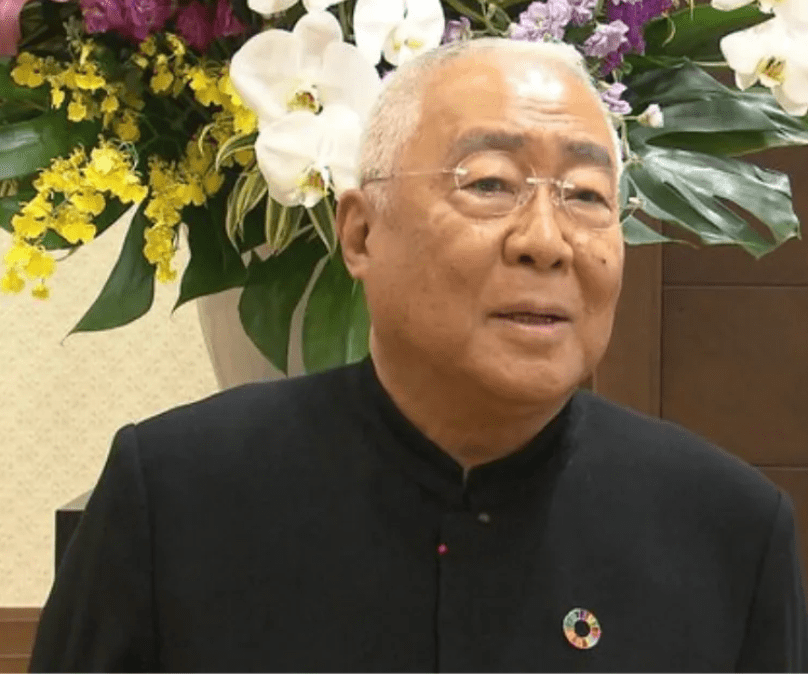
Japan’s Culinary Expert Yukio Hattori Dies 1945 – 2024

This Information Provided By: Benjamin Groff© Groff Media 2024© Truth Endures

Obituary: Yukio Hattori (1945 – 2024)

Yukio Hattori, beloved television personality, culinary expert, and educator, passed away on October 4, 2024, in Tokyo, Japan, at the age of 78. Best known as the insightful commentator on the popular Japanese cooking show Iron Chef, Hattori’s contributions to the world of food, nutrition, and culinary arts left an indelible mark on Japanese culture and beyond.

Born on December 16, 1945, in Tokyo, Hattori grew up in a family deeply rooted in the culinary tradition. He was inspired by his father’s work to pursue his passion for food and nutrition, eventually earning a PhD from Showa University. His profound understanding of both cooking and the science of nutrition shaped his career, which would extend far beyond the kitchen.

Hattori became the fifth president of Hattori Nutrition College, a prestigious institution founded by his father, known for its unique blend of culinary excellence and nutritional education. Under his leadership, the college trained thousands of chefs, nutritionists, and food critics, shaping the next generation of culinary professionals. His commitment to culinary education made him a pivotal figure in elevating the standards of both food preparation and healthy eating habits in Japan.

While his educational work was vital, Hattori was perhaps most recognizable for his television career. As a competitor, judge, and commentator on Iron Chef, Hattori’s sharp palate, deep culinary knowledge, and entertaining commentary endeared him to audiences across Japan and worldwide. His presence on the show not only lent credibility but also helped popularize Japanese cuisine internationally.

In addition to his work on television, Hattori appeared in films such as Aji ichi Monme (2011) and Mibu, and he continued to influence Japanese cuisine and public health through his numerous cookbooks, radio shows, and public health campaigns. He was a firm believer that good food should nourish both body and soul, a philosophy he called “Well Taste,” where flavor and health go hand in hand.

Yukio Hattori’s legacy will continue through his extensive contributions to culinary education, his influence on Japanese cuisine, and the students he mentored at Hattori Nutrition College. He is survived by his family, colleagues, and countless admirers who were inspired by his passion for food and nutrition.

Yukio Hattori’s memory will forever be cherished as one of the most prominent voices in Japan’s culinary world, whose life’s work brought taste and health together for the benefit of all.

A Special Note Of Thanks!

Fight Today For A Better Tomorrow – Saving America – Coming Home

A Report By: Benjamin Groff© Groff Media 2024© Truth Endures

A Nation’s Call

It was the fall of 2024, and the country had never seemed more divided. Political upheaval had peaked, with protests echoing through city streets, harsh words hurled in homes, and debates erupting at family dinner tables. The election season had become more than just a contest of policies; it had morphed into a battle over the nation’s soul, pitting neighbor against neighbor.

At the heart of this turmoil was a young senator named Jacob Randall. A man of few words but deep conviction, he had saw firsthand the devastating effects of division. Randall had grown up in a small town where his mother and father, though from opposite sides of the political spectrum, had found common ground in their love for family, faith, and community. That shared foundation had always given him hope that unity was possible.

However, as he stood before Congress, he wondered if that hope had been misplaced. The chamber was restless, with representatives glaring at one another across the aisle, the tension palpable. Randall chose to speak at what many called a last-ditch effort—a desperate attempt to heal the nation before it tore apart.

Taking a deep breath, he began.

“Fellow citizens, colleagues, I stand before you not as a Democrat or a Republican but as an American. Our great nation is facing a challenge unlike any other. We have become so entrenched in our political camps that we no longer see each other as fellow countrymen. We see enemies where once we saw neighbors. And that division is killing the very fabric of our society.

“My parents did not always agree on politics. Mother was a staunch conservative, Father a proud progressive. But they understood something we have forgotten: that compromise is not a weakness but the cornerstone of democracy. They believed that every person, no matter how much they disagreed, had something valuable to contribute to the conversation.”

Randall’s words caught the attention of some. A few heads began to nod slowly. He pressed on, feeling the weight of the moment.

“Our founders, too, were divided. They had different visions for this country and ideas about what liberty and justice should look. Nevertheless, they knew that to create something lasting, they had to pull together to find common ground. And they did. That is the spirit that created America. Moreover, that is the spirit we need to rediscover today.”

As Randall continued, he saw a shift in the faces before him. Some were hard, unmoving, but others softened, listening with new ears. He was not offering easy solutions but calling for something more complicated: humility.

“When we look across the aisle, we must not see enemies but partners in this great American experiment. We have different ideas about achieving a better future, but we all want a better one. And if we cannot even agree on that, we have already lost.”

He paused, letting the gravity of his words settle in the room.

“In every crisis, there is opportunity, an opportunity to rise above the noise, the hatred, and the division. It is an opportunity to remember that we are bound together not just by the laws of this land but by the ideals it represents. Life, liberty, and the pursuit of happiness—for everyone. Not just for those who agree with us.”

Randall stepped away from the podium and glanced up at the gallery above. It was filled with citizens from across the country, watching with anxious eyes, waiting for anyone to bring clarity to the chaos. He saw young activists clutching signs, older veterans with tears in their eyes, and families holding hands.

“I am not asking you to abandon your beliefs. Listen to those who see the world differently. Not to argue but to understand a call for uniformity, but for unity because we cannot get found without uniting.”

The silence in the chamber was deafening. No one was shouting for the first time in what seemed like years. No one was trying to outdo the other with statistics or soundbites. They were listening.

Randall’s speech ended with a simple message: “America is not a perfect nation, but it is a nation built on the belief that we can pursue perfection together. Let us, as a people, return to that pursuit—not as adversaries, but as Americans.”

As he stepped away from the podium, the room erupted—not in protest, but in applause. Representatives stood on both sides of the aisle, clapping not just for Randall’s words but for what those words represented: a glimmer of hope that maybe, just maybe, the country could pull itself back from the brink.

It would take work. It would not happen overnight. But in that moment, something had shifted. For the first time in a long time, there was a shared sense of purpose— a belief that even in the darkest of times, unity was possible—and that together, the nation could find its way back to the light.

Hurricane Helene: The Unexpected Reckoning – The Mara Gonzalez Story

A Story By: Benjamin Groff© Groff Media 2024© Truth Endures

The Fall of 2024 was supposed to be quiet—it had just started, at least that’s what the weather forecasters had predicted. But as the Atlantic winds shifted and the sky over the Caribbean darkened, something was brewing—a force no one anticipated. Hurricane Helene, named after the calmest of saints, defied its serene namesake.

It raged towards the coast, catching everyone off guard with a fury unlike any other.

Mara Gonzalez, a lifelong resident of Tallahassee, Florida, knows hurricanes too well. Her family had lived through the destruction of Hermine in 2016 and, even further back, the devastating flood of 1843 that left the area uninhabitable. But Helene was different. It didn’t give them time to prepare. It increased, catching wind over the Gulf of Mexico and swelling from a Category 2 to a dangerous Category 4 within hours.

Mara’s weather app pinged. “Helene upgraded to Category 5. Evacuation recommended for coastal residents.” Her heart sank as she looked out the window, the clouds swirling angrily in the distance.

Her husband, Luis, was packing supplies in the truck—water, canned goods, blankets—everything they had prepared weeks before when the first storm warnings of the season were announced. They had been waiting for something to hit, but nothing ever came. Now, with Helene’s ferocity looming, the preparations seemed rushed. They had planned to ride it out, but the panic spreading through town made Mara reconsider.

“Luis, I think we need to leave,”

She called out, her voice trembling. The wind had already picked up, howling through the streets like a warning cry. Despite her fear, Mara’s determination to protect her family was unwavering.

Luis wiped the sweat from his brow.

“We can still make it inland before the storm hits,”

He reassured her, though his voice wavered.

The children, nine-year-old Sofia and six-year-old Diego sat quietly in the truck’s backseat, their eyes wide with confusion and innocence. They had lived through tropical storms before, but nothing this ominous.

As they made their way out of the neighborhood, Atlanta seemed to be on the move. Lines of cars stretched down the highway, desperate to escape the path of destruction. The radio crackled with reports of the storm’s unexpected growth, and people were urged to evacuate immediately.

But Hurricane Helene wasn’t following any conventional path. As the Gonzalezes drove inland toward Atlanta, the sky darkened further, and the wind picked up speed. The air was thick with the smell of rain and fear. Helene was coming in fast, making landfall quicker than expected. Mara gripped the dashboard as the rain pelted the windshield, blurring their view of the road ahead. The sound of the rain was deafening, and the wind was howling like a pack of wolves, adding to the sense of impending doom.

“Luis, do you think we’ll be safe in Atlanta?”

She asked, her voice barely audible over the pounding rain.

“I don’t know, Mara. We have to keep moving.”

Luis’s hands were tight on the wheel, his knuckles white.

The radio cut out. Silence fell over the car for a moment before the blaring broke it of emergency alerts.

“A tornado is in the storm’s wake, and they are directly in its path.”

“Dad, what’s happening?”

Sofia asked, her voice small and scared.

“Just a bit of rough weather, baby. We’re going to be fine,”

Luis tried to reassure her, but the fear in his voice betrayed him.

The hurricane’s outer bands unleashed their full fury as they approached Tallahassee. Roads flooded, trees were ripped from their roots, and debris littered the streets. The city, usually a haven for those fleeing coastal storms, was under siege by Helene’s wrath.

Mara’s phone buzzed again, this time with a text from her mother, who had stayed behind in Tampa. The water was rising fast; stay safe. I love you all.

Mara’s breath caught as she imagined her mother huddled inside her home, fighting the rising floodwaters. She wanted to scream, to tell her to leave, but the storm had already overtaken the coast.

Hours passed in the chaos, and they found temporary shelter in a school gym, along with hundreds of others who had fled in the nick of time. The wind howled outside as the noises of roofs getting ripped off homes echoed, and power lines crashing down filled the air. Yet, amid this turmoil, there was a sense of unity among the survivors, a shared understanding of the need to support each other.

But Mara couldn’t sleep. She kept thinking about her mother and the others who stayed behind, hoping and praying they’d made it through the worst.

Morning came, but the storm lingered. Helene’s aftermath was unlike anything the city had ever seen. Tampa was submerged, and entire neighborhoods were wiped out. The streets were littered with debris, and the once vibrant city was now a ghost town. Atlanta too, was left battered, with flooding rivaling the disaster of Hurricane Harvey years before. The city was in a state of shock, trying to come to terms with the scale of the destruction.

Mara stood outside the shelter, looking at the devastation, trying to fathom the destruction that stretched as far as she could see. Helene had taken lives, homes, and peace of mind. Yet, as the sun rose, a strange calm settled over the city. People began to emerge, surveying the wreckage but already talking about rebuilding, helping one another, and survival.

“Hurricane Helene may have brought us down,” Luis said, placing a hand on Mara’s shoulder, “but it didn’t break us.” The city was a testament to that. Despite the devastation, people were already talking about rebuilding, helping one another, and survival. The spirit of the community was unbroken, and it was this resilience that would see them through the difficult times ahead.

Mara nodded, her mind racing with thoughts of what was next. There would be losses to mourn, people to find, and a future to rebuild. Helene had come unannounced and left destruction in its wake, but the people’s resilience would rise just as it always had, just as it always would.

“I AM AN INNOCENT MAN!” Did Missouri Kill An Innocent MAN? Was It Murder?

A Report By: Benjamin Groff© Groff Media 2024© Truth Endures

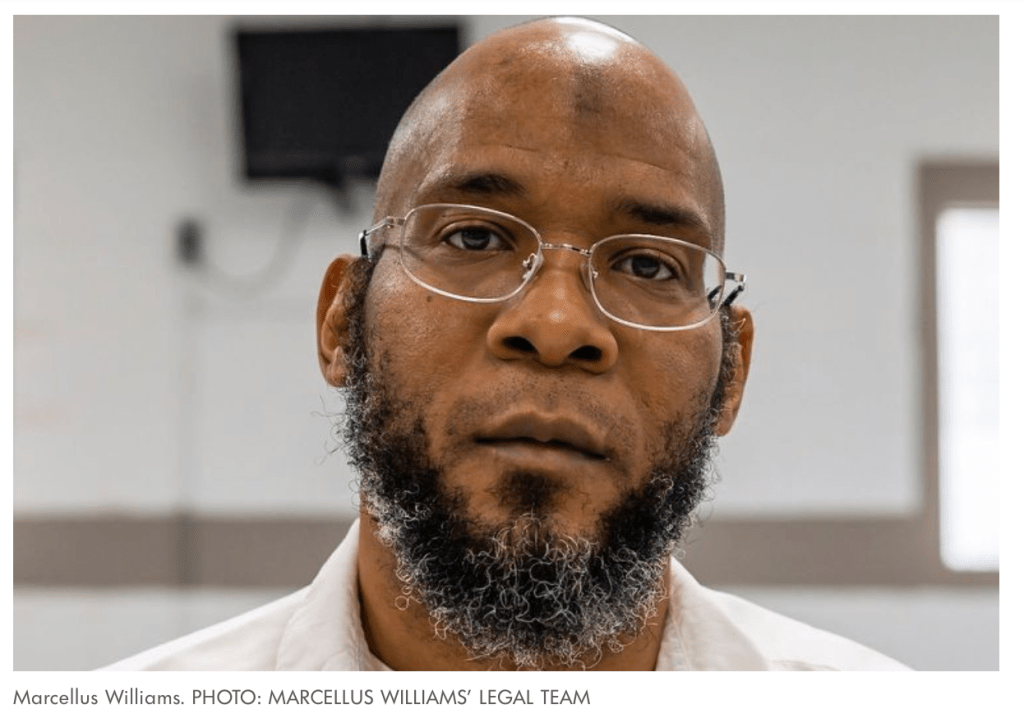
In September 2024, Missouri executed Marcellus Williams despite significant evidence casting doubt on his guilt. Williams was convicted for the 1998 murder of Lisha Gayle, a former St. Louis Post-Dispatch reporter, but recent DNA tests excluded him as the source of evidence found on the murder weapon. While Williams’ legal team sought a stay of execution, and even the prosecution expressed doubts, Missouri proceeded with the lethal injection after Governor Mike Parson dissolved a previous inquiry. His execution sparked widespread outrage, igniting debates on the reliability and ethics of the death penalty.

Williams’ final words were, “All praise be to Allah in every situation,” reflecting his unwavering faith. His attorneys argued that the DNA evidence should have been sufficient to overturn his conviction, but the courts dismissed this claim. In 2017, then-Governor Eric Greitens halted his execution and established a board to review the case, but this effort was reversed by Governor Parson, sealing Williams’ fate.

Even Gayle’s family had called for clemency, asking for Williams’ sentence to be commuted to life without parole. Despite their pleas, the state moved forward with the execution, leading to questions about whether justice had truly been served. The case has raised concerns about rushing death penalty cases and highlighted the dangers of executing potentially innocent individuals.

Williams’ case continues to fuel national debates over capital punishment and the failures of the justice system, particularly when substantial evidence suggests wrongful conviction. His death has become a rallying point for advocates pushing for reforms in the death penalty process, as critics argue that his execution may have been a tragic mistake. Was this mistake a murder carried out by the state of Missouri, and those who had the responsibility to stop it ––– the killers?

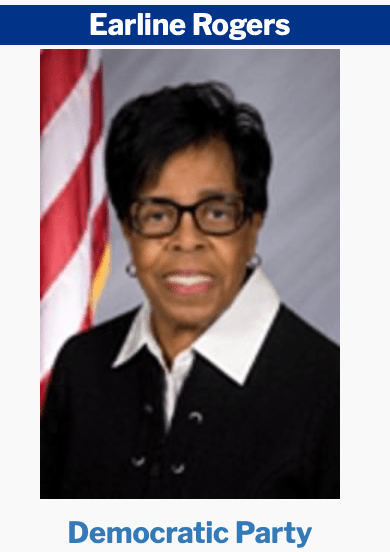
Earline S. Rogers (December 20, 1934 – September 5, 2024). In Memoriam

By: Benjamin Groff © Groff Media 2024© Truth Endures

Earline S. Rogers, a distinguished American politician and lifelong education and civil rights advocate, passed away on September 5, 2024, at 89. Rogers dedicatedly served the people of Indiana for over thirty years, first in the Indiana House of Representatives from 1982 to 1990 and then in the Indiana State Senate, representing District 3 from 1990 through 2016. 

As a proud member of the Democratic Party and the Indiana Black Legislative Caucus, she championed legislative efforts to support education, working families, and her beloved community of Gary, Indiana.

Born on December 20, 1934, Earline Rogers was a trailblazer from an early age. She earned her Bachelor’s (1957) and Master’s (1971) degrees from Indiana University, Bloomington

Her career began as an educator in the Gary Community School Corporation, where Earline made a lasting impact by [specific impact]. Her passion for public service led her to the Gary City Council, where she served as a member and President from 1980 to 1982.

Rogers made history with her election to the Indiana House of Representatives in 1982. During her tenure, she spearheaded [specific achievements] and continued to rise, later serving as Minority Whip during her tenure in the Indiana Senate. She was a strong and tireless voice on numerous committees, including AppropriationsHomeland Security, and Transportation, and as the Ranking Minority Member on the Education and Career Development and Family and Children Services committees. 

Throughout her career, she was known for improving education and advocating for students, always believing in the power of knowledge to empower and transform lives.

2016, after more than 30 years of public service, Rogers retired from political life, choosing not to seek re-election. Earline’s dedication and influence will continue to shape and inspire future generations through the laws she helped shape and the generations of students she inspired.

Earline Rogers leaves a legacy of courage, compassion, and commitment to public service. Her unwavering dedication to her community, particularly her profound belief in the importance of education as the key to progress and equality, will continue to inspire and connect us all.

She leaves behind a legacy of strength, integrity, and kindness that earned her the respect and admiration of her family, friends, and countless colleagues. Her memory will shine brightly forever in the hearts of those who knew her and the lives she touched throughout her incredible life. 

My Experience With Live Coverage of Severe Weather Events by KKBS 92.7FM: A Crucial Role From The 1990s…

The sky was cloudy to the southwest, and humidity had been building since the morning. Many had yet to pay attention to weather patterns forming in the Oklahoma and Texas Panhandles, particularly dew points that were above average. Everything was out of balance. No one was paying attention except for one News Director at a small community radio station in the Oklahoma Panhandle community of Guymon. That news director was me, Benjamin Groff II (JR), and our role in providing live coverage of severe weather events was crucial.

It had been a busy day for the news department at KKBS 92.7FM. The Oklahoma Secretary of State had been in town attending Civic functions, plus a rape trial at the Texas County Court House was underway, and the suspect had been a topic that brought turmoil in the community for his alleged sexual abuse of a child. There was also an ax murder victim discovered in a dirt cellar in Steven’s County, Kansas, and the Hugoton Court House was buzzing with activity as the sheriff there had a suspect in custody.

The KKBS broadcast signal reached a five-state region, covering the Oklahoma Panhandle, the Northern Texas Panhandle, Southwest Kansas, Southeast counties of Colorado, and Northeast New Mexico. An anomaly in broadcasting also allowed the station’s signal to get received on radios and listened to by residents of Vernal, Utah. Listeners from the area would call the station often with their weather conditions and share local news to be part of the radio station’s mix. Our commitment to serving the community was unwavering, and we valued every listener’s contribution.

In Perryton, Texas, to the southeast of Guymon, a city of less than 7500 souls, the area mainly consisted of farmers and ranchers. KKBS radio station also reached Spearman, Gruver, Stratford, and Dalhart, Texas. In each community, the station, under my direction, established contacts and points of communication to use during news events. The same situation existed in southwest Kansas from Elkhart, Dalhart, Liberal, Hugoton, Johnson City, and Ulysses.

The radio station studio on the north side of Guymon is a one-story building set behind a hill on one side. The broadcast tower is near the city center. It was on the same tower as most emergency services and, thus, on an emergency roster for being tended to promptly during power outages. Our studios were placed on priority through a demand I had made to the power company after I explained that we broadcast to every community in five states and were rebroadcast through each cable carrier of every community. We need to get back on the air to broadcast emergency notices to the people as soon as possible. I did not realize I made such an impact that the power company initiated a person to guarantee our station downtime was as minimal as sixty seconds or less. It was good that it happened.

As the day continued, I stepped outside and felt the air. I had felt the conditions before. It had been in my hometown 12 years earlier when a storm ripped through the area and tore the hell out of the county, killing a lifetime resident of the town and his wife as they were hunkered down in their cellar. Being a retired police officer, I had a sixth sense, which led me to believe we were in store for something more. I felt it. There were times I sit in the newsroom on an afternoon on a slow day and think out loud, saying this feels like a plane crash day, and low and behold, we would be breaking a plane crash somewhere in the valley later. It was the same way this day, and I began planning for it.

I asked our sales team to be on call and ready to return to the station within ten minutes of getting my call, not to ask questions, get in their car, and come. They would answer calls and send me information about storm coverage. They should send their families to storm cellars, and they would be OK with us; the hill protects the station. I asked our evening staff to get ready to rock and roll so that it would be different from business as usual. I was going to be interrupting their shows, and we would be going live with actual news actualities from the field, raw broadcast, and they needed to get prepared for raw emotions to get heard. When it happened, they were not. But maybe they were more than they would have been.

Shortly before 4 PM, I noticed on an antiquated system that there was a massive hail storm in north Texas Panhandle County near Gruver, Texas; I called the Gruver Texas City Manager from the newsroom. I always contacted people in a way that allowed me to quickly air with them regardless of what was happening; in this case, it was gold. I asked him if he was getting hail. He said he was and was trying to drive west out of town; I buzzed the main studio to get ready to go live at any moment with breaking news, and suddenly AJ, the city manager, said

OH MY GOD, BEN, THERE IS A TORNADO ON THE GROUND WEST OF GRUVER, TEXAS, AND IT IS MOVING NORTH…

I flashed the hand signal and said go live; use the weather signal…

Stacy was on the board and broke into music with a particular news weather bulletin where I came on and issued a “KKBS TORNADO WARNING” and had the city manager describe what he was seeing. After the conversation, I returned and said that the National Weather Service has yet to issue a Tornado Warning, and we are in contact with them trying to get them to notice the storm.

A small radio station in the Oklahoma Panhandle doesn’t carry much weight with the National Weather Service, and they should have paid more attention to what we were trying to explain to them or the fact that we had an actual sighting by a city manager. We contacted the Channel4 Meteorologist who used to offer services to our station and explained to him what we were seeing, and he said he would turn his radar toward us and take a look; as he did, he said,

Map-Radar Image is for reference purpose only not actual radar screen used.

Holy Moly! That looks like a hook echo! Has the National Weather Service put out anything on this yet?

I explained to him our frustration with the weather people, and he said look, I am going live and putting my warning out, I told him we had already put ours out. He said

Thank GOD. I hope people are listening!

The Local Civil Defense and the owner of the other radio station in Guymon were listening, and they were severely upset that we were putting out a weather warning without their authorization. They even entered their radio station (one I once worked at KGYN) and denied on air there was any chance of severe weather today, saying the other stations were nuts. The Civil Defense Director went as far as to call our station owner and threaten her with an FCC violation complaint. She called me and asked what type of warning I issued. I explained that I issued a KKBS weather warning and a KKBS tornado warning, confirmed by a city manager talking to us live on the air from Gruver, Texas. She smiled and said issue some more.

I continued broadcasting the weather warnings and hear the disgusting remarks on the police radio frequencies from the civil defense director and his people over our decision to warn people about the threat of undesirable weather moving into the region. What is more, the storm producing the tornado was now moving into an area referred to as Hitchland, an agriculture-based community and ranching area. As we were broadcasting, our friend from the television station called and told me he had confirmation that a tornado was on the ground. We then broke into our programming and broadcast that a tornado had hit the area, and there were casualties. As we did, we began to get phone calls about fatalities in the area. As we tracked this storm, we warned the Beaver County, Oklahoma communities that they would be in the track of the storm-producing tornados.

The dry line producing these storms was like a whiplash effect; it produced storms in front and behind its path. Another line of storms formed twenty miles west of Guymon, stretching from Guymon to Elkhart to Johnson City, Kansas. It was a night of stress and high excitement for those who enjoy broadcasting under pressure.

During one segment of events, the bank that the radio station shared the building with was hosting Claudette Henry, the Oklahoma Secretary of State, at a reception that evening; while I was broadcasting live during one of the live storm updates, I saw Ms. Henry walk past the newsroom. I quickly wrapped up, stretched my headphones cord to the door, and shouted.

“Is that Claudette?”

She responded

“It Sure Is”

In my best Oklahoma demeanor

“I get you to do a live interview with me quickly?”

Claudette said,

“Let’s go for it!”

The interview consisted of talking about how she can’t fly out of Guymon until our radio station gives the all-clear and mentioning how everyone in five states is listening to you guys. She said she was impressed with the quality of coverage we provided; she didn’t expect to see it in Guymon.

My station’s owner was sitting in the basement at her beauty shop, listening to the radio and receiving phone calls on her cell phone. She was one of the few people in town at the time who had a cell phone, and everyone called her on it. On this night, it was to thank her for providing a station with such a spectacular news team.

It have been better news for everyone. The operations manager had called the station manager a bitch during a sporting broadcast, and then failing to join in the weather broadcast appeared to have ended their relationship. The next day, she dismissed him from his duties and placed them upon me and his salary. A few years later, she added the sales manager responsibilities to my duties. A few years later, I accepted a position in Cheyenne, Wyoming.

It was the 1990s and anything goes was a leftover motto from the 80s!

Preventing Heatstroke: Why You Should Never Leave Kids or Pets in a Hot Car

A Story By Benjamin H Groff© Groff Media Copyright 2024©

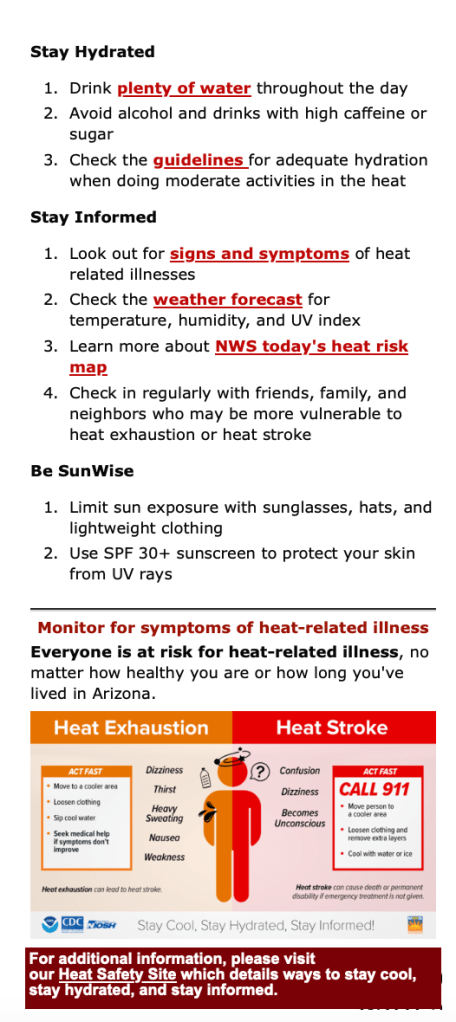
Dangerously high temperatures up to 117°F are expected with the potential to cause life-threatening illnesses or even death.

Your car can turn dangerously hot in just a few minutes.

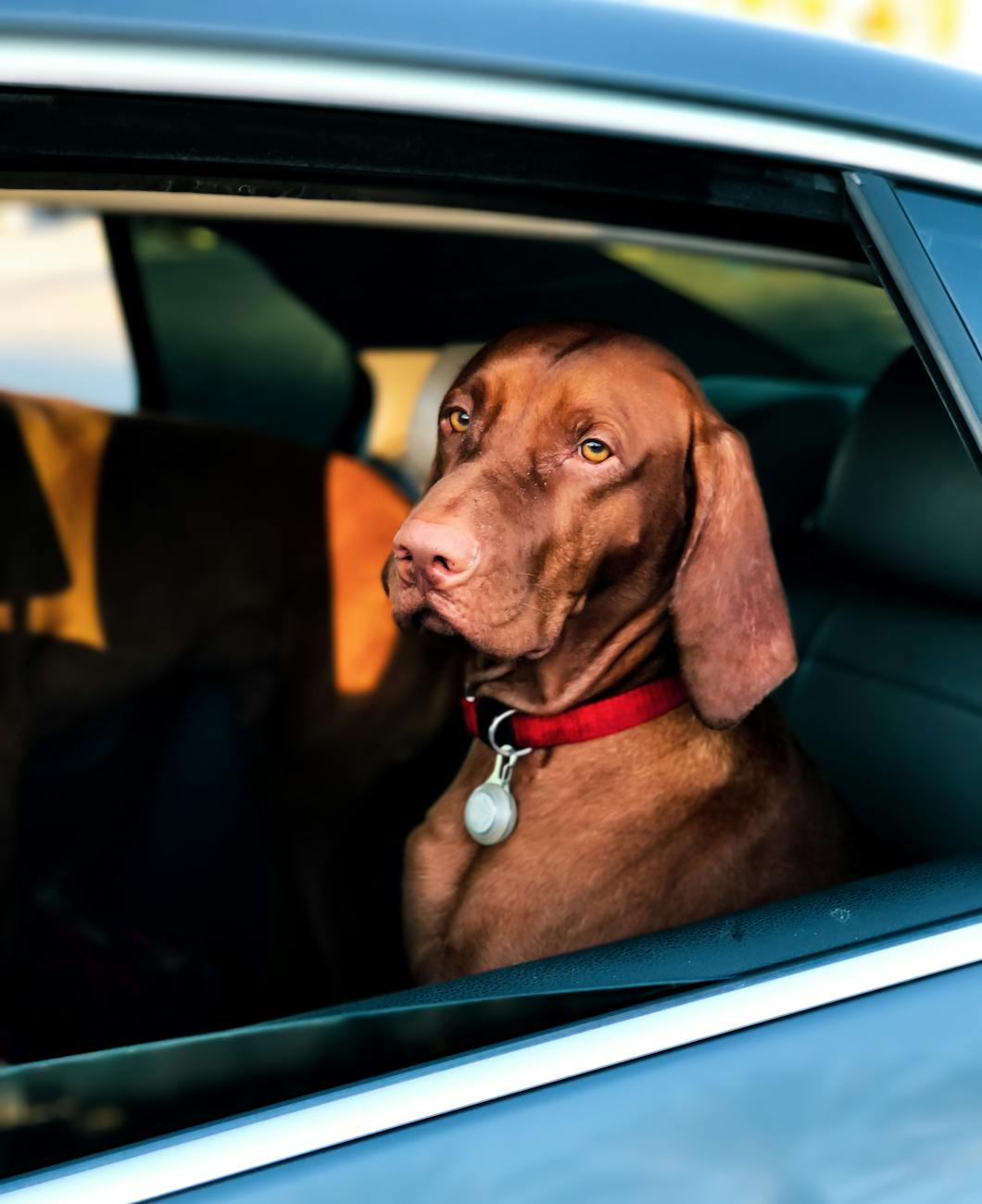
Temperatures inside your car can skyrocket to life-threatening levels within minutes, posing serious risks even on cooler days. Never leave children or pets unattended in a car. Always double-check to ensure everyone is out of the vehicle before leaving. Arizona is included in nationwide alert for heat warnings that could cause serious health concerns, stroke, or even death!

Biden’s Victory Speech: Uniting America for Progress | Biden Wins

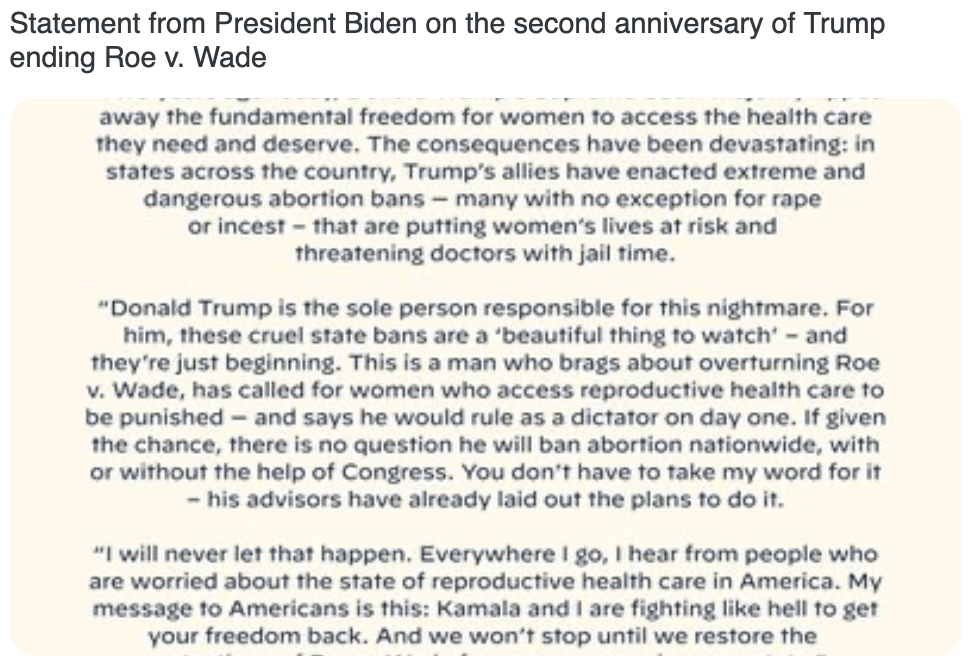
Before the presidential debates on Thursday, posts from supporters of President Biden are getting noticed. President Biden is getting noticed for his comment on the second anniversary of the revocation of ROE vs. Wade, a process that he says is caused by Donald Donald Trump.

    Three Presidents Who Are Respected Around The World
    There Is A Giant Difference Between The Two. When You Vote – It Is For Freedom!

    Former President Donald Trump was widely mocked after claiming to a crowd of supporters that he has “wounds all over my body” that they could see if he took his shirt off.

    Trump delivered the keynote address at the “Road to Majority” conference in Washington, D.C., organized by the conservative Christian political advocacy group, Faith and Freedom Coalition, on Saturday.

    For example, Presidents Abraham Lincoln, James Garfield, William McKinley, and John F. Kennedy were assassinated while still in office.

    Notably, Ronald Reagan was the victim of an attempted assassination in 1981 when a bullet fired by John Hinckley Jr. shot him in the underarm, broke one of his ribs, and punctured one of his lungs, causing significant internal bleeding. Reagan went on to serve two terms in office.

    In one of the more oddball moments in American history, Andrew Jackson in 1835 was attacked by an unemployed house painter whose pistols misfired—and promptly beat his failed assassin with his walking cane.

    And it is perhaps darkly comic that Theodore Roosevelt survived a 1912 assassination attempt after the assassin’s bullet became lodged in a folded copy of a speech Roosevelt was carrying in his breast pocket at the time.

    By contrast, Trump has never been in a similar position. Nor has he ever served in combat or sustained any wounds whatsoever considering he infamously dodged the Vietnam War draft by claiming he had bone spurs in his foot (a fact he has periodically downplayed).

    See the full report here!

    Fred and Matilda

    Fred and Matilda had been retired for over ten years. They had passed their silver years and were entering their golden years. Both had begun to experience forgetfulness, which was not severe but inconvenient. Fred would forget his wallet when he left home to go to town, or Matilda would forget to put extra tissues in her purse. She needed them to keep her nose wiped due to spring’s seasonal allergy season.

    Today, Fred and Matilda left their modest bungalow midcentury home on East Kiowa Street in Corprol, Oklahoma. They traveled thirty miles to see the couple’s son nearby. Due to Fred’s’ safe’ driving, the drive should take just over fifty minutes. He never exceeded fifty miles an hour and usually kept their ’53 Chevrolet Coup topped at 45 miles per hour. Matilda was known for always talking to Fred when he was driving. She never shut up.

    Matilda would say to him –––

    “Fred, ease to the left, honey; now go back to the right and watch it. Oh no—a car is coming! Now, someone is behind us. Wait, a car is approaching us; I think the guy behind us will pass us.

    Fred and Matilda’s son, Bill, looked at the clock at 1:00 PM. His parents should have been at his place at 11:00 AM. He thought they stopped by their old farm and got lost in time, recalling days when they had lived in the farming area for more than forty years, and everyone knew them. Even so, the people from those days mainly had moved on just as they had. So, it was unusual to find a two-hour distraction without calling him to let him know they would be delayed.

    Matilda, a constant verbal navigational bird, was a familiar presence to Fred. Her chatter, a constant companion during their drives, was a source of comfort to him. He had grown accustomed to her voice, finding solace in the sound. Fred’s driving was noticeably worse when she wasn’t there, a testament to her voice’s role in his life.

    At 3:00 PM, Bill was beside himself. Where were Fred and Matilda? He called their home to make sure they had not decided to go back home and make the trip another day; the phone just rang and rang. He called Fred’s and Matilda’s cell phones, but no one answered. Bill decided it was time to notify authorities.

    Bill called the Ninekakh Police Department, and Officer Nadine Smith answered. Nadine had a strong ‘Okie” accent and a sweet demeanor.

    “Ninekakh Police Department, Officer Smith, Who can I help today?”

    Bill was stunned by the sweetness and tone of Nadine’s voice and how comfortable she made him feel just by answering the call he had placed. Bill said –––

    “Hi, my name is Bill Roth. My parents, Fred and Matilda Roth, are late getting to my home outside Singer; they were driving here from Corprol.”

    Knowing Bill was concerned and having met the Roths several times, Nadine knew they were not the type to disappear carelessly. Nadine asked –––

    “Bill, honey, how old are your parents? Do you know what they are driving, and do you have any identification to help find them? And what were they doing today?”

    Bill was quick to answer –––

    My parents are driving a blue 53 Chevrolet Coupe two-door in their mid-70s. They were moving from Corpral to Singer to visit me today. They might have stopped by the old farm to remember old times, but I don’t know. They have never really been this late. Fred always wears grey pants, a white shirt, and a baseball cap, and Matilda usually wears a dress, blue or gray, that extends below the knee, with flat shoes; they both have gray hair. They quit taking photographs twenty years ago because both said it made them look like they were aging to get new pictures taken. They won’t even stand still for someone to get them in a cell phone, selfie-type picture.”

    Nadine, taking a deep breath, said –––

    Wow! Thank you. That is a whole lot of information, but it isn’t. I will get out and look at the highway between the two towns for them and any side roads. Also, I’ll put this out on the radio for other departments to be on the lookout for. Meanwhile, I suggest you stay where you are if they arrive at your place or call you.

    Bill was a nervous wreck. Thoughts raced through his mind of where they could be, what could have happened, and then who could have taken them or could they have been robbed. They could have been running off the road by another driver in a road rage incident. Bill remembered the time he got lost hiking with friends and how much worry it brought his parents. He thought to himself, ‘Payback is hell!’ Exhausted from thinking, Bill yells out loud –

    “At least they knew where to start looking for me. I was out hiking, and they had a starting point. Hell, I don’t have a clue where these two old farts are!”

    As Nadine was patrolling from the Ninekah Sheriff’s Department heading south toward Corprol, she saw a roadside melon and vegetable sales stand, the type set up to sell from the back of an old truck. She pulled over and talked to the farmer who was selling his goods and asked if he had seen anyone matching the description of Fred and Matilda. 

    “Yep, I saw them! They were two feisty people. For their age, I was surprised. 

    Nadine surprised that her luck had paid off, asked the farmer what he meant, and he replied –––

    “Well, this young guy was here too, and he had one of those cell phones out taking pictures of him and his girlfriend; it could have been his boyfriend. I couldn’t tell by looking. Anyway, he got a picture of the two older people and told them he hoped he and his sweety could be just like them when they got to be antique. And that is when all hell broke loose. The older adults didn’t want those pictures going anywhere. The young couple took off, and the others left behind them. I never saw two older adults driving like that. They were laying rubber.

    Nadine called Bill and told him what the farmer told her, and Bill, in a chilling voice, responded,

    “Christ, it’s Christmas 2015 all over again. They did the same thing when someone took a photo of them in the background at a convenience store on Christmas Eve of 2015. We saw them again in February. The family of the people who took the photos still hasn’t seen their people. The last report anyone ever heard was that they were trying to outrun an old couple driving a Blue 53 Chevy Coupe.”

    Officer Nadine Smith ––– Adam 851 Clear from report at 1700 hours, 15 miles south of Singer, on Highway 41, clear.  

    Dispatch to Smith, Affirmative, 1700 hours, KMH 253.

    Officer Smith drove to Bill’s home, where she discovered a blue 53 Chevrolet Coupe appearing to stick out of an outbuilding on the property. She went to Bill’s Door and rang the bell. When he answered, she asked if his parents had been in contact. He said they had not. 

    Smith asked Bill to walk out and look at the car in the shed, which, to his surprise, was his parents’ vehicle.

    How did they get past me? And where are they now?

    Fred and Matilda, in their enthusiastic but forgetful state, had indeed managed to return home unnoticed. Bill and Officer Smith, both puzzled and concerned, carefully approached the shed where the car was parked. The vehicle, though covered, was the distinctive blue ’53 Chevrolet Coupe.

    “Bill, stay behind me,” 

    Officer Smith instructed, her hand resting on her holster just in case.

    “Let’s check inside,” Bill suggested.

    Together, they slowly lifted the cover off the car, revealing it entirely. The sight brought a mix of relief and confusion to Bill’s face. The vehicle looked unscathed as if a chauffeur had driven the couple from a leisurely trip.

    As they peered into the car, they noticed the keys were still in the ignition, and Matilda’s purse was on the passenger seat. But there were no signs of Fred and Matilda themselves.

    “Where could they have gone?

     Bill murmured, more to himself than anyone else.

    Officer Smith walked around the shed, looking for any further clues. Just then, they heard a faint, familiar sound coming from the back of the house. Following the noise, they discovered Fred and Matilda sitting on a swing in the backyard, calmly chatting and sipping on lemonade.

    “Dad! Mom! What on earth happened?” 

    Bill exclaimed, running towards them.

    Fred looked up, somewhat surprised but pleased to see his son.

    “Oh, Bill, there you are! We were wondering when you’d find us.”

    With a serene smile, Matilda added,

    “We decided to take a little detour to the old farm, but then we thought we’d better come back home when it started getting late. We didn’t want to worry you.”

    Torn between relief and frustration, Bill tried to keep his voice steady.

    “Why didn’t you call me? We’ve been worried sick!”

    Fred scratched his head, looking a bit sheepish.

    “Well, son, we did mean to call you, but then Matilda realized she left her phone at home, and mine ran out of battery. By the time we returned, we were so tired we just sat down for a rest.”

    Upon witnessing the heartfelt reunion, Officer Smith felt a wave of relief wash over her.

    Mr. and Mrs. Roth, it’s good to see you’re both safe. You gave us quite a scare.”

    Ever the apologetic, Matilda said,

    “We’re sorry, dear. We didn’t mean to cause any trouble. We’ll be more careful next time.”

    Fred nodded in agreement.

    “Yes, we’ll charge the phone next time and keep it with us.”

    Bill sighed deeply, his worry slowly dissipating.

    “Just glad you’re both okay. Next time, please, let’s avoid any more detours.”

    Fred chuckled. “Deal. How about we all go inside and have some of Matilda’s famous apple pie? It’s been a long day.”

    As they walked back into the house, Bill couldn’t help but feel grateful for the small blessings—his parents were safe, and despite their forgetfulness, they still had their spirited sense of adventure. It was another reminder of how precious these moments were, even when they came with a bit of worry.

    ~ SHARING IN THE PRIDE ~

    NewFest Pride

    Navigate this page

    NewFest Pride has it all — premieres of the year’s most anticipated queer films, conversations, parties and outdoor screenings! Check out the full lineup below. 

    Get A Pass

    Membership Plus Members + above get free Virtual Passes.


    Learn more about becoming a NewFest Member 💖

    LINEUP

    A HOUSE IS NOT A DISCO (Opening Night Film & Party)

    Dir. Brian J. Smith

    MY OLD ASS

    Dir. Megan Park

    In this fresh coming-of-age story, an 18th birthday mushroom trip brings free-spirited Elliott (Maisy Stella) face-to-face with her wisecracking 39-year-old self (Aubrey Plaza).

    HAZE

    Dir. Matthew Fifer

    A young journalist returns home to investigate the unsolved deaths at an abandoned psychiatric center in this eerie, evocative psychological thriller from writer/director Matthew Fifer (CICADA)

    CLOSE TO YOU

    Dir. Dominic Savage

    Producer and co-writer Elliot Page stars in this emotionally observant drama about returning home as yourself and finding hope in potentially rekindled relationships

    FANTASMAS (Episodes 1 & 2)

    Dir. Julio Torres

    A delightfully wry new series from the imagination of creator, star, writer, and director Julio Torres (LOS ESPOOKYS, PROBLEMISTA)

    THE QUEEN OF MY DREAMS

    Dir. Fawzia Mirza

    Grad student Azra feels worlds apart from her seemingly rigid mother yet uncovers their unexpected connections on a trip to Pakistan in this vibrant festival favorite (TIFF, SXSW) from writer/director Fawzia Mirza. Ticket comes with entrance to Women’s Afternoon Out pre-screening reception

    SEBASTIAN

    Dir. Mikko Mäkelä

    A freelance writer and aspiring novelist on his way to ostensible success in London’s cultural spheres finds a different kind of exhilaration as a sex worker in this Sundance sensation.

    Dir. Sandra Itäinen

    Dir. Peter LoGreco

    IN-PERSON + STREAMING
    VIP All Access Pass — $185
    Discount for NewFest Members
    All in-person screenings and events (including Opening Night Film & Party, and Women’s Afternoon Out) and virtual screenings. Early access to theater and reserved seats. Learn how to fulfill passes here.


    IN–PERSON
    Individual Film Ticket – $19.50
    Discount for NewFest Members
    In-Person access to a single screening. Does not include A HOUSE IS NOT A DISCO or Women’s Afternoon Out Tickets.

    Opening Night Film + Party Ticket – $50
    Discount for NewFest Members
    In-Person access to the Opening Night Film A HOUSE IS NOT A DISCO and the following party. 

    Women’s Afternoon Out + THE QUEEN OF MY DREAMS Ticket – $30
    Discount for NewFest Members
    In-Person access to Women’s Afternoon Out Brunch prior to the screening of THE QUEEN OF MY DREAMS.

    In-Person All Access Pass — $115
    Discount for NewFest Members
    Includes all in-person screenings, including Opening Night Film & Party, and Women’s Afternoon Out. Learn how to fulfill passes here.


    STREAMING
    Virtual Pass — $30
    Discount for NewFest Members
    Virtual access to select screenings. Does not include in-person Q&A’s, however there are a select number of virtual Q&A’s available. All films screening virtually are available May 30 at 12 PM EST through June 3 at 11:59 PM EST. Streaming anywhere in the United States. Individual tickets are only available for WE’RE HERE and TRIXIE MOTEL: DRAG ME HOME.

    * Virtual passes and individual tickets are discounted for NewFest Members. Haven’t joined yet? Become a member today!

    A Cure For Monday Blues

    Not too long ago, in the quaint town of Willowbrook, there were three inseparable friends: Alex, Maya, and Jake. They worked at the same bustling marketing firm, where Mondays were universally dreaded. However, these three had a secret pact to evade the Monday blues.

    On Monday morning, as the sun peeked through the curtains, Alex, the creative genius of the trio, concocted a plan over breakfast. “Guys, I’ve got it! Let’s go on a spontaneous road trip!” Alex exclaimed, a mischievous glint in their eyes.

    Maya, the adventurous spirit, beamed with liberation. “Yes! Let’s break free from the chains of mundane Mondays and create unforgettable memories instead!”

    “Guys, I’ve got it! Let’s go on a spontaneous road trip!”

    Jake, the pragmatic one, hesitated momentarily before a smile spread across his face. “Alright, but let’s make it epic.”

    With that, they hastily packed their bags, loaded the car, and set off on an impromptu adventure. They drove through winding country roads, the sun’s golden rays filtering through the lush green trees, belting out their favorite tunes, stopping only for roadside attractions and delectable diners.

    As they reached the picturesque town of Willow Grove, they stumbled upon a quaint bed and breakfast nestled amidst rolling hills. The owner, an eccentric but kind-hearted elderly lady named Mrs. Maple, welcomed them with open arms. “You must be tired from your journey,” she said, her eyes twinkling with warmth. “Come in, I’ve prepared some fresh lemonade.”

    “We’re on the run from Mondays,” Maya confessed with a wink, and Mrs. Maple chuckled knowingly. “Well then, you’ve come to the right place, my dears. Here, every day feels like a Sunday.”

    Their days were filled with laughter, exploration, and newfound friendships. They hiked through lush forests, discovering hidden waterfalls and secret clearings. They picnicked by sparkling streams, the sound of the water providing a soothing backdrop to their conversations. And they shared stories under the starry night sky, the twinkling lights above mirroring the joy in their hearts.

    Meanwhile, back at the office, their absence raised eyebrows, but their colleagues couldn’t help but envy their spontaneous escapade. As they stepped back into the familiar hustle and bustle, a mix of nostalgia and determination filled their hearts. They were ready to face the challenges of the week, armed with the memories of their adventure and the strength of their friendship.

    As the sun dipped below the horizon on Friday evening, painting the sky in hues of orange and pink, Alex, Maya, and Jake reluctantly bid farewell to Willow Grove. With hearts full of memories and souls rejuvenated, they returned home just in time for the weekend.

    And though Monday morning loomed on the horizon, they faced it with a newfound resilience, bolstered by the strength of their friendship. They knew that with friendship and adventure, they could conquer anything—even the dreaded Mondays.

    A SMALL TOWN VOLUNTEER AMBULANCE TEENAGE DRIVER

    BenG

    AT 16 YEARS OLD I VOLUNTEERED AS A DISPATCHER FOR OUR POLICE DEPARTMENT AND AMBULANCE SERVICE. I DROVE HALF THE PEOPLE IN OUR TOWN TO THE HOSPITAL THIRTY MILES AWAY.


    In the quaint town of Binger, nestled amidst rolling hills and whispering woods, life moved at its own unhurried pace. It was the 1970s, and I, at the tender age of sixteen, found myself immersed in the h.eart of the community as a volunteer dispatcher and ambulance driver.

    Binger boasted a modest population of 850 souls, a close-knit tapestry of neighbors who looked out for one another. Our town’s medical emergencies were once tended to by the local undertaker, a man of solemn demeanor and a heart of gold. But as time marched on, age had caught up with his trusty driver, rendering him unable to steer the old ambulance through the town’s winding streets.

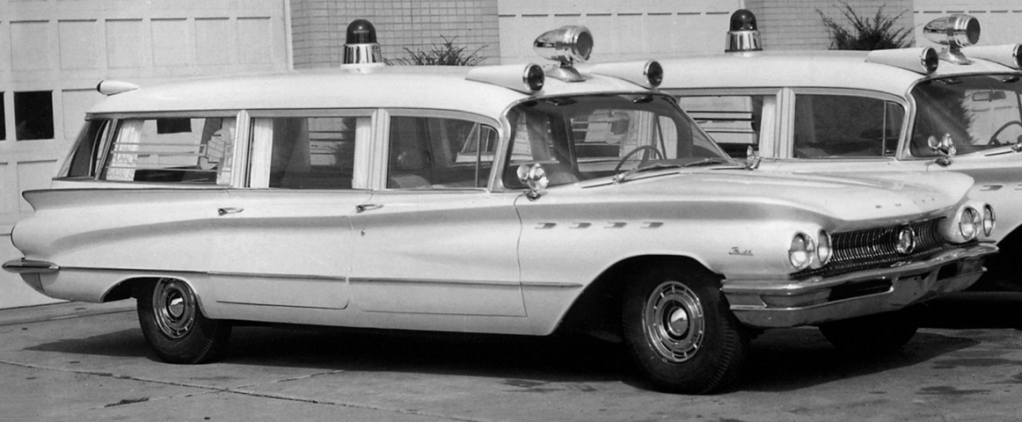
    With a sense of duty and a touch of nostalgia, the undertaker donated his faithful 1962 Buick station wagon to serve as our makeshift ambulance. It was a relic of bygone days, rigged with flashing lights, a wailing siren, a sturdy stretcher, and a precious oxygen bottle. Thus, a new chapter unfolded in Binger’s history, with a rotating roster of ten volunteers, including myself, standing ready to answer the call of distress.

    In those days, the rhythm of life was punctuated by the shrill ring of the telephone, summoning us into action. I would leap into the driver’s seat, adrenaline coursing through my veins, as I raced through the streets, navigating the twists and turns with practiced precision. The urgency of the situation would lend wings to my feet as I rushed to the aid of my fellow townsfolk.

    The years rolled by, and Binger evolved. In 1978, the benevolent gesture of the Chevrolet dealer brought a gleaming new station wagon into our midst, a symbol of progress and prosperity. We felt like modern-day heroes, equipped with state-of-the-art technology to serve our community.

    But as the 1980s dawned, change swept across the land. The state enacted stringent laws mandating EMT training and certification for ambulance attendants, a noble but burdensome requirement. Our volunteer organization, unable to meet the new standards, faced dissolution.

    With heavy hearts, we bid farewell to an era marked by camaraderie and selflessness. The nearest ambulance service now lay twenty-eight miles away, a stark reminder of the passage of time and the inexorable march of progress.

    Yet, amidst the bittersweet farewell, the spirit of Binger endured, a testament to the resilience of small-town values and the enduring bonds of community. And though our roles as volunteer dispatchers and ambulance drivers may have faded into memory, the echoes of our service reverberated through the annals of time, forever etched in the fabric of Binger’s history.