Hello to my loyal readers and visitors—this note will be brief, but heartfelt. Over the next few months, you may notice fewer stories appearing here. Please know this isn’t goodbye or silence; it’s simply a shift in rhythm.
I’m taking this time to focus on editing and publishing two books that have been waiting patiently for their moment. Writing new stories while preparing these projects feels like juggling reading, writing, and proofreading all at once. One task has to slow down. This way, the work can be done right. I’ll still share updates along the way, just not always on a daily schedule.
So if things feel a little quieter than usual, don’t worry. I haven’t decided to stay permanently in last year. I also haven’t skipped ahead without you into 2026. I’m still here… somewhere. I’m just surrounded by drafts and red ink. Stories are getting ready to find their way into the world.
Gregory de Polnay was born on 17 October 1943 in Chelsea, London, England, UK. He was an actor, known for Mansfield Park (1999), Doctor Who (1963) and Dixon of Dock Green (1955). He was married to Candice Caroline White. He died on 1 January 2026 in Poitiers, France.Some reports have listed as 2 January, 2026.
Big Finish Productions confirmed Gregory de Polnay’s death. He was known and respected there for his contributions to audio drama. News of his passing was met with sadness by colleagues, listeners, and admirers of his work.
Gregory de Polnay built a career defined by presence and voice. These qualities served him especially well in the world of recorded performance. Through his work with Big Finish, he became part of a storytelling tradition that values nuance, imagination, and character. He brought scripts to life for audiences. These audiences knew him primarily through sound rather than stage or screen.
De Polnay was not a household name. Yet, his work left a lasting impression within the creative communities he served. Fellow performers and producers remembered him as a dedicated professional. He matched his seriousness of craft with a deep respect for storytelling and collaboration.
Gregory de Polnay is survived by friends, colleagues, and listeners who continue to enjoy the performances he left behind. His voice endures in the stories he helped tell. This ensures that his contribution to the art of audio drama will not be forgotten.
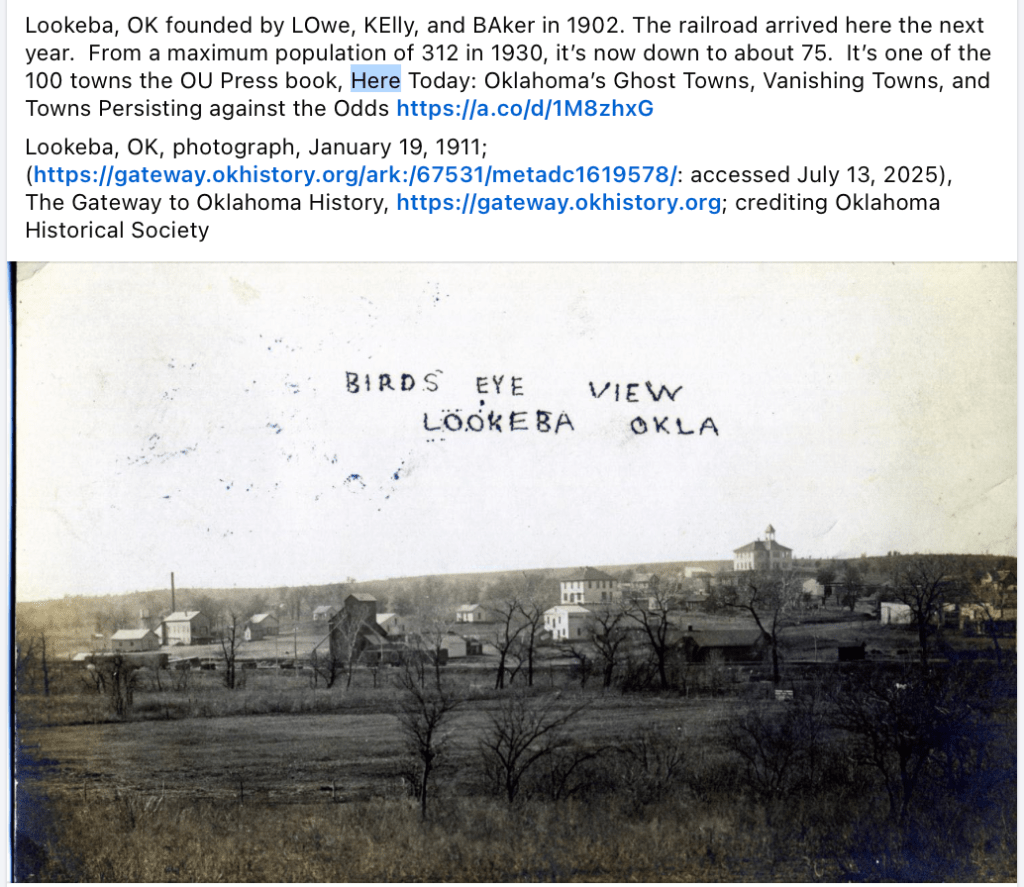
Most folks drive along the stretch of Oklahoma highway between Binger and Anadarko. They roll past Lookeba without ever knowing they’ve entered a place. This place is built on three simple names—Lowe, Kelly, and Baker. These names are stitched together like a handshake. Lookeba. A name that sounds almost tribal or mythic. Yet it originated from the ordinary people. They did what settlers always did in early-day Oklahoma: carved a life out of red soil and hope.
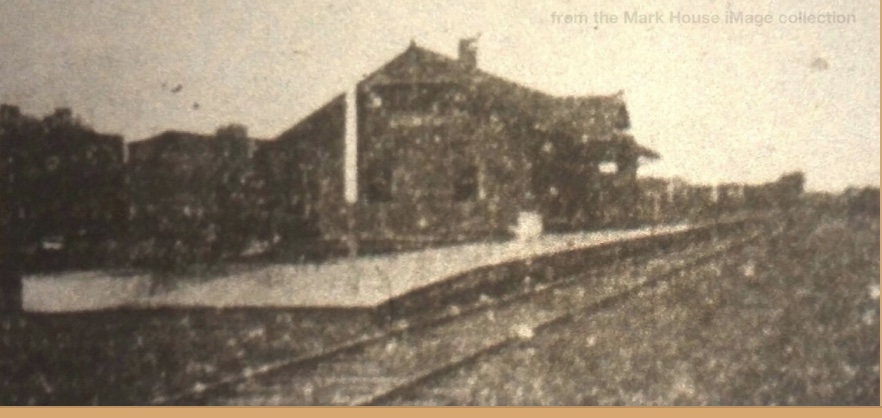
Lookeba Rock Island Depot 1904
Lookeba began as a crossroads community. It was a depot stop on the journey between larger towns. It was a place where wagons once creaked through cottonwood shade. Dust settled on the porch rails of the general store. Early schoolhouses rattled with the laughter of children carrying family names that would define the region for generations. The town’s claim to fame wasn’t oil or railroads or long sweeping history—it was quiet endurance. The land rolled gently. Storms gathered thick on the horizon. People stayed because they felt stitched to it.
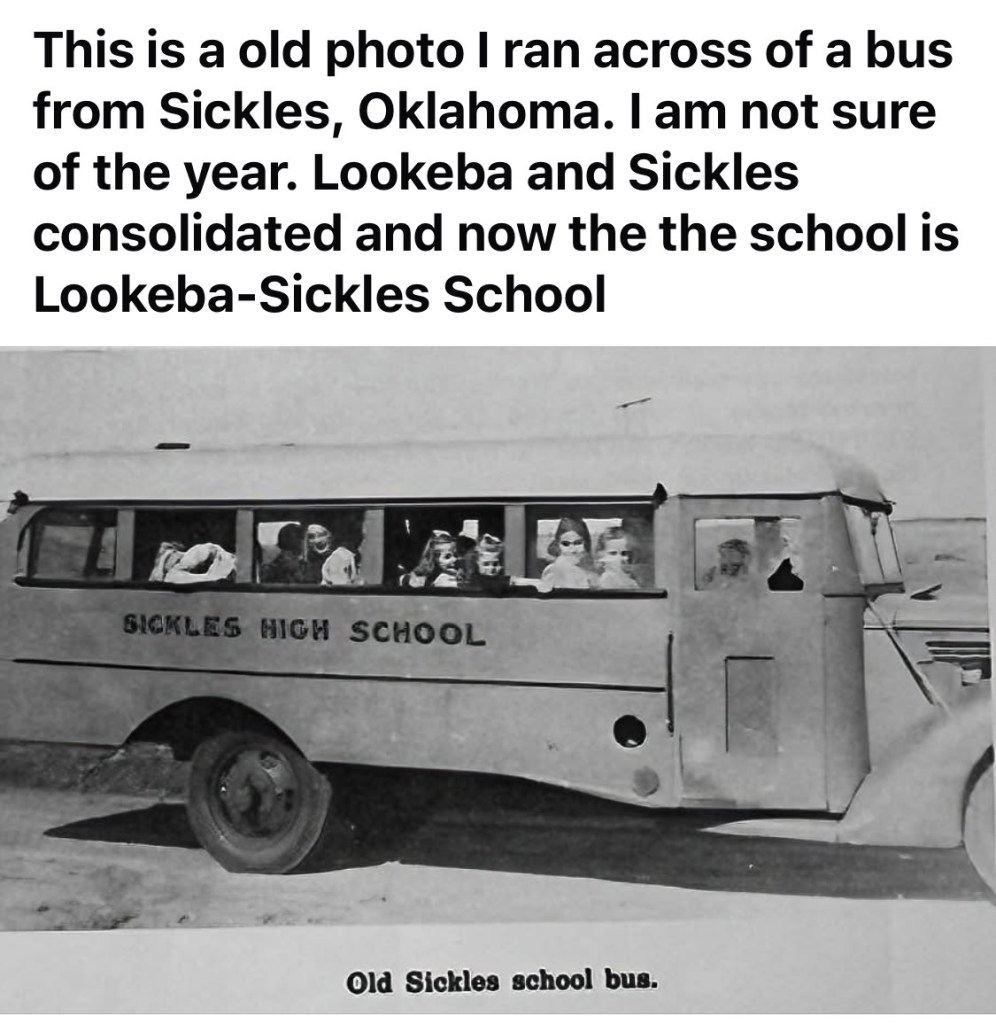
Just down the way sat Sickles. It was often written as “Sickless” in old letters and memories. The name came from Hiram Sickles, a farmer. His influence stretched further than the little community ever did on a map. Sickles was more minor—more crossroads than village. Yet, it had what every reasonable Oklahoma settlement needed. This included a school, a store, and neighbors who shared tools and gossip. They also offered weather predictions no weather forecaster can match.
For decades, the two towns lived like siblings. Lookeba was the older and slightly larger child with a stronger sense of identity. Sickles was the quieter shadow tucked between wheat fields and pastures. Students from both communities would merge into the Lookeba-Sickles School District. They formed friendships and rivalries. These bonds outlasted the buildings that once separated them. Generations of ballplayers, farm kids, and rodeo hopefuls came together under one mascot. They were often unaware of the deep connections spanning miles of family history. This history converged whenever the gymnasium lights buzzed to life for Friday night basketball.
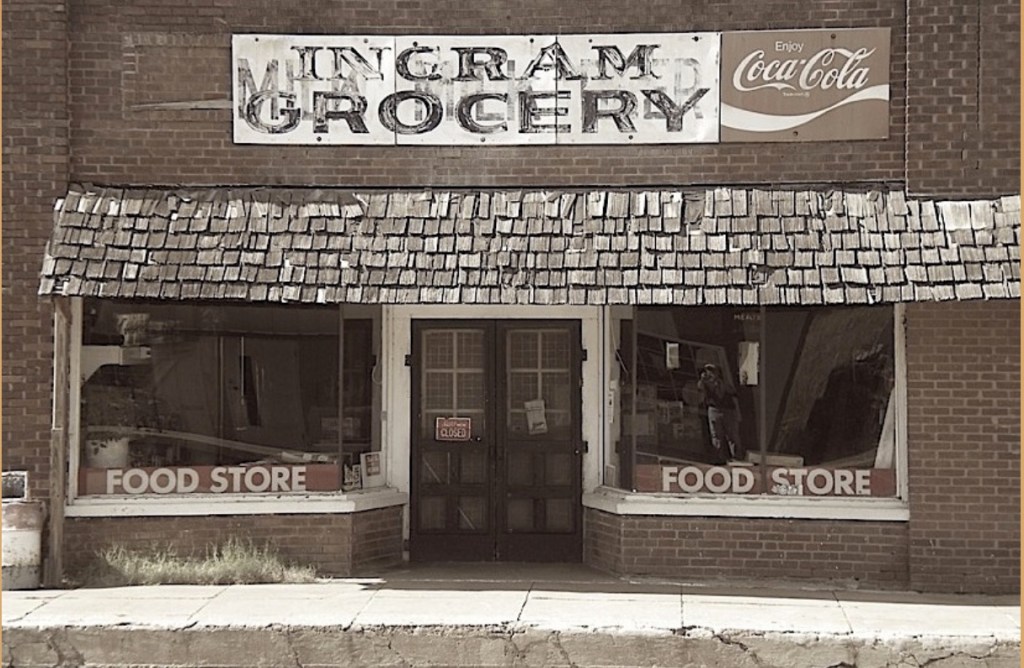
Ingram Grocery Lookeba
Time, as it always does in rural Oklahoma, thinned the businesses and emptied the old stores. The Sickles school population lowered long before its name faded from county conversations. Lookeba’s Main Street slowed to a pace that matched the prairie winds. But something remained—something that belongs only to towns like these.
A sense that history is not made by headlines but created by the people who refuse to disappear. Families make history. Their names still ring out in church directories, land deeds, and the memories of class reunions.
Stand in Lookeba today at dusk. The sun lays gold across the wheat. The cicadas start their evening hymns. You can still feel them: Lowe. Kelly. Baker. Sickles. The founders, the farmers, the families whose footprints shaped the land long before highway maps tried to catch up.
Somewhere between Lookeba and where Sickles still stands, you hear echoes of school bells if the wind is right. You also hear screen doors slamming. You hear the voices of children running toward a future. A future no one knew. But, it was a future built on names still remembered.
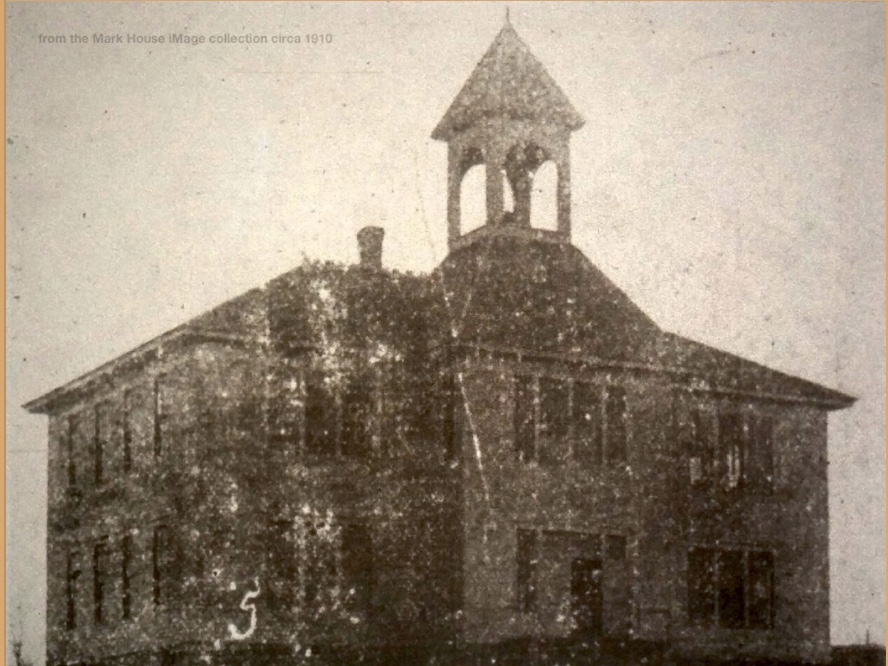
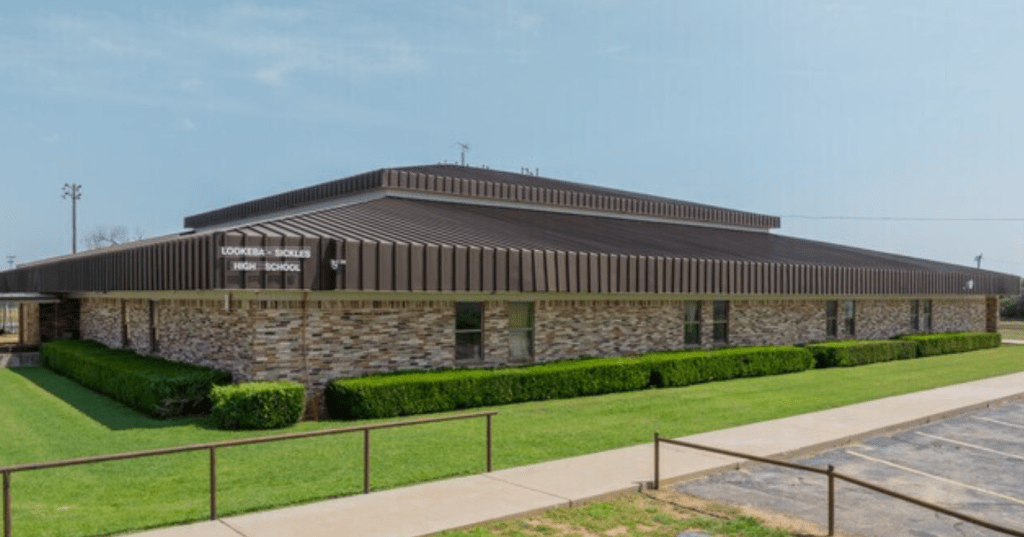
Lookeba-Sickles High School Current Day
Lookeba-Sickles High School is where I graduated many years ago. And, I still remember walking down the hallway and out the doors the last day of school. The thought of entering adulthood was on my mind. As I got to my car, I made a once glance back. A final goodbye, and I was gone.
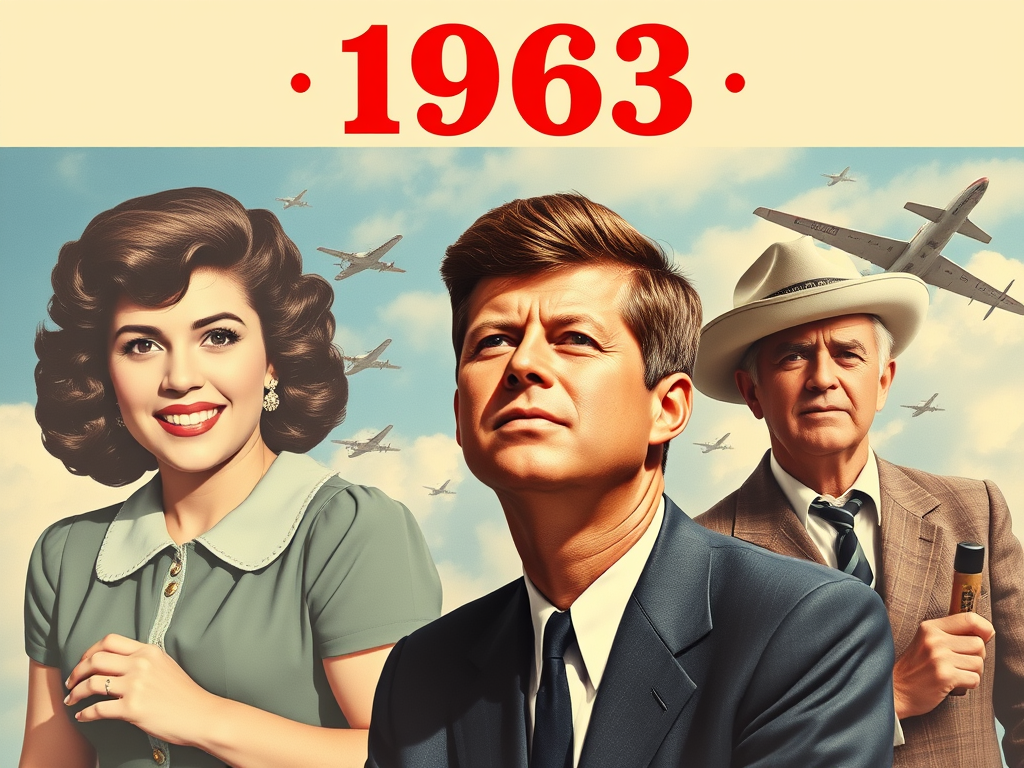
A topic came up recently about naming the most interesting—or most defining—events from the year you were born. For me, that year was 1963, which was sixty-two years ago. It was a year that carried an unusual weight, filled with moments of deep loss alongside remarkable progress and hope.
For fans of country music, 1963 was especially heartbreaking. In March, a plane crash claimed the lives of Patsy Cline, Hawkshaw Hawkins, Cowboy Copas, and Cline’s manager. Just a few months later, another aviation accident occurred. It took the life of Jim Reeves, one of the genre’s most beloved voices. The sorrow didn’t end there. Jack Anglin, one half of the duo Johnny & Jack, was killed in a car accident. He was driving to attend Patsy Cline’s memorial service. In a matter of months, country music lost several of its brightest stars, leaving a lasting scar on the industry.
Nationally, the year is most remembered for tragedy. President John F. Kennedy was assassinated in Dallas, Texas, an event that stunned the nation and the world. Two days later, the man accused of the assassination, Lee Harvey Oswald, was himself shot and killed. Oswald’s murder caught on live television by the shooter Jack Ruby, a Dallas nightclub owner. Because both men died before standing trial, no jury verdict was ever rendered regarding the assassination itself. While the Warren Commission later concluded that Oswald and Ruby acted alone, lingering questions have remained for decades.
There has also been confusion surrounding Jack Ruby’s legal fate. Ruby was convicted of murder with malice in March 1964 and sentenced to death, but that conviction did not stand. In October 1966, the Texas Court of Criminal Appeals overturned the verdict. The decision was due to excessive pretrial publicity. The court ordered a new trial. Before that retrial could occur, Ruby died on January 3, 1967, from complications related to lung cancer. As a result, no final conviction was in place at the time of his death.
Yet 1963 was not defined by tragedy alone.
Despite its losses, the year was also marked by hope, courage, and meaningful progress. On August 28, Martin Luther King Jr. delivered his “I Have a Dream” speech during the March on Washington. The speech inspired millions. It accelerated the push toward civil rights legislation that would soon follow. In science, Valentina Tereshkova became the first woman in space, orbiting Earth aboard Vostok 6—a milestone celebrated around the globe.
Popular culture flourished as well. The Beatles rose to international fame, bringing a sense of excitement and unity to a generation. Television, animation, and film offered families shared moments of comfort during a rapidly changing time. On the world stage, the United States, the Soviet Union, and the United Kingdom signed the treaty. This treaty was the Partial Nuclear Test Ban Treaty. This treaty represented a hopeful step toward easing Cold War tensions.
Looking back, 1963 stands as a year of contrast—one of profound sorrow and extraordinary progress. It reminds us that even in times of loss, history continues to progress. Resilience and creativity shape it. There is also the enduring hope for something better.
I was five or six years old in 1968. That is the thought I had at midnight when I couldn’t fall asleep. I tried counting sheep to fall asleep. Nevertheless, every time one got over the fence, I thought of the Pink Panther cartoon. There was an episode where that cool pink cat finally got all the sheep counted onto one side. Then, they stampeded back and trampled him in bed. I worried that happen to me. So I paused.
By then, I’d lost my place anyway. Was I on thirty-five? Or forty-five? I laughed quietly to myself and started thinking about where I first saw that Pink Panther episode. Ah, yes—the living room floor at my grandparents’ house. I had to have been five or six.
That memory sent me down an entirely different path. I started thinking about my grandparents—Mom and Pop, as I always called them in my stories. Mom was in her seventies, Pop in his eighties. Their home was my escape on many weekends and long summer days. Life there felt simple, steady, and safe.
Mom kept a half-gallon tin can filled with treasures. It contained an old set of dominoes, tiny farm animals, and a little truck. I imagined it hauled just about anything. On the linoleum floor of their den, I spent hours building domino fences to keep the animals contained. Sometimes I hauled them off to market. Other times, I stacked the dominoes carefully into what I imagined was an oil derrick. In 1968, an imagination was powerful. An incomplete set of dominoes became anything a kid wanted it to be.
While I worked, Mom rocked gently in her chair, watching me with a smile as her bird, Billy, sang nearby. Pop sat with his pipe, sending out a steady stream of smoke from his Prince Albert tobacco. That bucket of toys kept me busy all day—or so it seemed. I never thought about the world changing beyond that setting.
If I ever got tired of farming, there was something else waiting in that tin can: a long cotton rope. It was also there if I got tired of building oil wells. And the rope was always for one thing—getting hogtied.
The rules were simple. I had to lie still. No kicking. Pop would tie my hands and feet together behind my back. Then wait until the clock on the china cabinet struck the top of the hour. Only then I tried to get loose. I couldn’t kick myself free—I had to work the knots with my hands. It usually took a good hour, but I always managed to escape.
It wasn’t unusual for neighbors to stop by while the grandson was hogtied on the floor. Jimmy Schriver, who lived across the street and stopped in nearly every day, sometimes offered advice. He even tried to help once or twice, which earned him a sharp rebuke from both Mom and Pop.
“No,”
They’d say.
“He must learn to escape from being hogtied. It’s crucial in case his horse gets stolen. And he gets tied up on the trail.”
To a five-year-old, that sounded perfectly reasonable. My dad and I rode horses often. I watched plenty of Roy Rogers, Dale Evans, Rawhide, and Gunsmoke. This showed me that such things happen. In reality, I’ve never been hogtied by anyone other than my grandparents—but back then, it felt like practical training.
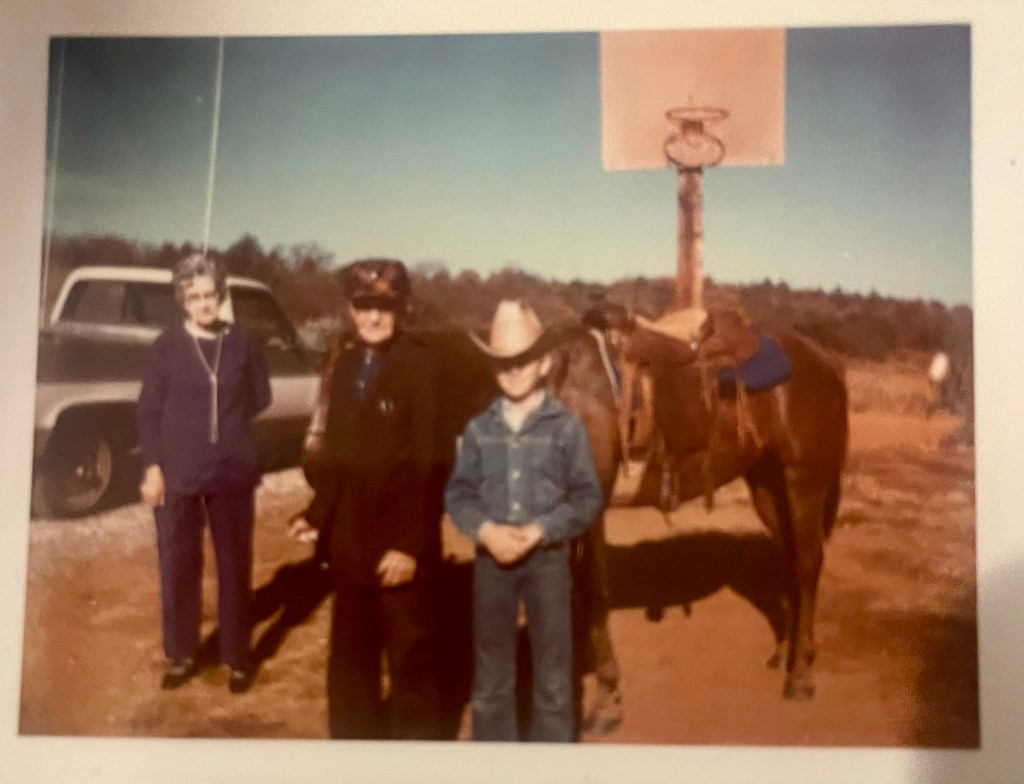
Mom, Pop, & Benjamin age 9,horses name is Sam.
Lying awake that night, I decided not to count sheep or cattle anymore—no sense risking a stampede. Instead, I wondered how my grandparents would be viewed today. What would someone think if they walked in and saw a child tied up on the floor? The child would be working knots while waiting for the clock to chime.
The more I thought about it, the smarter those two old-timers seemed. They discovered how to channel the boundless energy of a child. They couldn’t outrun or outplay the child. Instead, they turned that energy into patience, problem-solving, and imagination.
We played other games—wahoo, dominoes, bingo—but hogtying is the one that stayed with me. I’d look ridiculous asking for it now. If I see Mom and Pop again someday, I’d know which game to play first.
What I understand now is far more clear to me than it ever was back then. They were not really teaching me how to escape a knot. They were teaching me trust. Trust that I was safe. Trust that I could struggle and still be watched over. Trust that someone would always be nearby. They let me work it out on my own. They never let harm come to me. Being hogtied on that linoleum floor wasn’t about restraint. It was about freedom within boundaries. It was about confidence built quietly. It was the unspoken assurance that I was loved enough to be protected while learning how to untangle myself. That kind of trust, once given, stays with you for life. And today, would probably cause you to lose custody of your children.
You have chosen to follow my work. I’ve found my way to yours. Or we’ve somehow crossed paths through shared stories and curiosity. Regardless, I’m grateful you’re here. benandsteve.com is a place built on memory and reflection. We believe every life has value. Every voice deserves to be heard.
Here you’ll find personal stories, history, observations, tributes, and occasional wanderings into humor or wonder. Some pieces are quiet. Some are reflective. Some surprise you. All are written with intention and respect for the human experience we share.
benandsteve.com is a storytelling space built on memory, curiosity, and the belief that ordinary lives carry extraordinary meaning. Here you’ll find personal essays, family and local history, tributes, reflections, and observations drawn from lived experience.
This site isn’t about perfection or performance—it’s about honesty, connection, and preserving moments that otherwise be lost. Stories are shared not to impress. They are shared to remember and think. They remind us that we’re not alone in what we carry.
You’re invited to read, wander, think, and return whenever something calls you back.
Thank you for taking the time to read, follow, and engage. I hope something here resonates with you. It can steady you. Or if it reminds you that you’re not alone in this wide, complicated world. You’re always welcome back—and I’m glad you found your way here.
A Warm Welcome to New Subscribers
If you’re new here—welcome. Several reasons you are here. (1.) You have subscribed by choice. (2.) You discovered this site through a shared story. (3.) We have found one another through mutual curiosity. Regardless, I’m genuinely glad you’re here.
benandsteve.com is a place for storytelling in many forms. These include personal reflections, family and local history, and tributes. It also encompasses observations and the occasional moment of humor or wonder. Some posts are quiet and reflective. Others lean into memory, loss, resilience, or simple human connection. All are written with care and intention.
Thank you for reading, subscribing, and spending your time here. I hope something you find steadies you, sparks a memory, or reminds you that stories—especially ordinary ones—still matter. You’re always welcome back.
Wishing you a bright, hopeful, and peaceful New Year. Shall the months ahead bring stories worth telling. My wish is they bring memories worth keeping. I hope they offer moments that remind us we’re all connected in this beautiful, unpredictable world.
Here’s to a New Year filled with kindness, courage, and the quiet joys that make life meaningful. Shall we step ahead together with gratitude for where we’ve been and anticipation for what’s yet to come.
As we welcome a brand-new year, we hope every heart will find renewal. We wish every home find peace. We want every journey to find purpose. Whatever your traditions or celebrations, I wish you joy, health, and hope in the year ahead.
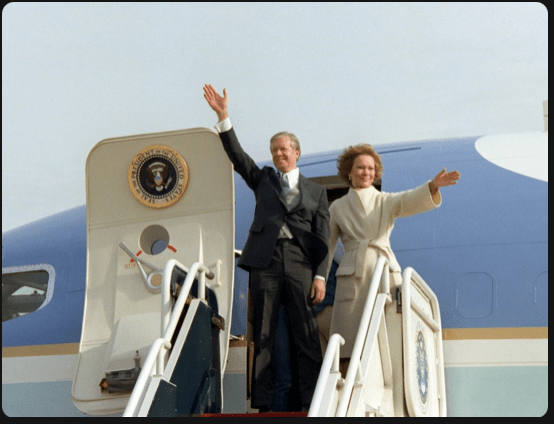
One year ago former U.S. President Jimmy Carter passed away. We close this year with a celebration to his life. Recognizing his many accomplishments. Here is one, a promise he had made on the campaign trail before he was elected to office. That if he won the presidency, he would return to Elk City, Oklahoma and thank them. He upheld that promise, as well as many others he made. A man with true humility, honesty and principles. Sorely missed as an example to others.We honor a true a leader by remembering his life!
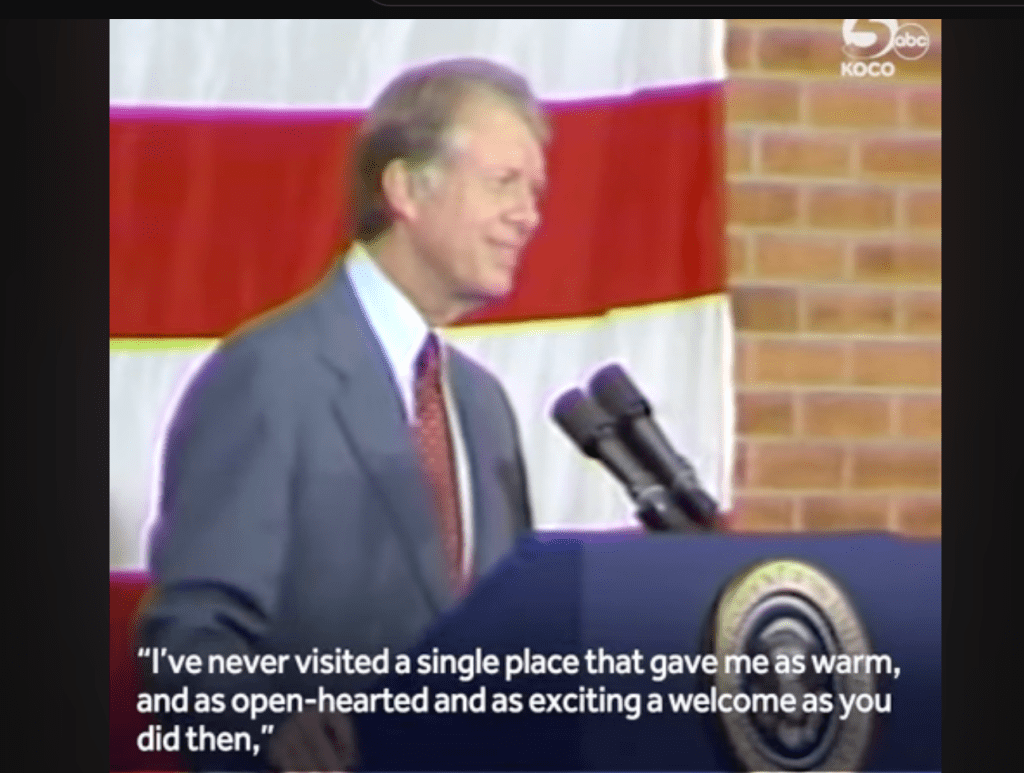
On March 24th, 1979, President Jimmy Carter returned to Oklahoma. He came to fulfill a campaign promise he had made during his first run for office. While campaigning, he passed through Elk City, Oklahoma, and vowed that if elected, he would return as President. True to his word, he came back to this small western Oklahoma town to connect with its residents.
By then, the memory of President Ford’s near-assassination and other threats against public figures lingered in the national consciousness. Carter was a peanut farmer from Plains, Georgia. He resonated with Oklahoma Citizens through his humility and shared values. This included his Democratic Party affiliation. First Lady Rosalynn Carter was accompanying him. Her warmth and grace complemented her husband. She left a positive impression on the locals.
At the time, Oklahoma’s Governor George Nigh was a celebrated figure in state politics. George Nigh was elected Lieutenant Governor more times than anyone else. He briefly served as Governor multiple times. This occurred when his predecessors resigned to take other offices. Despite some legal challenges about his eligibility, the State Supreme Court affirmed his ability to serve. He was now in his first full term as Governor. His presence at Carter’s visit added to the significance of the occasion.
The visit brought much excitement and preparation to Elk City, a town of about 12,000. The oil boom had not yet transformed the region. The high school’s field house was the largest venue available for the gathering. Elk City did not have an airport that accommodates Air Force One. Thus, the nearby Clinton-Sherman Airbase in Burns Flat, 15 miles east, was reactivated for the President’s arrival. A motorcade transported President Carter and his entourage to Elk City.
The event attracted widespread attention, with media outlets from a five-state area descending on the town. Governor Nigh, Oklahoma’s First Lady, U.S. Senators, Representatives, and many state officials joined the crowd. The field house overflowed with locals eager to witness history.
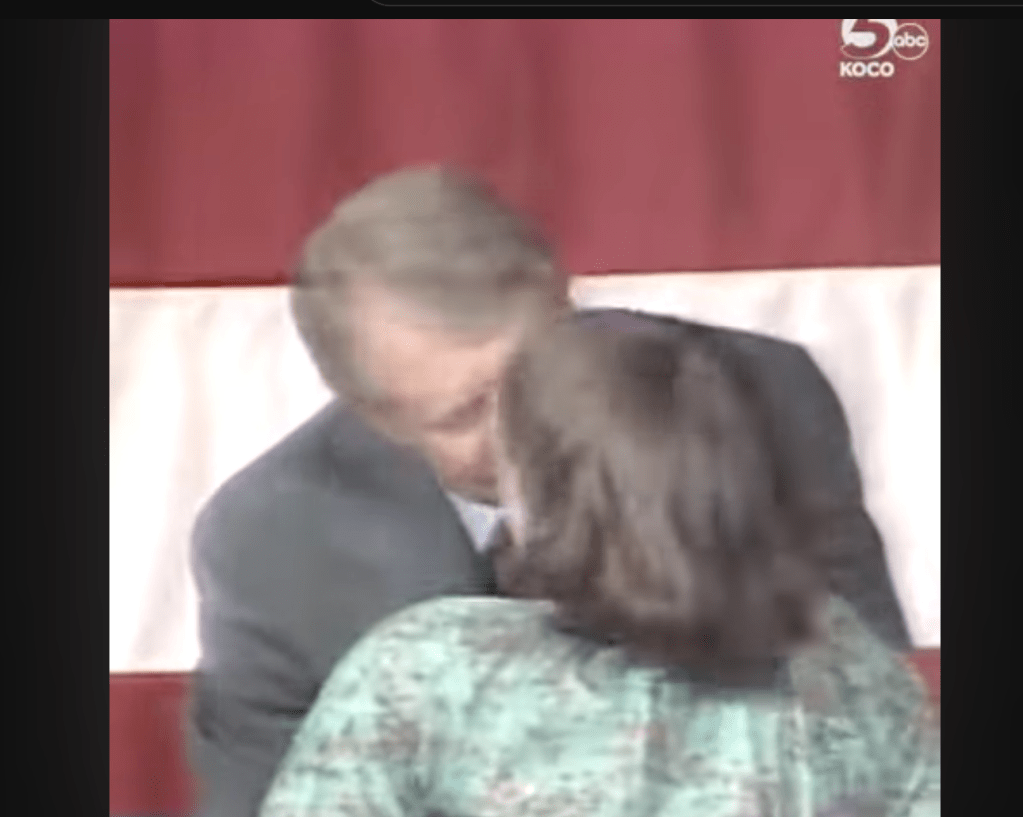
President Carter took the stage after introductions by various community leaders. His speech was marked by humility, sincerity, and a willingness to engage directly with the audience. During a question-and-answer session, a young girl boldly asked for a kiss. The President graciously obliged. This act endeared him further to the crowd.
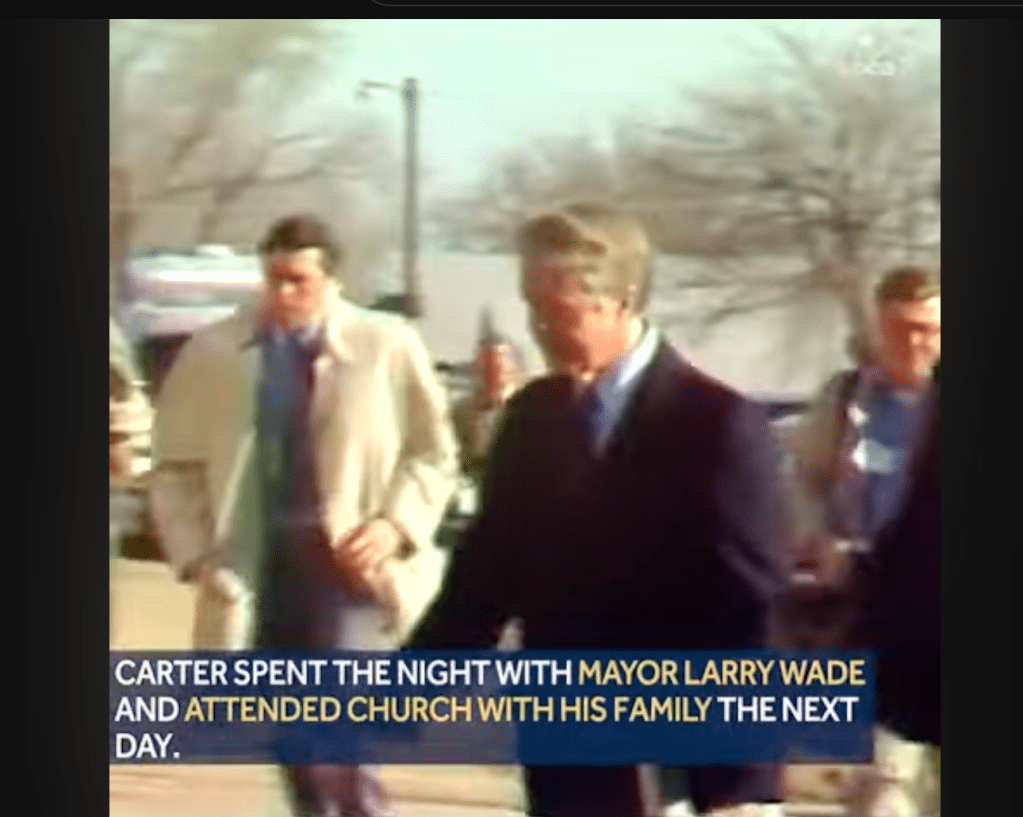
Unlike many politicians who have returned to the comfort of Washington, D.C., President Carter chose to stay overnight at the home of Elk City Mayor Larry Wade. While he and Rosalynn rested, Elk City police officers securely guarded their limousine. It was stored in the fire department’s bay. The fire trucks were temporarily parked on the street. This allowed room for the vehicle. The bay doors were locked to make sure its secure.
The next morning, the Secret Service inspected and prepared the limousine for the journey back to the Clinton-Sherman Airbase. At 7:00 AM, President and Mrs. Carter were to be escorted by a motorcade that included local police and the Oklahoma Highway Patrol. But the Carters had been invited to church. And to church they would go. The President’s and First Lady’s Church attendance was unannounced and brief. Two routes were used to guarantee security, though the President’s exact route remains uncertain. By 8:15 AM, all vehicles converged at the church. The Carters left church and went to the Clinton – Sherman Airfield, near Burns Flat. “Nothing is to schedule” one news reporter was noted as saying. And, for the Secret Service, they appreciated it wasn’t. The changes in the planned activity helped create enough of a distraction.
As Air Force One prepared for departure, President Carter and Rosalynn climbed the stairway. They turned to wave goodbye to the assembled crowd. Then, they boarded the plane. Within minutes, the jet’s engines roared to life. It ascended into the blue Oklahoma sky. The departure left behind a community that felt valued and appreciated.
Jimmy Carter’s visit to Elk City exemplified his commitment to keeping promises and connecting with everyday Americans. Years after making his pledge, he returned to this western Oklahoma town. This return reflected the integrity and personal touch that characterized his presidency.
This Story From The Classics. Posted Originally in 2024 it is Reposted this year as part of the best of the best stories benandsteve.com are sharing at years end.
I have driven thousands of miles in my police patrol unit. I have also answered nearly as many calls. I can attest that there are no ‘Good Dog Calls’ a police officer can be assigned to on duty.
Getting sent to a call involving a dog always includes extra concerns that should be more welcome. Dogs can be unfriendly, mean, unruly, and generally not trustworthy.
Case in point: I have responded to dog calls where the dog got reported missing. It was just across the street and refused to return to its owner. It came to my patrol unit and refused to get out. It insisted on staying, growling when we tried to pick it up and carry it back to its home. I can only guess why it didn’t want to go home.
I have been to dog calls where the dog has bitten a neighbor and had to get put in confinement. The owner objected to the dog’s removal, and a brigade of officers confiscated the dog. The animal control officer was not on duty. So the dog went into the police cruiser and made a hairy mess. It took weeks to get all the fuzz out. No pun intended. Then a day later, and while patrolling through the neighborhood, you see the dog getting walked by the owner’s child. Only to discover they have broken it out of doggy jail. You also have to file more serious charges against the dog owner. Something that you wish didn’t have to happen. The dog is confused over the whole back and forth. The Canine would have been home sooner had the owners only cooperated with the city.
Then, the next step is the crisis intervention, which is your own. It is early in the morning. And dispatch sends you to a home where a pit bull has a family trapped in their home. It will not allow them to get to their cars to leave to go to work or school. You arrive and see this dog running between the front and back doors, preventing the homeowners from exiting the house. You call your backup unit to bring the animal control unit since they are not on duty (as usual).
The backup officer arrives in the Animal Control Unit—the beauty of every small-town police department. You get the dog loop poles when they arrive and devise a plan. The homeowners will call the dog to the backdoor. This will allow an officer to enter the house through the front door. Then your backup partner will go in the house and go to the back door and call the dog. When he rushes to the back door he will use one of the loop poles. Slipping a loop over the dog’s head. As he does, I will come up from behind and slip a loop over the head. And we will have a two loop pole control of the dog. Then together we will be able to control the animal to get it into the animal control vehicle. As we carry out the plan, the dog fights with all it has. Trying feverishly to bite and attack us. We get it to the truck, lift it in, and slide it into a carrier. Loosening the pole loops, we leave them intact so we can use them when we get out to the shelter. So to place the animal in a pen. We close the gate and say farewell to the family that had got trapped inside their home. Waving to us, they are grateful for our service. The dog is fighting like crazy inside the truck. It sounds like we have the Tasmanian Devil inside.
We drove six miles to the shelter, and our anxiety peaked. We were ready to take on this beast we had struggled with earlier. It is now eerily quiet. We cracked open the gate and took hold of the poles. We tightened the slack in the loops. To make sure the dog had tension around its neck so we can control it. We flipped open the gate, and ––––– NOTHING. The dog was dead. DEAD! IT WAS LIMP.
We are dumbfounded at what the hell happened. We had put it in the back of the truck and drove six miles. An investigation indicated that the dog continued fighting even inside the truck’s cage. And either had a heart attack or choked itself while fighting within the closure. We had no choice but to take the dog to the shelter. Had we left it at large we would have had to fight the dog. And even got put in a position to shoot the animal due to its violence. We intended to try and avoid that scenario, but sadly, it ended the dog’s life anyway.
This Story From The Classics. Posted Originally in 2024 it is Reposted this year as part of the best of the best stories benandsteve.com are sharing at years end.
The last three days of the year often get overlooked. During this time, services go unnoticed around the average town or city. This well can be the case where you live.Police, Fire, Ambulance, and 911 Operators all do an incredible job. They work tirelessly in the build up to the New Year Eve Celebration and all the socializing involved. All the socializing is not celebratory, and the people they deal with are not all friendly.
As the year drew close, the city was abuzz with anticipation for the New Year’s celebrations. But for the fire, police, and ambulance services, the last three days of the year were anything but quiet. These dedicated men and women often worked long shifts. They sacrificed their own celebrations. They were on the front lines, ensuring the community’s safety and well-being.
Day One: December 29th
The fire department received a call about a house fire in the early morning hours. Flames engulfed the old wooden structure, and the firefighters worked tirelessly to control the blaze. They managed to rescue a family trapped inside, their faces covered in soot but grateful to be alive. Investigators later determined that a faulty space heater caused the fire. This serves as a stark reminder of the dangers of winter.
Meanwhile, the police were called to a domestic disturbance in a quiet suburban neighborhood. A heated argument escalated. Officers arrived with their professional demeanor and calm approach. They managed to defuse the situation. This ensured that both parties were safe and had a chance to cool down.
The ambulance service was dispatched to a car accident on the icy roads. A young driver had lost control of his vehicle and skidded into a tree. Paramedics worked quickly to stabilize him and transport him to the hospital. Despite the crash’s seriousness, the driver was expected to fully recover.
Day Two: December 30th
The fire department responded to a call about a gas leak in an apartment building. Residents were evacuated as firefighters located the source of the leak and shut it off. Their quick response and decisive action prevented a potential explosion. This reassured the residents. They were allowed to return to their homes once it was deemed safe.
The police were called to a robbery at a local convenience store. The suspect had fled the scene, but officers gathered evidence and track him down. The thief was apprehended and taken into custody, and the stolen goods were returned to the relieved store owner.
The ambulance service received a call about an elderly woman who had fallen in her home. Paramedics arrived to find her in pain and incapable of moving. They carefully lifted her onto a stretcher. They transported her to the hospital. At the hospital, she was treated for a broken hip. Her family was grateful for the swift and compassionate care she received.
Day Three: December 31st
On New Year’s Eve, the fire department was on high alert as fireworks lit up the night sky. They responded to several small fires caused by stray sparks, but thankfully, none resulted in severe damage. Firefighters patrolled the city, ensuring that everyone enjoyed the celebrations safely despite the potential dangers they faced.
The police were busy with calls about noise complaints and public intoxication. Officers maintained a visible presence in the city center, where crowds had gathered to watch the fireworks show. They worked to keep the peace and make sure everyone rang in the new year without incident.
The ambulance service was called to help a young woman who had collapsed at a New Year’s party. Paramedics quickly assessed her condition and determined that she had consumed too much alcohol. They provided her with the necessary care and transported her to the hospital for further observation.
When the clock struck midnight, the city erupted in cheers and celebrations. The fire, police, and ambulance services continued their vigilant watch, ready to respond to emergencies. For them, the end of the year was just another day. They served and protected their community. This often came at the cost of their own family celebrations.
Remember this New Year’s Eve and throughout the Holiday Season, Do Not Drink And Drive. Party Responsibly. Stay Alive For 2025!
This Story From The Classics. Posted Originally in 2024 it is Reposted this year as part of the best of the best stories benandsteve.com are sharing at years end.
The year was drawing to a close. In the small town of Willow’s End, the final days carried a weight of reflection and anticipation. The air was cold but not bitter. The snow was soft and forgiving. Every storefront on Main Street was adorned with strings of lights that twinkled like tiny stars.
December 27th
Emily wandered through the park, her boots crunching against the frost-bitten ground. She carried a notebook. Its pages brimmed with half-written resolutions. They held sketches of dreams she hoped to realize in the coming year. Her golden retriever, Milo, bounded ahead, his tail wagging like a metronome.
The park was quiet, save for the sound of distant laughter from the skating rink.
Emily paused by the frozen pond, watching the skaters glide effortlessly across the ice.
She scribbled in her notebook:
Be brave enough to try something new.
December 28th
The morning dawned with a vibrant sunrise, streaks of orange and pink painting the horizon. Friends and families gathered for breakfast at the local diner, sharing stories of their year. Old Mr. Harper, the town’s unofficial historian, sat by the window, regaling a group of children with tales of Willow’s End’s founding.
Emily listened from a nearby booth, smiling to herself. Inspired, she jotted another resolution:
Learn the stories of those who came before me.
December 29th
The storm arrived unexpectedly, blanketing the town with fresh snow. Emily stayed indoors, wrapping herself in a quilt by the fireplace. She reread letters from old friends, rediscovering the warmth in their words.
Milo lay at her feet, snoring softly. The snowstorm felt like a pause, a chance to breathe before the year’s end. In her notebook, she wrote:
Reconnect with those who matter most.
December 30th
By morning, the storm had passed, leaving the town glistening under the winter sun. Emily joined the townsfolk in clearing sidewalks and helping neighbors dig out their cars. Laughter echoed as children built snowmen and adults exchanged cups of steaming cocoa.
As Emily shoveled, she realized how connected the community felt in such moments. That evening, she added another note to her resolutions:
Be an active part of something bigger than myself.
December 31st
The year’s final day arrived, bringing a mix of celebration and introspection. The town square rang with energy as the community readied for the annual New Year’s Eve bonfire.
Emily stood among the crowd, her notebook tucked safely in her coat pocket. When the clock struck midnight, fireworks began exploding, painting the sky with bursts of color. Cheers and laughter filled the air.
Emily closed her eyes and whispered her final resolution:
Embrace the unknown with hope.
The last five days of the year hadn’t been filled with grand adventures. There weren’t dramatic changes. Yet, they had been quietly transformative. As Emily walked home under the starlit sky, she felt ready for the year ahead. She was also prepared for whatever life had in store.
John’s eyes fluttered open, the sterile white ceiling of the hospital room coming into focus. His head throbbed, and he felt disoriented. He overheard two doctors talking outside his room as he tried to piece together what had happened.
“Only seven days left,” one of them said. “We need to make sure everything is in order.”
John’s heart sank. Seven days left? He must be dying. Panic surged through him as he realized he had only a week to live. But instead of succumbing to fear, a fierce determination took hold. He couldn’t stay in the hospital; he had to escape and make the most of his remaining time.
Ignoring the pain in his head, John began to formulate a plan. He waited until the nurses changed shifts, then quietly slipped out of bed. John found a set of scrubs in a nearby closet and put them on, hoping to blend in. With his heart pounding, he made his way down the hallway, avoiding eye contact with anyone who would recognize him.
As he reached the exit, a nurse called out to him.
“Excuse me, sir, where are you going?”
John’s mind raced.
“I… I need some fresh air,”
he stammered.
The nurse frowned but didn’t pursue him. John pushed open the door and stepped into the cold winter air. He had made it out, but now what? He had no money, phone, or idea where to go.
John was determined to make the most of his final days. He wandered the city and visited places he had always wanted to see. He watched the sunrise from the top of a hill, the sky ablaze with colors. He fed the ducks at the park, their quacks a symphony of nature. And he even ate a fancy dinner by sneaking into a high-end restaurant, savoring every bite.
As the days passed, John felt a strange sense of peace. He had lived more in those few days than he had in years. On the seventh day, he found himself back at the hospital, drawn by a need for closure.
He walked through the doors and was instantly recognized by a nurse. “John! We’ve been looking for you everywhere. You need to be in bed; your head wound is serious.”
John sighed and allowed himself to get led back to his room. As he lay in bed, he overheard the doctors talking again.
“Only one day left,”
one of them said.
“I can’t believe the year is almost over.”
John’s eyes widened in realization. They talked about the end of the year, not his life. Relief, pure and unadulterated, washed over him, followed by a wave of exhaustion. He had been running from a misunderstanding, and now he was free.
As the clock struck midnight, John smiled to himself. He had a new lease on life and a newfound appreciation for every moment. He vowed to live each day with the same passion and urgency he had felt during those seven days. He understood that life was too precious to waste. His experience had transformed him, filling him with hope and a deep appreciation for the gift of life.
The holidays end. The bills arrive. Suddenly, the return line reveals more about our country than any economist ever can! Inflation, Stagnation, Slugflation, Depression.
It is the day after Christmas, and we all knew it would unfold exactly like this—a madhouse. Every store in town feels like it’s hosting its own miniature stampede. People rush in with returns clutched under their arms. These include sweaters that didn’t fit, gadgets they didn’t want, and décor that clashed with the kitchen. There are also duplicates of things they never needed one of in the first place. Others, running just as fast, are there for the sales—snatching up the merchandise that didn’t move before December 25.
Can you relate to this scene? If you’re in the checkout line with a cart full of discounts, you are one of the lucky ones. You are not carrying a stack of bills. You are not yet crushed by what this economy has become. Some call it stagflation. Others, half-jokingly but not entirely incorrectly, call it slugflation. Depending on where you stand, your job, your savings, and your prospects, your perception differs. You feel like we’re living through something that looks and sounds an awful lot like a depression.
“The glow of the holidays fades quickly. Yet, the truth we uncover in the days afterward often shows us who we are. It also reveals what we are still trying to endure.”
Stagflation, properly defined, is that painful moment when the economy stops moving, yet prices keep climbing. Wages stall, groceries rise, and efforts to fix things seem to vanish into a fog of economic stubbornness. For those without employment, the future feels dimmer than ever. For those nearing retirement, dreams of quitting work drift further out of reach. Families survive paycheck to paycheck. Some juggle bills so tightly that “robbing Peter to pay Paul” isn’t a saying. It’s a monthly way of life. They pray for health, because one unexpected medical bill breaks what’s left of their fragile stability.
Slugflation isn’t an economic term from textbooks—it’s a social one whispered in frustration. It describes households where the cost of living is so crushing that escape becomes a priority. Even temporary escape takes precedence over responsibility. The father who buys a beer before buying groceries. The single worker who stops at the bar on payday because the rent is already too high to manage anyway. It’s not irresponsibility. It’s more about resignation. People try to numb the hopelessness that elected officials promise to fix but never do.
And then there’s Depression—the word that carries both economic weight and personal weight. Economists use it to compare modern troubles to the Great Depression of the 1930s. They examine the stock market collapse, the Dust Bowl, and the poverty that blanketed the nation. But there’s another depression, quieter and far more personal: the emotional one. The kind that settles into a person’s bones, whispering that today is as well be tomorrow, because neither holds hope. It’s the feeling of sinking in deep water, kicking tirelessly, yet never breaking the surface for air.
Crowds push through automatic doors post-Christmas. Return lines snake around the aisles. Some people see chaos. Others see bargains. But some feel something heavier. They have the unmistakable realization that the holiday glow dies fast. The struggles waiting outside never take a day off.
Christmas Day arrives not with the roar of celebration. Instead, it comes with something softer — a quiet that settles into the corners of our homes. It feels like a memory we haven’t revisited in years. The rush is gone. The wrapping paper has been tamed. Even the dogs, sensing the unusual calm, take their morning patrol with a little more dignity than usual.
For many, Christmas is loud. It is laughter ricocheting off the walls. Kids tear into gifts with a speed that should qualify as a competitive sport. Kitchens hum like tiny factories. But for others, Christmas unfolds differently. It is a day of gentle reflection. The heart revisits people who can’t sit at our table anymore. It also revisits places we carry quietly inside us.
On Christmas Day, the world slows just long enough. We remember what truly matters, including the people, the memories, and the grace that carried us here.
This year, Christmas seems to be asking something new of us. Not to act, not to impress, not to outdo last year’s festivities — but simply to exist. To look around at what we already have, rather than everything we think we’re missing. To notice the warmth in the room. Feel the softness of a familiar voice. Experience how a simple cup of coffee somehow tastes better when shared with someone you love.
People across the world are celebrating in a thousand different ways. Some celebrate with grandeur. Some celebrate with grief. Others celebrate with gratitude. Some hold onto just a sliver of hope they’re trying hard to keep. But Christmas, in its truest form, honors all of these experiences. It is not a single story. It is the stitching together of many. It includes the joyful and the healing. It includes the lonely trying to feel less alone. It also includes the families trying to reclaim a little peace after a long year.
And that’s the quiet miracle of Christmas Day 2025. It reminds us that the heart’s greatest gifts don’t fit under trees. They aren’t bought, wrapped, or returned. They come in moments — unexpected, unpolished, and unforgettable. A hand held. A memory honored. A breath taken in gratitude for having made it this far.
Your home can be filled with the noise of celebration. It can also be surrounded by the stillness of reflection. This Christmas Day let the season bring you what you need most. It is a reminder that you are part of a larger story. You are carried by love, by time, and by the simple hope that tomorrow will shine a little brighter. There is relief knowing that Santa didn’t run out of gas. He also didn’t run out of magic during the 2025 Christmas Holiday Season. But it came mighty close!
Have a Merry Christmas, A Cool Yule, Feliz Navidad. Celebrate all of the feasts and festival days around Christmas and holiday season. While other countries the only holidays included in the “season” are Christmas Eve, Christmas Day, St. Stephen’s Day/Boxing Day, New Year’s Eve, New Year’s Day and Epiphany, in recent times, this term in the U.S. began to expand to include Yule, Hanukkah, Kwanzaa, Thanksgiving, Black Friday and Cyber Monday. So We have come to say Merry Holidays and Happy Christmas, or if it pleases you Merry Everything!
Every December, folks on Maple Street used to say you can tell what year it had been. They based this on the lights in the windows. Some houses glowed bold and bright—twinkling with those oversized retro bulbs that hummed faintly like bees in summer. Others preferred tiny strings of white lights, wrapped neatly around porch rails and fence posts. It was a small-town ritual that began long before online shopping, driverless cars, or video doorbells watched over quiet porches.
But there was one window everyone looked for: the old bay window at the Carson house. For nearly fifty years, Mrs. Carson placed a simple candle there. It is a battery-powered one these days. It started as a wax taper she lit by hand. It was always the very first decoration to be on the street. Neighbors claimed Christmas didn’t truly arrive until that soft golden light shone through the glass.
This year, though, December came with heavier hearts. The world felt louder. News cycles ran faster. People walked a little quicker, spoke a little sharper, and seemed to hold their breath through whole conversations. Even Maple Street, usually steady as a winter sunrise, felt unsettled. Packages disappeared from porches. The price of everything seemed to climb. Neighbors waved from a distance instead of stopping to talk.
Then, one cold Monday evening, the Carson house lit up. The sky had turned that winter blue, which looks borrowed from an old postcard. One warm candle in the window. Just like always.
For a moment, everything paused. Lights flicked on across the street. A mother tugged her kids outside to look. A man walking his dog stopped mid-stride. A teenager who normally never looked up from his phone actually noticed. It was as if the whole neighborhood exhaled—quietly, gratefully—into the glow of something remembered.
“Sometimes the world forgets where home is… and a light helps you find your way back.”
The next night, folks gathered on the sidewalk to carol again, something they hadn’t done in years. Someone brought hot cocoa in a thermos. Another neighbor, who hadn’t spoken much since losing her husband last spring, brought cookies she’d made from his favorite recipe. One by one, the stories came out. They spoke of who they’d lost. They talked about who they loved. They shared what they hoped for in the new year. There were tears. There was laughter and awkward pauses. There was the healing that only happens when people stand close enough to see one anothers humanity again.
When the singing ended, a little girl asked Mrs. Carson why she always put that candle in the window. Mrs. Carson smiled, smoothing the girl’s hair with her gloved hand.
“Because sometimes the world forgets where home is,” she said. “And a light helps you find your way back.”
As the group drifted home, the candle kept shining—steady and warm, cutting gently through the cold. It is not a beacon to erase the troubles of the world. Instead, it serves as a reminder that even in uncertain times, the smallest tradition can steady us.
And that Christmas is not a date or a sale or a perfect living-room photo. It’s the quiet moment when we find our way back to one another— one flicker of light at a time.
Some days in history whisper more than they shout. December 22nd is a unique day. It is close enough to Christmas to borrow its glow. Yet, it is far enough away to carry stories all its own. Across the world and across time, remarkable things have unfolded on this winter day. These include moments of peace, small miracles, and human resilience. There are also traditions that remind us what the season means.
On December 22, 1882, in New York City, something quietly revolutionary happened. The first string of electric Christmas tree lights was displayed. Edward H. Johnson, a friend and partner of Thomas Edison, hand-wired 80 red, white, and blue bulbs. He wrapped them around a Christmas tree in his parlor window. Passersby stopped in awe, incapable of imagining a world where candles didn’t flicker dangerously among pine needles. That little illuminated tree didn’t just brighten a room. It changed how Christmas would look forever. It set the stage for every glowing neighborhood street and every child’s gasp at a living-room tree shimmering with color.
“Christmas doesn’t arrive all at once; it gathers quietly—in small lights, shared hopes, and simple acts of kindness.”
In 1914, during the early days of World War I, Pope Benedict XV made a plea. He renewed his call for a Christmas truce. He hoped soldiers would lay down their weapons in a gesture of peace. Though his appeal was formally rejected by commanders, the idea took root in the hearts of ordinary men. Just three days later, British and German troops stepped out of trenches. They shook hands and sang carols. They shared simple gifts—a handmade token, a cigarette, a song carried across the snow. December 22nd was the breath before the miracle, the moment hope stirred quietly in the cold.
December 22nd has also seen acts of generosity that echo the season’s oldest stories. In 1947, after the devastation of World War II, the U.S. Congress approved emergency assistance. This aid became part of what the world would know as the Marshall Plan. It ensured that families across Europe would have food on the table for their first Christmas. They would also enjoy warmth in their homes. It was a global gesture wrapped in the spirit of giving. One nation extended a hand to millions just as winter closed in.
In more recent times, December 22nd has become a day of community gatherings for modern traditions. These include the last holiday concerts before school breaks. Candlelight services start earlier each year. Charity drives reach their peak as people remember that giving is a privilege of the heart. Across cities and small towns, volunteers load food boxes, firefighters deliver toys, and neighbors check in on neighbors. It is the quiet engine of Christmas—the work done without fanfare.
And today, just as in years past, December 22nd invites us to pause. We are encouraged to notice the light in our own windows. We should join hands in the work of kindness. Let the warmth of the season reach places that have been cold for far too long.
“In every age, a single day can hold the spark that brings the season to life.”
That’s what makes December 22nd special. It is not the beginning of the season, nor the grand climax. It is the steadying moment before Christmas arrives. A day shaped by innovation, by hope for peace, by generosity, and by the simple acts that bind us together.
For Christmas is three days away, but its spirit has already stepped quietly into the room.
It was Christmas Eve, and the moon cast a silvery glow over the rugged terrain of the American West. Santa Claus stood at the edge of a vast canyon. He stroked his thick white beard as he surveyed the land below. The snow drifts piled high, blanketing the valleys, draws, and washes, creating a breathtaking and treacherous scene. His sleigh and reindeer had brought him far, but this terrain was no place for flying. The jagged canyon walls and towering evergreens made it impossible for his magical team to navigate.
Santa turned to a figure waiting patiently in the moonlight: a sturdy chestnut stallion saddled with a well-worn western saddle. The horse, named Thunder, had been his trusted companion for these trips into the Deep West for hundreds of years. He patted Thunder’s neck affectionately.
“Looks like it’s up to us again, old friend,”
Santa said.
He swapped his sleigh for the horse, securing the large sack of gifts over Thunder’s haunches. As he mounted, the jingling of bells on his coat mingled with the creak of leather. He clicked his tongue. They were off. The sound of hooves crunching through snow echoed into the quiet night.
The descent into the canyon was steep, and the trail was narrow and winding. Santa guided Thunder with practiced ease, his red coat standing out against the stark white snow. They crossed frozen creeks, forded icy streams, and climbed rocky outcrops that tested Thunder’s strength and agility.
The air was warmer but still crisp when they reached the valley floor. Santa paused to check his list, illuminated by a soft, magical glow. The Wilson-Anderson family ranch was just a few miles away, nestled among the rolling hills and cottonwood trees.
This family had been here for generations, raising cattle and carrying on the traditions of the American West. Santa always made a special effort to visit their remote ranch, knowing life’s challenges in such a rugged land.
The silhouette of the homestead came into view as they approached the ranch. Its windows glowed warmly in the cold night. Santa dismounted and led Thunder to the barn, leaving the horse to rest and nibble on hay.
Quietly, Santa crept to the house. He climbed onto the porch and found the door unlocked, as was common in these parts. Inside, the living room had simple yet heartfelt decorations. There was a cedar wreath and a small tree decorated with handmade ornaments. Stockings hung above a wood-burning stove.
Santa set to work. He filled the stockings with treats and small trinkets. Then he placed a beautifully wrapped gift for each family member under the tree. Santa left a fine leather rope for the youngest, Jesse. A tiny cowboy hat was also there because Jesse had asked for a lasso.
Before leaving, Santa took a moment to admire the scene. The family dog, a blue heeler, stirred from its bed by the fire. Recognizing the kind man, it wagged its tail and drifted back to sleep.
For Santa Claus, this was more than just delivering gifts. It was a tribute to the resilience of the families. These families carved out lives in the harsh beauty of the deep West. As he rode into the night, he hummed a cowboy tune. He felt grateful for the chance to be part of their enduring story. It was magical, even for one night each year.
Santa returned to the barn, where Thunder waited patiently. With a final glance at the peaceful ranch, he mounted his horse and began the journey back. The moon was high, and the stars sparkled like diamonds as they retraced their path through the snow-filled wilderness.
It was Christmas Eve. The sleigh soared high worldwide. The northern wind whistled through the bells on the reindeer harnesses. Santa Claus wore his crimson coat and had twinkling eyes. He held the reins tightly. His sack of presents was bursting at the seams. Santa’s job went beyond delivering gifts. He needed to make sure every child was sound asleep before he even set foot on their rooftops.
Santa had his secrets. He carried a special pocket watch gifted by the elves centuries ago. This watch sensed the rhythms of sleep in every home. A little pointer swung wildly when a child stirred awake. Santa would patiently wait, high above the house, until the child drifted off again.
Tonight, in a small town nestled under a blanket of snow, Santa’s watch began to twitch. He hovered over a modest little house on Maple Street.
“Ah, looks like young Clara is having a restless night,”
Santa mused, his voice soft and kind. He tapped his watch lightly, watching the pointer as it steadied.
Confident she was asleep, he climbed down the chimney with practiced ease. The room was warm, lit by the soft glow of a dying fire. Stockings hung neatly by the hearth, and the scent of pine filled the air from the brightly decorated tree. Santa moved silently. He set down a dollhouse wrapped in shimmering paper. He also placed a pair of skates for Clara. This added to the cozy atmosphere.
But a creak echoed through the room just as he reached into his sack for the next gift. Santa froze. Two wide eyes peeked out from behind the door, framed by Clara’s curly hair. She gasped audibly, her tiny face a mixture of astonishment and delight.
“Oh no!”
Santa whispered. He had a rule for centuries: no child should ever see him deliver gifts. Magic thrived on belief, and his sight can cause the magic to falter. But here she was, staring right at him.
“Santa?”
Clara asked, her voice barely a whisper.
Santa thought quickly. He tapped his boot. The room filled with a light dusting of sparkles. Clara suddenly found herself in the most enchanting of dreams. In her vision, Santa smiled and said,
“Go back to bed, little one. This is your special Christmas moment to remember only in your heart.”
Her eyes fluttered shut. She slipped back into sleep. This was a testament to Santa’s quick thinking and resourcefulness.
Santa sighed with relief and adjusted the gifts under the tree.
“Close call,”
he chuckled softly, brushing soot off his coat. Before he disappeared up the chimney, he placed an extra candy cane in Clara’s stocking. It was a silent reward for her innocent curiosity.
Outside, the reindeer waited, their noses glowing faintly in the night. Santa climbed aboard his sleigh, glancing once more at the little house before urging the team onward. As the sleigh vanished into the night, leaving behind a trail of twinkling stars, Santa smiled.
“Sometimes,”
he said to the stars,
“even the magic needs a little extra magic.”
As the sleigh vanished into the night, Santa smiled.
A fellow blogger brought up a concern about the difficulties faced throughout the year. They discussed how they met those challenges. Sometimes those challenges are so big they pull one down. Making life’s trials more meaningful is the person one becomes by succeeding.
There’s an old Christmas song. It starts with the words, “Put one foot in front of the other.” Soon, you’ll be walking across the floor. It’s always been a pick-me-up for me this time of year. While it’s meant for children, I believe the child in us all still needs lifting up occasionally.
Hard times in life often seem to arrive when we’re already struggling, or at least that’s how it feels. Looking back on my own experiences, those moments have pushed me to become a better version of myself. Overcoming our shortcomings during difficult seasons speaks quietly to others who are watching. This happens even when we don’t realize we’re setting an example. Sometimes, it’s deeply needed.
Sometimes our hardships end up serving others just as much as they serve us. This response wrote itself, and I’m not entirely sure where it came from—but maybe that’s the point.
I’m curious. What song, moment, or quiet reminder has helped you? How did it help you put one foot in front of the other when life felt heavy?
For a lift of the holiday spirit ~ here is the instructions on putting one foot in front of the other.